
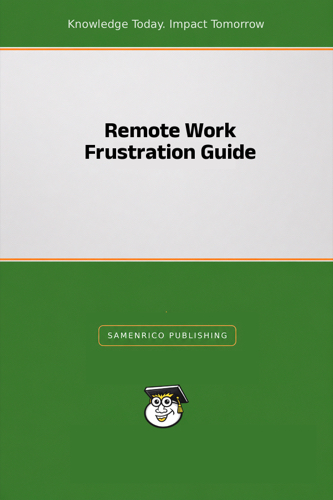
Non-FictionSelf-HelpRemote WorkFrustration
Remote Work Frustration Guide eBook
Manage anger about tech issues, isolation, or home
Manage anger about tech issues, isolation, or home distractions while remote.
Formats
Free sample
Chapter 1: The 1,200-Switch Hangover--–- It begins, as it always does, with a small crack. Not in your screen—though that will come later—but in your patience. You are thirty-seven minutes into a deep focus session, the kind where the world falls away and you remember why you were hired. The cursor blinks. Your hands rest on the keyboard.
And then: a chime. Not your phone. Not the doorbell. Slack. A message from a colleague who could have emailed.
You glance at it. Just a glance. That is all it takes.You are no longer writing. You are now reading. You are now deciding whether to respond.
You are now glancing at the unread count in your email tab—forty-seven messages since you last checked twenty-two minutes ago. You are now wondering if that Zoom link you clicked earlier actually worked. You are now thinking about lunch. You are now, in the span of five seconds, doing the work of five different people inside a single exhausted brain.This is not multitasking. Multitasking, as you have been told your entire career, is a lie.
What you are actually doing is context switching—the rapid, relentless, and ruinous act of moving your attention from one task to another, then back again, paying a cognitive penalty each time you cross the threshold. And you are doing it more than you know.According to research cited in Digital Exhaustion and Zen Productivity, the average remote worker switches between apps, tabs, and tasks approximately 1,200 times per day. Some studies put the number even higher. One thousand two hundred times. That is roughly one hundred times per hour.
That is once every thirty-six seconds. You are, in other words, never doing one thing. You are always doing several things, poorly, while your brain slowly boils over with a low-grade fury that you cannot name but can definitely feel.This chapter is about that fury. It is about the specific, tech-driven rage that rises when your Wi-Fi lags, your screen freezes, or your computer decides—for no reason you can discern—to install updates in the middle of a client presentation. It is about why you want to throw your laptop out the window not because you are a violent person, but because your brain has reached its limit and the frozen screen is simply the final straw.And it is about the solution: a practical, science-backed protocol for reducing your switching penalty by half, protecting your flow state, and lowering the cortisol levels that are quietly poisoning your afternoons.The Myth of Multitasking Let us begin with a funeral.
We are burying the word "multitasking" today. It has served us poorly.The term was borrowed from computer science in the 1960s, describing a machine's ability to process multiple instructions simultaneously. The human brain, despite its wonders, does not work this way. When you believe you are multitasking—answering email while on a Zoom call while eating lunch while thinking about a deadline—you are actually performing a rapid sequence of single tasks. Your attention moves from one thing to the next, spending perhaps a few seconds on each, before jumping again.Dr.
Adam Gazzaley, a neuroscientist at the University of California, San Francisco, has spent years studying this phenomenon. His research, cited extensively in Zen Productivity, reveals that every time you switch tasks, you pay a "switching penalty": a small but measurable cost in time, accuracy, and cognitive resources. The penalty might be a fraction of a second, but over 1,200 switches, those fractions accumulate into hours of lost productivity and, more importantly, a profound sense of mental exhaustion.Here is what happens inside your brain during a context switch. First, you must disengage from the current task. This requires suppressing the neural networks that were active and relevant.
Second, you must activate the neural networks for the new task, retrieving the relevant rules, goals, and memories. Third, you must reorient your attention to the new environment. This cycle—disengage, activate, reorient—happens in a blur, but it is not free. Each switch consumes glucose, oxygen, and something harder to measure: willpower.Now imagine doing this 1,200 times. By 2:00 PM, your brain is running on fumes.
By 4:00 PM, every notification feels like an attack. By 5:01 PM, when your partner asks what is for dinner, you explode. This is not a character flaw. This is biology.The Cortisol Connection To understand why tech frustration feels so visceral—why a spinning wheel or a frozen screen can send you from calm to rage in one second—you need to understand cortisol. This is the book's central biological framework, and we will return to it repeatedly.Cortisol is a steroid hormone produced by your adrenal glands.
It is often called the "stress hormone," but that is reductive. Cortisol is actually a survival mechanism. It evolved to help you respond to threats. When your ancestors saw a predator, their cortisol spiked, flooding their bodies with glucose and preparing them for fight or flight. This response is efficient, ancient, and entirely inappropriate for a frozen Zoom call.Here is the problem.
Your brain does not distinguish well between a physical threat (a predator) and a social or technological threat (a colleague ignoring your message, a screen freezing mid-sentence). The same cortisol response activates. Your heart rate increases. Your muscles tense. Your prefrontal cortex—the part of your brain responsible for rational decision-making and impulse control—begins to shut down.
You become, in essence, a less intelligent, more reactive version of yourself.Now add context switching to the cortisol equation. Every switch is a small stressor. Each time you move from email to Slack to your document, your brain registers a minor disruption. These disruptions trigger tiny cortisol spikes. Individually, they are negligible.
Collectively, over 1,200 switches, they create a state of chronic low-grade stress. You are not having a panic attack. You are not crying at your desk. You are simply simmering, all day, at a low boil.This is why a frozen screen can make you want to throw your laptop. The frozen screen is not the cause of your rage.
It is the trigger. The cause is the 1,199 switches that came before it, each one raising your cortisol a little more, each one lowering your threshold for frustration. When the screen finally freezes, your brain is already at max capacity. The smallest inconvenience becomes the final straw.Digital Exhaustion: The Physical Toll Context switching does not only affect your mood. It affects your body.
There is a reason you feel physically tired after a day of remote work, even if you have not moved from your chair. That fatigue has a name: digital exhaustion.Digital exhaustion is the physical and mental fatigue that comes from managing too many digital domains simultaneously. It is not the same as eye strain or carpal tunnel, though those may accompany it. Digital exhaustion is the feeling of being drained by the sheer act of navigating between email, Slack, Zoom, your document editor, your project management tool, and whatever else your company has decided to adopt this quarter.Research cited in Digital Exhaustion shows that remote workers spend an average of twenty-three minutes recovering their focus after…
This is the end of the free sample. Get the eBook to keep going. Buy now
About this book
Details
- Author
- Barraza Charleen
- Publisher
- SamEnrico
- Language
- English
- Genre
- Non-Fiction, Self-Help, Remote Work, Frustration
- Released
- 2026-06-09
- Pages (approx.)
- 147
- Available as
- eBook, Audiobook

Read better in the ZLOADR app
Your eBooks on your phone or tablet. Sign in with your SamEnrico account and start reading.
More by Barraza Charleen
 The Body Language for TherapistsBarraza Charleen$11.99
 Agoraphobia Expansion WorkBarraza Charleen$11.99
 The Rocket League Addiction RecoveryBarraza Charleen$11.99
 Healthcare Worker Esteem FixBarraza Charleen$11.99
 The Headless Heist: Canada's Prohibition-Era Art and AtrocityBarraza Charleen$11.99
 Understanding Microphthalmos, Microcornea, and SclerocorneaBarraza Charleen$17.99
 Logo Description Prompt GuideBarraza Charleen$12.99
 EV Industry Capital GuideBarraza Charleen$12.99
 Application Solutions ArchitectBarraza Charleen$11.99
You may also like
 Hong Kong Handover 1997Dunn Johnnie$11.99
 Zumba For Postnatal Recovery CourseNeal Christian$11.99
 Zumba for BeginnersLadner Nikia$11.99
 YouTube Comment Mining GuideHumes Pandora$12.99
 Worry Box MeditationCarlin Rudy$11.99
 Workplace Stress MeditationNguyen Lynn$11.99
 Workplace Stress and Sleep RepairHawley Ivory$11.99
 Workplace Perfectionism CureDelaney Jeffry$11.99
 Workplace Injustice Anger GuideWallen Isabelle$11.99
 Work Addiction and Burnout LinkGreenwood Ester$11.99
 Women in Yoga and WellnessBeattie Galina$11.99
 Women in Stand Up ComedyChun Evangeline$11.99