
Non-FictionSelf-HelpSelf Assessment
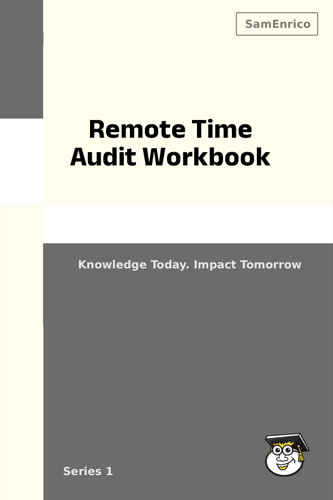
Remote Time Audit Workbook eBook
Track your work from home hours to identify leaks
Track your work from home hours to identify leaks and productivity killers.
Formats
Free sample
Chapter 1: The 15-Hour Ghost--You are not lazy.Let that land for a moment. You are not undisciplined. You are not "bad at working from home." You did not suddenly forget how to be productive when you traded your cubicle for a kitchen table.And yet, something is wrong.You start your day with a clear plan. By 10 AM, you have replied to eleven Slack messages, joined a meeting that could have been an email, and spent twenty minutes searching for a file that you swear was on your desktop yesterday. At 2 PM, you look up from your screen and realize you cannot remember what you actually accomplished.
At 5 PM, you close your laptop—not because you are done, but because you are exhausted. And at 10 PM, lying in bed, you open Slack "just to check" and see a message from your boss that sends your brain spinning into tomorrow's to-do list.You lost hours today. Not to Tik Tok. Not to Netflix. Not to any of the obvious villains that productivity gurus love to blame.You lost them to something far more insidious: invisible leaks.These are not moments of procrastination.
They are structural flaws in the way remote work operates—flaws that steal your time not in big, noticeable chunks, but in tiny, undetectable drips. Seven seconds here. Forty-five seconds there. A five-minute recovery period after a Slack ping. A ten-minute task that somehow expands to fill thirty minutes because you kept switching between three different windows.By the end of the week, those drips have filled a bucket.
By the end of the month, they have filled a barrel. By the end of the year, they have filled an entire room—a room full of hours that you will never get back.This book exists to help you find those hours.But here is the promise that makes this book different from every other productivity system you have encountered: You will not need to track every minute of every day for the rest of your life. You will not need to become a clock-watching robot. You will not need to install surveillance software on your own computer or turn your home into a military operation.Instead, you will do something that most time management books are afraid to ask of you: You will audit your time for exactly one week. One week of honest, judgment-free observation.
And from that single week of data, you will extract the patterns, leaks, and fixes that will serve you for the rest of your remote career.That is the 15-Hour Ghost—the average amount of time that remote workers lose each week to invisible leaks, according to aggregated data from thousands of self-audits. Fifteen hours. Nearly two full workdays. Every week. Without realizing it.By the time you finish this workbook, you will know exactly where your fifteen hours are going.
More importantly, you will have a personalized system for plugging those leaks—not by working more, but by working differently.The Myth of the Naturally Productive Remote Worker Before we hunt the ghost, we must first bury a myth.The myth says that some people are simply "good at working from home" and others are not. That productivity is a personality trait—something you either have or you lack. That the remote workers who seem to glide through their days with ease possess some secret discipline that the rest of us simply do not.This is nonsense.What looks like natural productivity is almost always the result of invisible systems. The person who never misses a deadline has a calendar system you cannot see. The person who always responds to emails within an hour has batching rules you have not asked about.
The person who seems to have endless energy at 9 AM has structured their morning around their chronotype—not around willpower.The most productive remote workers are not the most disciplined. They are the most self-aware. They have simply run their own version of this audit, whether they knew it or not, and built their days around what they discovered.Here is what the research actually tells us: remote work is neither inherently more productive nor inherently more distracting than office work. The difference is that office work comes with pre-built structures—a commute, a physical desk, visible coworkers, a clear end to the day—that compensate for our natural cognitive weaknesses. Remote work strips those structures away and leaves us to fend for ourselves.The problem is not you.
The problem is the vacuum left behind by the disappearance of the office.And vacuums can be filled.Introducing the 80% Rule Before we go any further, you need to understand the single most important principle in this entire workbook. It is called the 80% Rule, and it will save you from perfectionism, shame, and abandonment of this process.Here it is: 80% adherence to any protocol yields 90% of the benefits.You do not need to track every fifteen-minute block perfectly. You do not need to complete every worksheet. You do not need to follow every suggestion in every chapter. You do not need to become a productivity monk who never checks Instagram during work hours.You need to do about 80% of what this book suggests, about 80% as well as you theoretically could, and you will get about 90% of the possible results.That remaining 10% of results?
It would require 100% perfection—and perfection is the enemy of done. The remote workers who try to achieve perfect systems are the ones who abandon those systems within two weeks. The ones who accept "good enough" are the ones who actually change their lives.So here is your permission slip: skip what does not work for you. Modify what feels rigid. Ignore any worksheet that feels like too much work.
This book is a toolkit, not a commandment. Take what serves you. Leave what does not.The 80% Rule will appear again in Chapter 12 when we talk about sustaining your new habits. For now, simply know that you are allowed to be imperfect. In fact, imperfection is the path to success.The Emergency Leak Plug There will be days when none of this works.
Days when your toddler is screaming, your internet is down, your boss just assigned an urgent project, and you have not slept in nine hours. On those days, you will not have the bandwidth to run a full time audit or complete a detailed worksheet.That is why this workbook includes an Emergency Leak Plug—a one-page reference card located in the Appendix. Go find it now. Physically locate it in the back of this book. Take a moment to see where it lives.The Emergency Leak Plug contains exactly five actions.
They are the highest-leverage, lowest-effort interventions from this entire workbook. When your day is falling apart, you do not need to read a chapter. You do not need to complete a worksheet. You need to pull out that card and do one of the five things on it.Here is a preview of what you will find there, so you know what to expect:Close all but one tab. Seriously.
Just one. The one that contains your most important task right now.Set a five-minute timer. Work on that single task…
This is the end of the free sample. Get the eBook to keep going. Buy now
About this book
Details
- Author
- Mahaffey Zula
- Publisher
- SamEnrico
- Language
- English
- Genre
- Non-Fiction, Self-Help, Self Assessment
- Released
- 2026-06-09
- Pages (approx.)
- 119
- Available as
- eBook, Audiobook

Read better in the ZLOADR app
Your eBooks on your phone or tablet. Sign in with your SamEnrico account and start reading.
More by Mahaffey Zula
 The Nobel And The Electron MicroscopeMahaffey Zula$11.99
 GAD Decision Making GuideMahaffey Zula$11.99
 Market Share Bubble ChartMahaffey Zula$11.99
 Daily Priority Setting RoutineMahaffey Zula$11.99
 The Silk Road's Shadow: The Con Artist Who Sold the MoonMahaffey Zula$11.99
 The Deep Time Detectives: Unlocking Europe’s Ice Age SecretsMahaffey Zula$11.99
 Supply Chain Planning AnalystMahaffey Zula$11.99
 Understanding Growth Retardation Hydrocephaly Lung HypoplasiaMahaffey Zula$17.99
 BPO First Response Time GuideMahaffey Zula$12.99
 Foreign Qualification Requirement TrapMahaffey Zula$12.99
 How to Become a Classifier OperatorMahaffey Zula$11.99
You may also like
 Hong Kong Handover 1997Dunn Johnnie$11.99
 Zumba For Postnatal Recovery CourseNeal Christian$11.99
 Zumba for BeginnersLadner Nikia$11.99
 YouTube Comment Mining GuideHumes Pandora$12.99
 Worry Box MeditationCarlin Rudy$11.99
 Workplace Stress MeditationNguyen Lynn$11.99
 Workplace Stress and Sleep RepairHawley Ivory$11.99
 Workplace Perfectionism CureDelaney Jeffry$11.99
 Workplace Injustice Anger GuideWallen Isabelle$11.99
 Work Addiction and Burnout LinkGreenwood Ester$11.99
 Women in Yoga and WellnessBeattie Galina$11.99
 Women in Stand Up ComedyChun Evangeline$11.99