
Non-FictionSelf-HelpRemote Teams
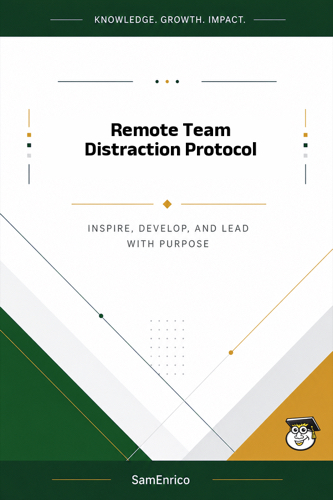
Remote Team Distraction Protocol eBook
Coordinate async communication to reduce interrupt
Coordinate async communication to reduce interruptions using this practical distributed work guide.
Formats
Free sample
Chapter 1: The Ping Paradox--It was 3:17 PM on a Wednesday when Marcus, a seasoned engineering director at a 400-person tech company, realized he had become a full-time notification manager who occasionally did some engineering work.He had started the day with three clear goals. By 11 AM, he had accomplished none of them. Instead, he had answered forty-two Slack messages, attended a "quick sync" that ran fifty-five minutes, reviewed a document that could have been an email, and spent thirty minutes searching for a decision that someone had made in a chat thread six months ago. At 3:17 PM, he closed his laptop, walked away from his desk, and sat on his couch staring at the ceiling for a full ten minutes. He wasn't thinking about work.
He wasn't thinking about anything. He was just... depleted.Marcus is not real. But you have worked with Marcus. You might be Marcus.
The name changes, but the story repeats itself thousands of times per day across every remote and hybrid team on the planet. The specifics vary—Slack instead of Teams, Zoom instead of Google Meet, Jira instead of Asana—but the underlying pattern is universal. Knowledge workers are drowning in communication. And the most disturbing part is that they believe it is their own fault."I just need better time management," Marcus told himself. "I need to be more disciplined.
I need to say no more often."He was wrong. The problem was not his discipline. The problem was the invisible architecture of expectations that had been built around him, brick by brick, notification by notification, without anyone ever making a conscious decision to build it.The Invention of the Open Door Once upon a time, there was a management philosophy called "open door." The idea was simple: managers should keep their office doors open so that employees could approach them with questions, ideas, or concerns. It was a reaction against the closed-door, command-and-control culture of mid-century corporations. It was supposed to foster transparency, trust, and collaboration.The open door policy had a hidden assumption, though.
It assumed that employees would use the open door judiciously. It assumed that the manager could still close the door when they needed to focus. It assumed that the physical act of walking to the door created a natural filter: only important things warranted the effort.Then remote work happened. The physical door disappeared. In its place, we got Slack, Teams, Whats App, email, text messages, Zoom, Webex, Google Meet, and a dozen other channels, all pinging simultaneously, all expecting attention, all feeling urgent.
The open door became an open vein. And unlike the physical door, you cannot close the digital one without seeming rude, unresponsive, or disengaged.This is the Ping Paradox: the technologies designed to make us more connected have made us less productive, and the behaviors designed to make us more responsive have made us less effective. The more available you are, the less you accomplish. The faster you reply, the more replies you receive. The harder you try to keep up, the further you fall behind.The Three Layers of the Trap The Ping Paradox is not a simple problem with a simple solution.
It is a multi-layered trap, and understanding its layers is the first step to escape.Layer One: The Technology The tools we use every day are not neutral. They are designed by some of the brightest minds in behavioral psychology, and they are optimized for one metric above all others: engagement. Every notification, every badge, every "someone is typing" indicator is carefully calibrated to trigger a dopamine response. Your brain releases a small amount of this feel-good neurotransmitter when you receive a message, when you reply, and when you receive a reply to your reply. The loop is self-reinforcing.
You are not checking Slack because you need to; you are checking because it feels good.The technology companies call this "user engagement." A more honest term would be "behavioral addiction." They have built slot machines for your pocket, and the jackpot is a message from a colleague.Layer Two: The Social Contract Even if you could resist the technology, you still have to contend with your teammates. Most workplace cultures have implicit—and sometimes explicit—expectations about response times. "I usually hear back from Sarah within five minutes." "If you tag me, I'll get right on it." "We're a fast-moving team; we don't let things sit."These expectations are rarely written down. They are rarely discussed. They just emerge, like moss on a damp wall, until they become immovable.
And once they exist, violating them feels dangerous. You worry that your colleagues will think you are slow, or lazy, or that you don't care. You worry that your manager will notice. You worry that you will miss something important.So you reply. And reply.
And reply. Not because you want to, but because the social cost of not replying feels higher than the productivity cost of replying.Layer Three: The Brain The deepest layer of the trap is your own neurology. Your brain did not evolve for the modern workplace. It evolved for the savanna, where threats were rare but severe, where you could spend hours focused on a single task (like tracking an animal or gathering berries), and where social signals were infrequent but highly meaningful.Today, your brain is flooded with hundreds of social signals per day, most of them low-stakes, and it cannot tell the difference between a genuine emergency and a routine question. Every ping activates the same threat-detection circuitry.
Every notification triggers a cortisol spike. Every unread badge feels like an unfinished task, and unfinished tasks occupy what psychologists call "working memory" even when you are not consciously thinking about them.This is why you feel tired at the end of the day even if you never did anything "hard." Your brain has been in low-grade threat response for eight hours. Your working memory has been clogged with dozens of open loops. Your attention has been shattered into tiny fragments. You are exhausted not because you worked hard, but because you switched contexts so many times that your brain never had a chance to rest.The Math of Interruption Let me show you the math.
It will hurt, but you need to see it.Assume you work an eight-hour day. That is 480 minutes. Now assume you check your messages every six minutes. That is ten checks per hour, eighty checks per day. Many knowledge workers check more frequently than this, but let us start with a conservative estimate.If each check takes one minute—just to glance, not to reply—that is eighty minutes per day spent on the act of checking alone.But the real cost is not the checking.
The real cost is the recovery. According to research by Dr. Gloria Mark at the University of California, Irvine, it takes an average of twenty-three minutes to return to a state of deep focus after an interruption. Twenty-three minutes. Let that sink in.Now, if you check every six minutes, you never get those twenty-three minutes.
You never return to deep focus at all. You spend your entire day in a state of what Dr. Mark…
This is the end of the free sample. Get the eBook to keep going. Buy now
About this book
Details
- Author
- Dillard Ladonna
- Publisher
- SamEnrico
- Language
- English
- Genre
- Non-Fiction, Self-Help, Remote Teams
- Released
- 2026-06-07
- Pages (approx.)
- 133
- Available as
- eBook, Audiobook

Read better in the ZLOADR app
Your eBooks on your phone or tablet. Sign in with your SamEnrico account and start reading.
More by Dillard Ladonna
 The Anger Survival GuideDillard Ladonna$11.99
 Self Hypnosis Visualization Scripts HandbookDillard Ladonna$11.99
 Schedule Chunking for ParentsDillard Ladonna$11.99
 Fitness Clothing EssentialsDillard Ladonna$11.99
 The Doppelgänger Effect: The Untold Story of the 1971 Time Capsule MysteryDillard Ladonna$11.99
 Neutrino Whispers: The Ghost Particles That Haunt the CosmosDillard Ladonna$11.99
 How to Start a Prefabricated Constructions (domestic) Assembly and Erection Business (Beginners GuidDillard Ladonna$11.99
 Food Waste AuditorDillard Ladonna$11.99
 Understanding Encephalopathy Subacute Spongiform, Gerstmann-straDillard Ladonna$17.99
 Ocean Freight DirectoryDillard Ladonna$12.99
 Bookkeeping Goal SettingDillard Ladonna$12.99
You may also like
 Hong Kong Handover 1997Dunn Johnnie$11.99
 Zumba For Postnatal Recovery CourseNeal Christian$11.99
 Zumba for BeginnersLadner Nikia$11.99
 YouTube Comment Mining GuideHumes Pandora$12.99
 Worry Box MeditationCarlin Rudy$11.99
 Workplace Stress MeditationNguyen Lynn$11.99
 Workplace Stress and Sleep RepairHawley Ivory$11.99
 Workplace Perfectionism CureDelaney Jeffry$11.99
 Workplace Injustice Anger GuideWallen Isabelle$11.99
 Work Addiction and Burnout LinkGreenwood Ester$11.99
 Women in Yoga and WellnessBeattie Galina$11.99
 Women in Stand Up ComedyChun Evangeline$11.99