
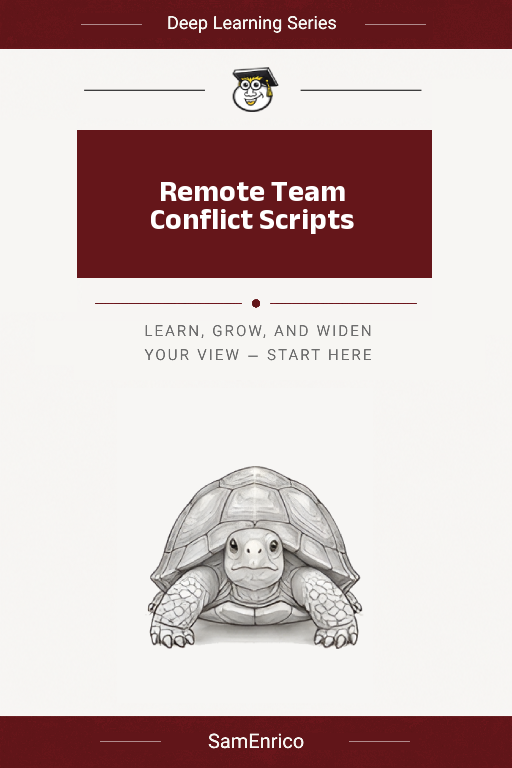
Remote Team Conflict Scripts eBook
Use proven scripts to address remote team conflict
Use proven scripts to address remote team conflicts. Templates for managers and team members.
Formats
Free sample
Chapter 1: The Silence That Costs Millions--–- The Slack message arrived at 2:00 AM on a Tuesday. “I’m done. I can’t work with Jamie anymore. I’m giving notice on Friday.” I stared at the screen, my stomach churning. The project was on track.
The team was hitting every deadline. The daily standups were professional, even friendly. And yet, one of my best people was ready to quit over a conflict I never saw coming. I spent the next week in damage control. I learned that the tension had been festering for months—in passive-aggressive thread replies, in silent withdrawal from meetings, in conversations happening in DMs instead of channels.
I had missed every signal because I was managing the way I always had: by assuming that no news was good news.This book exists because of that message. And because of the hundreds of conversations I’ve had since then with remote managers who have received their own version of that 2:00 AM wake-up call. Some received it as an email from HR. Some received it as a resignation letter that began “I love the work, but…” Some received it as a sudden drop in output from a previously high-performing team member. The specifics vary, but the pattern is the same: remote teams avoid conflict at higher rates than co-located teams, and that avoidance costs millions.This chapter quantifies the hidden cost of “being nice.” You will learn why avoidance masquerades as professionalism, the three distinct types of remote conflict, and how written communication turns minor misunderstandings into major blowups.
By the time you finish this chapter, you will understand why your team’s silence is not a sign of health—it is debt accruing interest.The Avoidance Masquerade Let me name the phenomenon that is quietly destroying your team’s productivity. I call it the avoidance masquerade. It happens when team members sense friction and decide, consciously or unconsciously, that the safest option is to say nothing. They tell themselves: “I don’t want to cause drama.” “It’s not a big deal.” “I’ll just let it go.” “They didn’t mean it.” “It’s not worth the awkwardness.”Each individual decision to avoid is reasonable. Each act of avoidance feels professional.
You are not shouting. You are not accusing. You are not escalating. You are being mature.Except you are not. You are being silent.
And silence is not professionalism. Silence is the absence of conflict, not the resolution of it. A team that never disagrees is not a team that agrees. It is a team that has stopped talking.In remote environments, avoidance is even more tempting. You do not have to look the other person in the eye.
You do not have to share an elevator. You can simply… not reply. You can let the thread go cold. You can assume they will forget. They will not forget.
They will remember. They will remember every ambiguous message, every delayed reply, every time you went quiet. And they will interpret your silence through the lens of their own anxiety.The avoidance masquerade is seductive because it feels safe in the moment. But safety is not the same as health. A team that avoids conflict is not a team without problems.
It is a team where problems are invisible—until they are too big to ignore.The 2.8-Hour Problem Now let me put a number on what avoidance costs you. According to the CPP Global Human Capital Report—a study of over 5,000 employees across nine countries—unaddressed workplace conflict costs organizations an average of 2.8 hours per employee per week in lost productivity, turnover, sick days, and time spent thinking about the conflict instead of working.Let me translate that. For a single employee, 2.8 hours per week is 145 hours per year. At an average salary of 60perhour(includingbenefits),thatisnearly60 per hour (including benefits), that is nearly 60perhour(includingbenefits),thatisnearly9,000 per employee per year in pure waste. For a team of ten, that is 90,000.Foradepartmentoffifty,thatis90,000.
For a department of fifty, that is 90,000.Foradepartmentoffifty,thatis450,000. For a company of five hundred, that is $4.5 million.And that is just the direct cost. The indirect costs are larger. Conflict drives turnover. Replacing an employee costs 50-150% of their annual salary.
Conflict reduces innovation because people stop sharing risky ideas. Conflict increases sick days because stress suppresses immune function. Conflict damages customer relationships when internal friction spills into external communication.The 2.8-hour problem is not a rounding error. It is a line item on your profit and loss statement. And most organizations never measure it because they never measure conflict at all.
They measure revenue. They measure margin. They measure customer satisfaction. They do not measure the silence that is slowly eroding all of those metrics.Here is the uncomfortable truth: every time you choose avoidance, you are making a financial decision. You are deciding that the short-term discomfort of a difficult conversation is worth the long-term cost of lost productivity, turnover, and quiet quitting.
That might be the right decision in the moment. But you should make it with your eyes open.The Three Types of Remote Conflict Not all conflict is the same. Before you can resolve a conflict, you need to know what kind you are dealing with. The three types of remote conflict are distinct, and each requires a different approach.Type 1: Task Conflict Task conflict is disagreement about the work itself—how to do it, who does what, when deadlines should be set, what quality looks like. Task conflict is about the what, not the who.Here is the surprising thing about task conflict: when managed well, it is productive.
Teams that engage in task conflict make better decisions because they surface different perspectives before committing to a course of action. They catch blind spots. They pressure-test assumptions. They build better solutions.The key phrase is “when managed well.” Task conflict becomes destructive when it is personal, when people attach their identity to their position, or when the disagreement is never resolved and simply lingers. But a healthy debate about the best way to launch a campaign?
That is not a problem. That is how good work gets done.In remote teams, task conflict is harder to spot because you cannot see people leaning forward or gesturing emphatically. A passionate debate about deadlines can look identical to a personal attack when all you have is text. That is why remote teams often shut down task conflict prematurely—they mistake passion for aggression.Type 2: Relationship Conflict Relationship conflict is personal friction—clashing styles, resentment, perceived disrespect, personality differences. Unlike task conflict, relationship conflict is almost never productive.
It does not lead to better decisions. It leads to avoidance, triangulation, and eventually, turnover.Relationship conflict is the silent killer of remote teams because it hides so well. Two people who genuinely dislike each other can still deliver their work on time. They can still attend meetings and say the right things. An outside observer might not notice anything wrong.
But the energy is drained. The collaboration is gone. The magic of a high-performing team—the trust, the spontaneity, the willingness to go the extra mile—evaporates.In remote settings, relationship conflict…
This is the end of the free sample. Get the eBook to keep going. Buy now
About this book
Details
- Author
- Hutchens Elicia
- Publisher
- SamEnrico
- Language
- English
- Genre
- Non-Fiction, Professional's Cheat Sheet, Mediation Skills
- Released
- 2026-05-30
- Pages (approx.)
- 104
- Available as
- eBook, Audiobook

Read better in the ZLOADR app
Your eBooks on your phone or tablet. Sign in with your SamEnrico account and start reading.
More by Hutchens Elicia
 The Envy and Social Media GuideHutchens Elicia$11.99
 Remote Work Desk ErgonomicsHutchens Elicia$11.99
 Financial Stress Credit Score AnxietyHutchens Elicia$11.99
 The India Vendor Management GuideHutchens Elicia$11.99
 The Deep Blue Inventors: How Black Engineers Revolutionized Underwater ExplorationHutchens Elicia$11.99
 Learn to Play the VielleHutchens Elicia$11.99
 Patent ParalegalHutchens Elicia$11.99
 How to Become a Mailer ApprenticeHutchens Elicia$11.99
You may also like
 Remote Team Conflict Resolution GuideEllison Sari$12.99
 Remote Conflict Identification GuideWingfield Ara$12.99
 Async Conflict Resolution GuideHebert Elisabeth$12.99
 Remote Team Success StoriesTolliver Joey$12.99
 Remote Team Conflict MistakesMcclung Merri$12.99
 Remote Team Conflict ChecklistChristian Cornelia$12.99
 Video Call Conflict MediationVarney Doretha$12.99
 Remote Team Conflict ToolsMarin Shara$12.99