
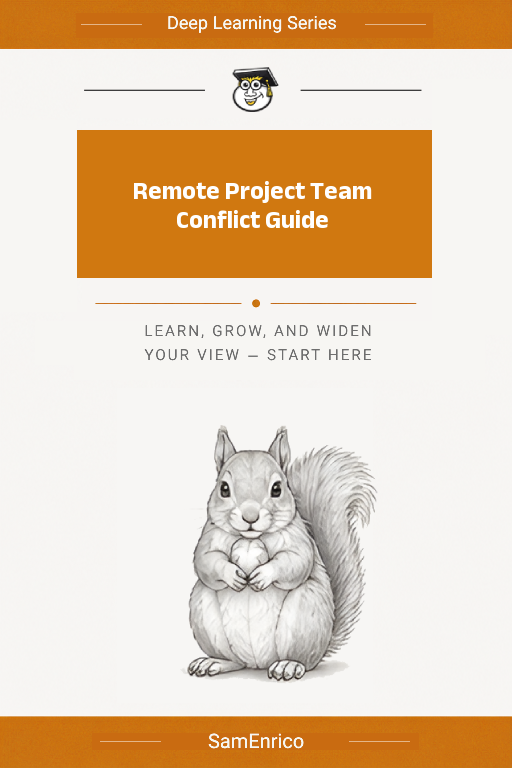
Non-FictionProfessional's Cheat SheetProject Dynamics
Remote Project Team Conflict Guide eBook
Addresses cross-functional remote conflicts arisin
Addresses cross-functional remote conflicts arising from misaligned priorities, resource contention, and deadline pressures in project teams.
Formats
Free sample
Chapter 1: The Silence is a Symptom--It begins not with a slammed fist or a raised voice, but with a cursor that stops moving.You are watching a shared document—perhaps a project roadmap or a requirements spec. Three people are editing. Then two. Then one. The third person’s avatar lingers in the corner, present but inert.
They are still in the document. They are no longer contributing. You send a polite @mention: “Thoughts on the timeline adjustment?” The read receipt appears instantly. No reply comes. An hour passes.
Then a day. The work continues around them, but they have become a ghost in the machine.This is what remote conflict looks like.In a physical office, you would have seen the signs. The crossed arms during a stand-up. The sharp exhale when a name was mentioned. The whispered conversation by the coffee machine that stops when you approach.
The slammed laptop lid. The door closed just a little too firmly. Conflict in colocated teams is noisy, uncomfortable, and unmistakable. You might dread it, but at least you can see it coming.Remote conflict is silent. It is the Slack message that goes from rapid-fire back-and-forth to radio silence.
It is the video call where one participant’s camera turns off and never turns back on. It is the sudden, unexplained shift from using first names to using “the engineering team” or “product” as a cold, distant abstraction. It is the Jira ticket that sits in “In Review” for five days with no comments, no feedback, no acknowledgment—just a digital limbo where work goes to die.And here is the dangerous truth that most remote managers learn too late: a quiet remote team is rarely a happy team. It is almost always a team that has learned, through painful experience, that disengagement is safer than confrontation.The Mute Button Phenomenon Let us name the enemy. I call it the Mute Button Phenomenon—the active, learned avoidance of the very channels where conflict resolution could occur.The name is deliberately ironic.
Every video conferencing platform has a mute button. It is designed to silence background noise: the barking dog, the garbage truck, the neighbor’s leaf blower. But remote workers have discovered a secondary use for the mute button. They use it to silence themselves. Not literally—though some do turn off their microphones and never unmute—but figuratively.
They mute their objections. They mute their disagreements. They mute the small, clarifying questions that might have prevented a larger disaster.But the muting does not happen only during calls. It happens across every channel of remote communication.In Slack or Teams: A team member sees a message that frustrates them. They type a response.
They delete it. They type another. They delete that too. Eventually, they close the window and mark the channel as muted. The conversation continues without them.
Their perspective is lost not because it lacked merit, but because the effort of typing felt exhausting and the risk of being misunderstood felt too high.In email: A project manager sends a request for updated timelines. The recipient reads it, feels a spike of resentment about an unrealistic deadline, and moves it to a folder called “Later.” Later becomes next week. Next week becomes never. The requester assumes the timeline is fine because no objection was raised. The recipient assumes the requester doesn’t care about their constraints because no one asked.
Both are wrong. Both are silently building a case against the other.In shared documents: A contributor sees a flawed assumption in a proposal. They highlight the text, then hesitate. Adding a comment feels aggressive. Leaving a suggestion feels passive-aggressive.
They close the document without marking anything. The flaw remains. The project proceeds on faulty foundations. Months later, when the flaw becomes a crisis, no one remembers who spotted it first.In private direct messages: This is where the rot truly spreads. A group of three engineers who feel unheard by their product manager create a private channel.
At first, it is for venting. “Can you believe she asked for that by Friday?” Then it becomes strategic. “We should just tell her it’s not possible and let her figure it out.” Then it becomes an alternate reality. Decisions are made in the private channel. Agreements are formed.
By the time the issue reaches the public channel, the war has already been lost. The public conversation is just theater.The Mute Button Phenomenon has a cousin, and it is equally destructive: performative agreement.This is the art of saying “yes” in a meeting while meaning “no.” It looks like a nod. It sounds like “I can try.” It feels, to the person hearing it, like alignment. But performative agreement is not alignment. It is conflict deferred.
The person who says “yes” in the Zoom call will, an hour later, DM a colleague: “There is no way we can do that.” The person who hears “yes” will plan assuming buy-in. The gap between what was said and what was meant will widen until something breaks.And something always breaks.Why Remote Teams Choose Silence Over Conflict The natural question is: why? Why would a capable, well-intentioned professional choose silence over the productive airing of disagreement?The answer is not cowardice. It is rational risk assessment. Let me walk you through the calculation that happens, often unconsciously, in a remote worker’s mind when they encounter a conflict-triggering situation.Factor One: The Absence of Non-Verbal Cushioning In person, you can disagree with someone while smiling.
You can say “I think that’s wrong” while leaning forward with curiosity rather than aggression. You can interrupt a heated moment by placing a hand on someone’s arm—a gesture that says “I’m still with you even though we disagree.” These non-verbal cues are the social lubricant that makes conflict productive rather than destructive.Remove them, and every disagreement becomes more dangerous. A typed sentence that says “That approach won’t work” lands differently than a spoken one. Without tone, without pace, without facial expression, the reader fills the gap with their own assumptions. And because humans are wired to assume the worst when information is incomplete (a survival mechanism left over from our evolutionary past), they will usually assume hostility.“That approach won’t work” becomes, in the reader’s mind, “You are incompetent.”Knowing this, the remote worker chooses silence.
It is not that they have nothing to say. It is that the cost of saying it feels too high.Factor Two: The Permanence of the Written Word In a live conversation, disagreement is ephemeral. You say something slightly harsh. The other person looks hurt. You immediately correct: “Sorry, that came out wrong.
Let me rephrase.” The moment passes. The relationship survives.In a written channel, disagreement is permanent. Every word you type becomes a record. A screenshot can be taken. A DM can be forwarded.
A Slack thread can be reviewed months later during a performance evaluation. The risk of saying something that will be misinterpreted, and then preserved in that misinterpreted form, is terrifying to most professionals.The rational choice, again, is silence.Factor Three: The Diffusion of Accountability…
This is the end of the free sample. Get the eBook to keep going. Buy now
About this book
Details
- Author
- Perrin Francisca
- Publisher
- SamEnrico
- Language
- English
- Genre
- Non-Fiction, Professional's Cheat Sheet, Project Dynamics
- Released
- 2026-05-30
- Pages (approx.)
- 153
- Available as
- eBook, Audiobook

Read better in the ZLOADR app
Your eBooks on your phone or tablet. Sign in with your SamEnrico account and start reading.
More by Perrin Francisca
 Early Adopter Fitness TechPerrin Francisca$11.99
 Equifax's 143 Million Social Security NumbersPerrin Francisca$11.99
 Egypt Nasser Pan AfricanismPerrin Francisca$11.99
 Confidence Affirmation HandbookPerrin Francisca$11.99
 John Wayne Gacy Artwork AnalysisPerrin Francisca$11.99
 Whispers in the Bamboo: The Forbidden Love of the Moon Princess and the Mortal ScholarPerrin Francisca$11.99
 Understanding Mucopolysaccharidosis Type Iv-bPerrin Francisca$17.99
 AI Talking Head Video GuidePerrin Francisca$12.99
 Procurement Supplier Contracts ManagerPerrin Francisca$11.99
 How to Become a Cloth SanderPerrin Francisca$11.99
You may also like
 Hong Kong Handover 1997Dunn Johnnie$11.99
 Zumba For Postnatal Recovery CourseNeal Christian$11.99
 Zumba for BeginnersLadner Nikia$11.99
 YouTube Comment Mining GuideHumes Pandora$12.99
 Worry Box MeditationCarlin Rudy$11.99
 Workplace Stress MeditationNguyen Lynn$11.99
 Workplace Stress and Sleep RepairHawley Ivory$11.99
 Workplace Perfectionism CureDelaney Jeffry$11.99
 Workplace Injustice Anger GuideWallen Isabelle$11.99
 Work Addiction and Burnout LinkGreenwood Ester$11.99
 Women in Yoga and WellnessBeattie Galina$11.99
 Women in Stand Up ComedyChun Evangeline$11.99