
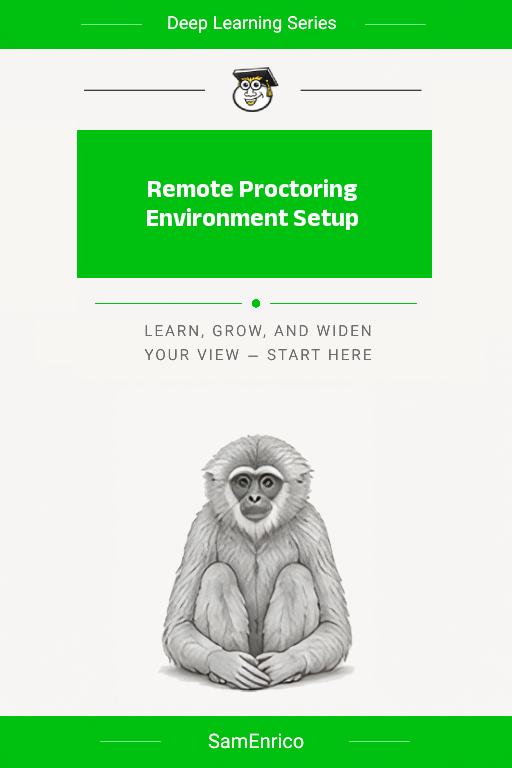
Remote Proctoring Environment Setup eBook
Prepare your room, lighting, desk, and computer to
by Wilson Casey
Prepare your room, lighting, desk, and computer to pass automated proctoring checks without issues.
Formats
Free sample
Chapter 1: The Blank Slate...--Imagine standing in the center of your own bedroom, slowly turning in a circle while a stranger watches every corner of your private space through a webcam. Your bookshelves, your posters, even the pile of laundry in the corner — all of it is being scrutinized not by a curious friend, but by an algorithm trained to detect deception. This is the reality of remote proctoring, and for millions of students and professionals each year, the first sixty seconds of the room scan determine whether their exam even begins.Welcome to Chapter 1. If you take nothing else from this book, master the content of this single chapter. The room you test in is the single most visible variable in the entire proctoring equation.
You can have perfect lighting, a flawless internet connection, and the cleanest digital hygiene imaginable — but if your walls contain a single whiteboard with old grocery lists, or if your bookshelf holds a textbook from last semester, you risk an automatic flag, a paused exam, and hours of frustration.This chapter is called "The Blank Slate" for a reason. By the time you finish reading, you will understand exactly why proctors need to see every wall, floor, and ceiling tile. You will learn why that inspirational poster you love is a liability. You will discover three proven strategies for handling bookshelves without destroying your personal library. And you will walk away with a repeatable, five-minute room scan procedure that has been tested across every major proctoring platform: Honorlock, Proctor U, Proctortrack, Respondus, and SMOWL.But first, let us confront the uncomfortable truth that most test-takers never consider until it is too late.The Psychology of the Room Scan Why does a proctor need to see your ceiling?
The answer has nothing to do with invasion of privacy and everything to do with the concept of "hidden surfaces." In the physical world of traditional testing centers, every desk is identical, every wall is bare, and every ceiling tile is uniformly white. The testing environment is designed to offer zero information beyond the exam itself. Remote proctoring attempts to replicate this sterile environment by requiring test-takers to temporarily transform their personal spaces into neutral, information-free zones.The room scan serves two distinct purposes, one technical and one psychological.The technical purpose is straightforward: the proctor (whether AI or human) must verify that no unauthorized materials, people, or devices are present within the testing environment. This includes obvious violations like open textbooks or smartphones, but it also includes less obvious threats like a second monitor hidden behind a pillow, a sticky note attached to the back of a door, or a person crouching under a desk. The panoramic scan — typically requiring a slow 360-degree rotation of the laptop or webcam — ensures that every potential hiding spot is documented before the exam begins.The psychological purpose is more subtle but equally important.
The room scan is a ritual. It signals to the test-taker that the rules are real and that compliance is expected. Research in behavioral psychology has shown that the act of physically demonstrating one's environment to an authority figure increases rule-following behavior by approximately forty percent compared to simply signing an honor code. The scan creates a moment of accountability. When you personally show the proctor your blank walls, you are psychologically committing to maintaining that blank slate for the duration of the exam.Understanding this dual purpose transforms the room scan from an annoyance into an opportunity.
By deliberately and confidently presenting a clean environment, you signal to the proctor that you are prepared, professional, and trustworthy. This positive first impression matters more than most test-takers realize.The 360-Degree Mandate: What Proctors Actually Need to See Let us break down exactly what the proctoring software requires during a room scan. While specific platforms have minor variations, the core requirements are nearly universal across Honorlock, Proctor U, Proctortrack, Respondus, and SMOWL.All four walls. You must show every wall in the room, from floor to ceiling, with particular attention to corners. The proctor needs to see that no one is standing in a corner, that no notes are taped to the walls, and that no additional doors or windows exist that could allow someone to enter unnoticed.The floor.
This is often overlooked. You must tilt the camera down to show the floor beneath your desk and chair. The proctor is looking for papers, devices, or simply confirmation that no one is hiding underneath your desk. A clear floor with no clutter is ideal.The ceiling. Yes, the ceiling.
Some test-takers have been flagged because a ceiling tile was slightly displaced, suggesting the possibility of a hidden camera or notes stored above. While this is rare, the requirement exists. Briefly tilt the camera upward to show that the ceiling is intact and contains no writing or devices.Under the desk. Many proctoring platforms now specifically request that you show the underside of your desk surface. This is to verify that no notes or devices are taped underneath.
If your desk has drawers, you may be asked to open them briefly to show they contain only office supplies — not textbooks or phones.Behind the monitor. Finally, you must show the space directly behind your computer monitor. This area is a common hiding spot for sticky notes or secondary devices. Simply lift or turn the monitor slightly to reveal the wall behind it.The entire scan should take between sixty and ninety seconds. Move slowly — approximately one foot per second.
Jerky or rapid movements can cause the AI to flag the video as "unclear," requiring a repeat scan. Speak clearly as you pan, announcing what you are showing: "Here is the left wall. Here is the floor. Here is the ceiling. Here is under the desk." This narration serves two purposes: it proves that you are the one controlling the camera, and it creates a timestamped record of your compliance.The Wall Problem: Why Your Decor Is a Liability Now we arrive at the most common reason for room scan failures: the wall problem.
You have spent years carefully curating your study space with posters, whiteboards, calendars, and framed artwork. That space makes you feel comfortable and motivated. Unfortunately, nearly all of it is prohibited during a proctored exam.Posters and artwork. Any poster or framed image that contains text, numbers, formulas, diagrams, or recognizable symbols is a potential violation. Why?
Because the AI cannot distinguish between a motivational quote and an exam answer. A poster that says "You are capable of great things" is harmless, but the algorithm does not know that. It only detects that text exists on the wall within your field of vision. The safest approach is to remove all posters and artwork from the testing room entirely. If removal is impossible (for example, in a shared dorm room), cover them with a plain white or black sheet secured with painter's tape.Whiteboards and dry-erase boards.
These are absolute violations. Even a completely erased whiteboard can retain faint traces of previous writing that might be visible under certain lighting conditions. Whiteboards must be removed from the room or turned to face the wall. If…
This is the end of the free sample. Get the eBook to keep going. Buy now
About this book
Details
- Author
- Wilson Casey
- Publisher
- SamEnrico
- Language
- English
- Genre
- Non-Fiction, Student's Shortcut, Environment
- Released
- 2026-06-01
- Pages (approx.)
- 146
- Available as
- eBook, Audiobook

Read better in the ZLOADR app
Your eBooks on your phone or tablet. Sign in with your SamEnrico account and start reading.
More by Wilson Casey
 Business Bank Account GuideWilson Casey$11.99
 Mindfulness for Grief GuideWilson Casey$11.99
 Eisenhower Matrix for Police OfficersWilson Casey$11.99
 The Priority and GTD MethodWilson Casey$11.99
 Calming Parental Burnout With Self CareWilson Casey$11.99
 Blind Tech CompensationWilson Casey$11.99
 Design Thinking For ParentingWilson Casey$11.99
 Childhood Trauma Recovery GuideWilson Casey$11.99
 The Sacher Torte Dynasty: Vienna’s Sweet EmpireWilson Casey$11.99
 Oisín and Niamh: The Forgotten Years in Tír na nÓgWilson Casey$11.99
 A Collector's Handbook to the Fiat 133Wilson Casey$11.99
 Mastering The Art of Muay ChaiyaWilson Casey$11.99
You may also like
 Environmental Science GuideDunn Clyde$12.99Environmental Science GuideDunn Clyde$12.99Environmental Science GuideDunn Clyde$12.99
 Online Exam Background Check GuideMadrigal Jimmy$12.99Environmental Science GuideDunn Clyde$12.99Environmental Science GuideDunn Clyde$12.99Environmental Science GuideDunn Clyde$12.99Environmental Science GuideDunn Clyde$12.99Environmental Science GuideDunn Clyde$12.99Environmental Science GuideDunn Clyde$12.99Environmental Science GuideDunn Clyde$12.99Environmental Science GuideDunn Clyde$12.99