
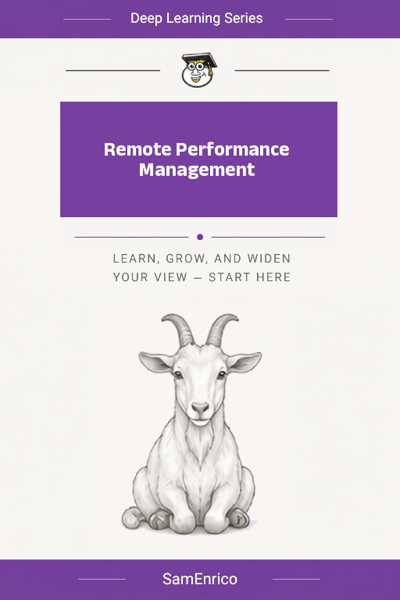
Remote Performance Management
A Coursebook on Remote Performance Management
A Coursebook on Remote Performance Management
Formats
About this book
Free sample
Chapter 1: The Visibility Lie...--Most managers believe a simple, dangerous lie. The lie whispers that if you can see someone working, they are actually working. If you can walk past their desk and hear keyboard clicks or see a furrowed brow, you can breathe easy. But if you cannot see them—if their Slack status flickers yellow or their camera stays off—a quiet alarm sounds in your gut. That alarm has a name: presenteeism bias.
It is the single greatest enemy of remote performance management, and it has been poisoning management practice for over a century.This chapter dismantles that lie. It will show you why "seeing is believing" fails completely when your team works from home, a coffee shop, or another continent. More importantly, it will replace that broken belief with a new operating system for managers: outcome-based trust. By the end of this chapter, you will understand why remote workers are often more productive than their office-bound peers, how the anxiety of not seeing your team leads to destructive micromanagement, and how to define the metrics that actually matter—without turning into a digital warden. This chapter establishes the foundation upon which the entire book is built.
Every subsequent chapter—from hiring (Chapter 2) to feedback (Chapter 6) to metrics (Chapter 10)—will refer back to the core shift introduced here: moving from managing activities to managing outputs.Let us begin by naming the enemy.The Origins of the Visibility Lie The belief that visibility equals productivity did not emerge from bad management. It emerged from the physical constraints of pre-industrial work. On a farm, you could see who was plowing and who was resting under a tree. In a factory, you could walk the floor and spot an idle machine or a worker leaning on a shovel. Frederick Winslow Taylor, the father of scientific management, built an entire philosophy around this visibility.
In his 1911 treatise "The Principles of Scientific Management," Taylor argued that managers must observe workers closely, time their motions with a stopwatch, and eliminate any "soldiering"—the deliberate slowing of work. Taylorism assumed that the manager's eyes…
This is the end of the free sample. Get the eBook to keep going. Buy now
Contents
- Chapter 1
- Chapter 2
- Chapter 3
- Chapter 4
- Chapter 5
- Chapter 6
- Chapter 7
- Chapter 8
- Chapter 9
- Chapter 10
- Chapter 11
- Chapter 12
Details
- Author
- Huntley Sondra
- Publisher
- SamEnrico
- Language
- English
- Genre
- Non-Fiction, Informative, Educational
- Released
- 2026-05-18
- Pages (approx.)
- 156
- Available as
- eBook, Audiobook

Read better in the ZLOADR app
Your eBooks on your phone or tablet. Sign in with your SamEnrico account and start reading.
More by Huntley Sondra
 The Talk Show DeathHuntley Sondra$11.99
 The Lightning Talk MethodHuntley Sondra$11.99
 Trucker Nap Strategy GuideHuntley Sondra$11.99
 Caregiver for Parent with DementiaHuntley Sondra$11.99
 Attribution Retraining CourseHuntley Sondra$11.99
 Self Hypnosis for Erectile DysfunctionHuntley Sondra$11.99
 Terms by Fund SizeHuntley Sondra$11.99
 Fibromyalgia Pacing PrimerHuntley Sondra$11.99
 Commercial Property ManagementHuntley Sondra$11.99
 The Queen Who Loved Too Much: The Scandalous Romance of Marie Antoinette and Axel von FersenHuntley Sondra$11.99
 The Magyar Storm: Arpad's Raiders and the Birth of HungaryHuntley Sondra$11.99
 Fenrir's Howl: The Wolf Who Swallowed the SunHuntley Sondra$11.99