
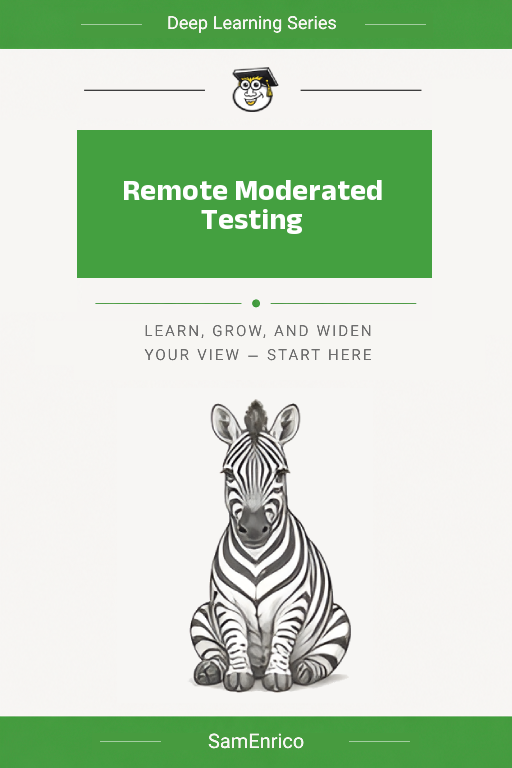
Non-FictionNon-Obvious CareerModerated TestingRemote Pay
Remote Moderated Testing eBook
Use Lookback or UserTesting to conduct paid sessio
by Akin Loise
Use Lookback or UserTesting to conduct paid sessions from home.
Formats
Free sample
Chapter 1: The Living Room Revolution--–- The first time I ran a moderated usability test from my living room, I was sure it would fail. The participant—let's call her Maria—had agreed to 75forsixtyminutesofherevening.Shewasanurse,workingnights,andshewastestingaprototypeforahospitalshift−schedulingapp.Ihadborrowedmyroommate′sexternalmicrophone,clearedmycoffeetableofcathair,andcreateda Lookbacksessionlinkwiththedesperatehopeofamanwhohadexactly75 for sixty minutes of her evening. She was a nurse, working nights, and she was testing a prototype for a hospital shift-scheduling app. I had borrowed my roommate's external microphone, cleared my coffee table of cat hair, and created a Lookback session link with the desperate hope of a man who had exactly 75forsixtyminutesofherevening.Shewasanurse,workingnights,andshewastestingaprototypeforahospitalshift−schedulingapp.Ihadborrowedmyroommate′sexternalmicrophone,clearedmycoffeetableofcathair,andcreateda Lookbacksessionlinkwiththedesperatehopeofamanwhohadexactly75 in his freelance budget and no plan B.Maria joined the call five minutes early. She was sitting on her sofa, still in scrubs, with a mug of tea that steamed into her laptop camera.
Her cat walked across her keyboard. She apologized. I told her not to. And then she shared her screen, and for the next fifty-seven minutes, she did something no lab-based study had ever captured: she showed me exactly how shift-scheduling software fails in real life. She multitasked.
She got interrupted by a text from her charge nurse. She mumbled "this is stupid" under her breath when a button was too small. She laughed when I asked her to explain her thinking, then said, "Wait, you actually want to know? Okay, here's the real problem…"That session changed everything I believed about user research. I had spent years in corporate usability labs—one-way mirrors, eye-trackers, dedicated observers, the whole intimidating apparatus.
We had produced reports. We had made recommendations. But Maria, in her scrubs with her cat and her tea, taught me more about that scheduling app in fifty-seven minutes than ten lab sessions ever had. Not because she was smarter or the prototype was better. Because she was home.This chapter dismantles the assumption that professional labs produce better data.
It argues that remote moderated testing in the participant's natural environment yields higher ecological validity—meaning you observe real behaviors, interruptions, and multitasking that no sterile lab can replicate. You will learn why "home" is not a constraint but an advantage. You will understand the psychology of the paid participant at home: more relaxed, more honest, and more distracted in ways that actually improve your research. And you will see why the shift from lab-based to remote moderated testing is not a compromise or a cost-cutting measure but a fundamental improvement in how we understand human behavior with technology.The Myth of the Perfect Lab For decades, the usability lab was the gold standard. A typical setup looked like this: a room with a one-way mirror, a dedicated recording system, a researcher behind the glass taking notes, and a participant sitting in a chair that was slightly too uncomfortable, under lights that were slightly too bright, speaking into a microphone that reminded them they were being watched.
The assumption was that controlling the environment produced cleaner data. Remove the distractions. Eliminate the variables. Focus the participant entirely on the task.There is only one problem with that assumption: it is wrong.The lab does not remove distractions; it replaces real distractions with artificial ones. The participant is not "focused" on the task; they are performing for an invisible audience behind the mirror.
They are not behaving naturally; they are behaving as they believe a good participant should behave. And the data you collect is not a record of how someone uses your product in the world; it is a record of how someone uses your product when they are being watched in a strange room with a one-way mirror.This is not speculation. The academic literature on ecological validity—the degree to which research findings generalize to real-world settings—has long warned against over-reliance on artificial environments. A 2017 meta-analysis of usability testing methods found that participants in lab settings completed tasks faster and made fewer errors than participants in remote settings, but those same participants reported lower satisfaction and lower intention to use the product afterward. In other words, the lab made people better at using the product in the moment but less likely to actually want to use it in real life.
That is not a success. That is a mirage.The remote moderated session inverts the lab's logic. Instead of bringing the participant to the research, you bring the research to the participant. They sit on their own couch, at their own desk, in their own cluttered home office. They use their own computer, their own internet connection, their own browser with their own extensions and bookmarks and saved passwords.
They get interrupted by their own children, their own pets, their own doorbell. And in those interruptions, you see the truth.Why Home is Not a Constraint Let me be explicit about something that makes many researchers uncomfortable: the distractions of home are not noise. They are signal.When a participant's Slack notification pops up during your session, and they glance at it for half a second before returning to your task, you have learned something. You have learned that your product is competing for attention with their actual job. That is not a confounding variable.
That is the variable. If your product cannot hold a user's attention when their boss is messaging them, your product will fail in the market regardless of how well it performs in a distraction-free lab.When a participant's child runs into the room and asks for a snack, and the participant says "just a minute, honey" while trying to complete your checkout flow, you have learned something. You have learned that your flow requires more than thirty seconds of uninterrupted focus. If your target user is a parent working from home, that is fatal. A lab would never show you this.
A lab would give you a clean completion rate and a satisfied participant who had no idea they were missing the real constraint.When a participant's battery dies at forty-two minutes because they forgot to plug in their laptop, and they scramble for a charger while apologizing, you have learned something. You have learned that your session length exceeds their typical device habits. If you are testing a mobile app, that matters. People do not plan their phone's battery life around your research protocol.These are not failures of remote testing. They are the entire point.The psychology of the home participant also differs fundamentally from the lab participant.
In a lab, participants experience what researchers call "evaluation apprehension"—the anxiety of being judged by experts behind a mirror. They become hyper-competent, hyper-vigilant, and hyper-conscious of their every click. They apologize for mistakes. They over-explain simple actions. They try to "help" the researcher by guessing what the "right answer" is.At home, that apprehension dissolves.
Not entirely—they know they are being recorded, and they know they are being paid—but enough. They swear when something is frustrating. They say "I don't get it" without embarrassment. They abandon tasks without asking permission. They reveal their actual relationship with technology, which is almost always messier, more emotional, and more intuitive than what you see in a lab.There is a word for this…
This is the end of the free sample. Get the eBook to keep going. Buy now
About this book
Details
- Author
- Akin Loise
- Publisher
- SamEnrico
- Language
- English
- Genre
- Non-Fiction, Non-Obvious Career, Moderated Testing, Remote Pay
- Released
- 2026-05-30
- Pages (approx.)
- 153
- Available as
- eBook, Audiobook

Read better in the ZLOADR app
Your eBooks on your phone or tablet. Sign in with your SamEnrico account and start reading.
More by Akin Loise
 ICU Doctor Stress ReliefAkin Loise$11.99
 Child Emotion RegulationAkin Loise$11.99
 Anger Management for Insomnia at WorkAkin Loise$11.99
 The Breath Not Self PracticeAkin Loise$11.99
 Deep Sea Diver's Fatigue GuideAkin Loise$11.99
 AI Redlining Comparison WorkflowAkin Loise$11.99
 Egyptian Magic GuideAkin Loise$11.99
 Public Speaking Outline PalaceAkin Loise$11.99
 Affirmations For Morning AnxietyAkin Loise$11.99
 The Vanishing of the SS Marine Sulphur Queen: America’s Greatest Maritime MysteryAkin Loise$11.99
 The First Ecologists: Decoding the Ancient Forests of Southeast AsiaAkin Loise$11.99
 Pill Poppers: The Hidden Epidemic of Quaalude Abuse in the 1970sAkin Loise$11.99
You may also like
 Hong Kong Handover 1997Dunn Johnnie$11.99
 Zumba For Postnatal Recovery CourseNeal Christian$11.99
 Zumba for BeginnersLadner Nikia$11.99
 YouTube Comment Mining GuideHumes Pandora$12.99
 Worry Box MeditationCarlin Rudy$11.99
 Workplace Stress MeditationNguyen Lynn$11.99
 Workplace Stress and Sleep RepairHawley Ivory$11.99
 Workplace Perfectionism CureDelaney Jeffry$11.99
 Workplace Injustice Anger GuideWallen Isabelle$11.99
 Work Addiction and Burnout LinkGreenwood Ester$11.99
 Women in Yoga and WellnessBeattie Galina$11.99
 Women in Stand Up ComedyChun Evangeline$11.99