
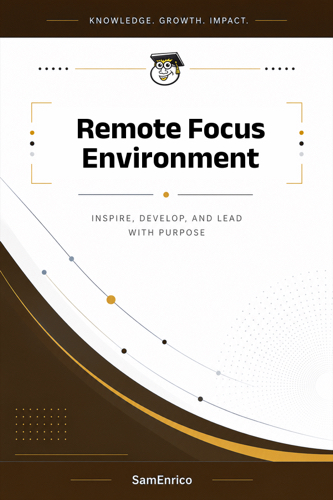
Remote Focus Environment eBook
Set up your physical workspace for maximum concent
Set up your physical workspace for maximum concentration.
Formats
Free sample
Chapter 1: The Willpower Lie--–- It is 2:47 PM on a Tuesday. You have been staring at the same paragraph for eleven minutes. Your phone has buzzed three times. A Slack notification just appeared. Somewhere in your house, a laundry machine is beeping.
You are not lazy. You are not undisciplined. You are not broken. You are fighting a battle that your brain was never designed to win.Let me tell you a story about a man named Mark. Mark is a senior software engineer.
He is good at his job—or at least he used to be, before the pandemic sent him home. Mark set up his laptop on his dining table. He bought a nice chair. He told himself he would be disciplined. He made a schedule.
He downloaded a focus app. He tried everything.And every day at 2:47 PM, Mark found himself staring at the ceiling, wondering why he couldn't just focus.Mark is not real. But you are. And you have felt what Mark feels.The remote work revolution promised freedom. No commute.
Flexible hours. Work from anywhere. But for millions of people, that freedom has come with a hidden cost: the slow, grinding realization that your home—the place where you relax, eat, sleep, and live—has become a battlefield for your attention. And you are losing.This book is not about trying harder. It is not about willpower, discipline, or "grit." In fact, I am going to argue that willpower is the single worst tool for focus you could possibly use.
This book is about building an environment that focuses for you—so you don't have to.But before we build anything, we need to understand what we are fighting against. We need to understand why your brain, for all its evolutionary brilliance, is catastrophically ill-equipped for remote work. And we need to understand why you are not the problem.The Cognitive Load Inventory: Why Your Brain Feels Like It's Drowning Let us start with a simple experiment. Look at your desk right now. Do not clean it.
Just look.How many objects do you see? A coffee mug? A stack of papers? A phone face-up? A water bottle?
A notebook? A pen? A pair of headphones? A lamp? A plant?
A pile of mail?Now, I want you to understand something that will change how you see your workspace forever: every single one of those objects is talking to you.Not literally, of course. But neurologically, every object in your peripheral vision is demanding a tiny slice of your brain's processing power. Your brain, evolved on the African savanna, cannot simply ignore a visual stimulus. It must evaluate it. Threat?
Not threat? Food? Not food? Potential mate? Not potential mate?
This evaluation happens in milliseconds, but it happens for every object.This is called Cognitive Load Theory, and it is the single most important concept in this book.Cognitive load is the total amount of mental effort being used in your working memory. Think of your working memory as a narrow pipe. Information flows through it. When the pipe is clear, you can think deeply, solve problems, and create. When the pipe is clogged—with visual clutter, with notifications, with unfinished tasks, with background noise—you cannot.Here is the brutal truth about remote work: your home office is a cognitive clogging machine.In a traditional office, your workspace was designed (however poorly) for work.
The walls were neutral colors. The desk had only work items. The sounds were office sounds—keyboards, low conversation, HVAC hum. Your brain learned to filter these as "work mode" cues.In your home office, that filter is gone. Every object that belongs to your home life—the pile of laundry, the dishes in the sink, the pet bed in the corner, the mail on the edge of your desk—is screaming for attention.
Your brain cannot tell the difference between "urgent" and "important" when both are sitting in front of you. To your ancient neural circuitry, a pile of laundry is just as threatening as a spreadsheet deadline. Both demand evaluation.And evaluation consumes energy. Finite energy.This is why you are exhausted at 2 PM. It is not because you worked hard.
It is because your brain has spent the last six hours suppressing irrelevant stimuli—a task that burns through mental fuel at an astonishing rate.The Five Sources of Cognitive Load In this book, we will address five distinct sources of cognitive load. Each will have its own chapter. But for now, let me name them so you can see the battlefield:1. Visual Load. Everything you see.
The clutter, the cables, the open tabs, the notifications. Your eyes are the primary gateway to your attention, and they are under constant assault.2. Auditory Load. Everything you hear. The dog barking, the neighbor's television, the HVAC kicking on, the sudden silence that is broken by an even more sudden sound.
Your ears are always listening for threats, and every unexpected sound is a threat.3. Digital Load. Everything on your screen. The 47 browser tabs, the unread email count, the Slack badge, the calendar reminder, the file folder called "Miscellaneous" that contains everything and nothing.4. Social Load.
Everything involving other humans. The housemate who knocks, the child who needs attention, the partner who wants to chat, the colleague who sends a "quick question" that takes forty minutes to resolve.5. Decisional Load. Every choice you make. Where to save this file.
What to work on next. Whether to check that notification. Whether to get water now or later. Each decision is a tiny tax.By the end of this book, you will have a concrete plan to reduce each of these loads. You will not eliminate them entirely—that is impossible—but you will reduce them enough that your brain can finally do what it does best: focus.But first, we need to understand the enemy in more detail.
And the enemy is not your phone. It is not your housemate. It is not Slack.The enemy is a structure inside your own skull called the Default Mode Network.The Default Mode Network: Why Your Brain Treats Laundry Like an Emergency For most of human history, your brain had one job: keep you alive.That is not an exaggeration. For 200,000 years, humans lived in small tribes, constantly threatened by predators, rival tribes, starvation, and disease. Your brain evolved to prioritize immediate environmental threats above everything else.
That pile of leaves rustling? Could be a lion. That berry? Could be poison. That stranger?
Could be an enemy.Your brain is excellent at this. It is why humans survived.But here is the problem: your brain cannot tell the difference between a rustling bush and a Slack notification. To your neural circuitry, both are unexpected stimuli that require immediate attention. Both trigger the same threat-detection system. Both pull you out of focus mode and into vigilance mode.This threat-detection system lives in a part of your brain called the Default Mode Network (DMN) .The DMN is active when you are not focused on an external task.
It is your brain's "idle" mode—the network that runs when you are daydreaming, remembering, planning, or worrying. The DMN is…
This is the end of the free sample. Get the eBook to keep going. Buy now
About this book
Details
- Author
- Epperson Nickolas
- Publisher
- SamEnrico
- Language
- English
- Genre
- Non-Fiction, Self-Help, Workspace, Environment
- Released
- 2026-06-09
- Pages (approx.)
- 137
- Available as
- eBook, Audiobook

Read better in the ZLOADR app
Your eBooks on your phone or tablet. Sign in with your SamEnrico account and start reading.
More by Epperson Nickolas
 Francis Vernacular PrayersEpperson Nickolas$11.99
 The Beginner's Mindfulness JournalEpperson Nickolas$11.99
 Remote Work Loneliness CureEpperson Nickolas$11.99
 The Hypnosis Listening Environment GuideEpperson Nickolas$11.99
 Shredding the Southern Skies: The Rise of Australia & New Zealand’s Skateboarding LegendsEpperson Nickolas$11.99
 Learn to Play the Accordina (Instrument)Epperson Nickolas$11.99
 How to Start a Fish and Chip Shop Business (Beginners Guide)Epperson Nickolas$11.99
 Twitter Pre Launch CommunityEpperson Nickolas$12.99
 Blockchain MOOC CertificatesEpperson Nickolas$12.99