
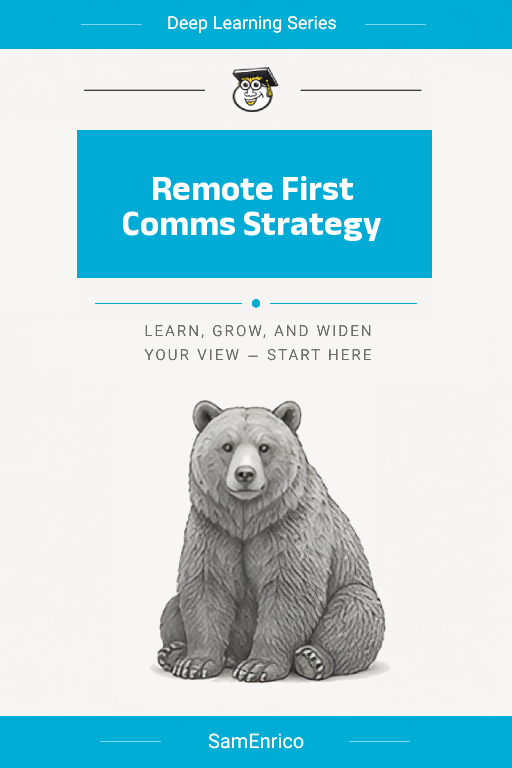
Non-FictionProfessional's Cheat SheetRemote FirstAsync Culture
Remote First Comms Strategy eBook
Build internal communication systems for remote fi
Build internal communication systems for remote first global teams prioritizing async written documentation over live meetings.
Formats
Free sample
Chapter 1: The $100 Million Illusion--–- The CEO pressed “End Call” on his tenth Zoom of the day, rubbed his temples, and whispered to his empty home office: “We’re working harder than ever. Why is nothing getting done?”That moment—invisible, unrecorded, and universally familiar—is the most expensive single second in modern business. It is the exact instant when leaders mistake frantic activity for productive output. And it is the central delusion that this book exists to shatter.Welcome to the $100 million illusion.The Great Misunderstanding Let us begin with a simple experiment you can conduct right now, without leaving your chair. Open your calendar application.
Look at the past seven days. Count every meeting that lasted thirty minutes or longer. Now count every two-hour block of uninterrupted time where you wrote, thought, or built something without a single notification or call.For most knowledge workers in 2026, the first number will exceed fifteen. The second number will be zero.This is not a personal failing. It is a structural collapse.
And it has been hiding in plain sight for nearly a decade, masked by the vocabulary of productivity—words like “alignment,” “sync,” “touch base,” and “quick call”—that sound like work but function like theft.The $100 million illusion is the belief that visible busyness equals economic value. It is the assumption that a full calendar means a productive organization. It is the lie that back-to-back Zoom calls create alignment when, in fact, they fragment focus, exhaust talent, and bankrupt attention spans one thirty-minute increment at a time.Consider a mid-sized global company with two hundred knowledge workers averaging twenty-five thousand dollars per employee per month in fully loaded cost (salary, benefits, overhead, tools). That company spends approximately five million dollars monthly on human capital. If those employees spend just ten hours per week in meetings—a conservative estimate for most remote-first organizations—that company is burning over one million dollars every single month on the mere act of gathering, not on the act of producing.But the real cost is far worse than the salary expense.
Because meetings don't just consume time; they destroy the time around them.The Fragmentation Tax In 2001, before smartphones, before Slack, before the pandemic normalized back-to-back Zoom, a computer scientist named Gloria Mark began studying how knowledge workers actually spend their days. What she discovered has been replicated across dozens of studies since: the average worker focuses on a single task for approximately three minutes before being interrupted or switching voluntarily. After an interruption, it takes an average of twenty-three minutes to return to the original task with the same depth of focus.Twenty-three minutes.This is the Fragmentation Tax—the hidden cost of every interruption, every notification, every “quick question,” and every meeting that could have been an email. And it is the single largest unaccounted expense on any corporate balance sheet.Here is how the math works in practice. You schedule a one-hour meeting with eight people.
The meeting itself costs eight person-hours of salary, plus overhead. But the real damage happens in the thirty minutes before the meeting, when attendees context-switch away from deep work to “prepare.” It happens in the thirty minutes after the meeting, when attendees struggle to remember what they were doing before the call. And it happens in the hundred small resets throughout the day as meeting fragments collide with one another.A one-hour meeting with eight people does not cost eight hours. It costs closer to sixteen hours of productive capacity—and that is before anyone has actually done anything.The $100 million illusion convinces leaders that these meetings are necessary. That alignment requires live conversation.
That remote teams will drift apart without constant check-ins. But the data tells a different story.The Case Studies That Broke the Illusion Let us examine three organizations that took radically different paths through the remote work revolution.Company A: The Meeting-Heavy Midsize A 450-person marketing technology firm went fully remote in 2022. The CEO, a former agency executive who believed that “culture is built in the room,” mandated daily stand-ups, weekly all-hands, biweekly cross-functional syncs, and monthly strategy offsites conducted over Zoom. By 2024, the company had added seventeen recurring meetings to the average employee’s calendar. Employee satisfaction scores plummeted.
Turnover reached 38 percent annually. And when the CEO finally commissioned a time audit, he discovered that his senior leadership team spent an average of twenty-eight hours per week in meetings—leaving twelve hours for actual strategy, execution, and deep work.The company was burning over three million dollars annually on meeting time alone. They filed for restructuring in early 2025.Company B: The Radical Async Pivot A 120-person software development firm with teams in Ukraine, Brazil, and the Philippines faced a different problem. Time zone differences made live meetings nearly impossible. The CTO, a veteran of open-source communities where async communication was the only option, declared a radical experiment: for one quarter, no recurring meetings would be allowed.
Every status update would be written. Every decision would begin with a document. Every “quick sync” would be replaced by a Loom video.The results shocked everyone. Developer throughput increased by 41 percent. Bug resolution time dropped by 27 percent.
And employee satisfaction scores—particularly among the Ukrainian team, who could now work during daylight hours without midnight calls—rose to the highest in company history.The experiment became permanent. The company has since grown to 310 employees without adding a single recurring all-hands.Company C: The Meeting Middle Ground A 2,000-person financial services firm tried a compromise. They kept live meetings but capped every call at twenty-five minutes. They banned all internal meetings on Thursdays. They required a written agenda for every gathering, distributed at least twenty-four hours in advance.
The results were positive but limited. Throughput improved by 12 percent. But the underlying culture—the belief that real work happens in rooms, not in documents—never shifted. Employees continued to feel exhausted. Managers continued to complain about “too many meetings.” And within eighteen months, calendar creep had pushed the average meeting load back to 80 percent of pre-intervention levels.The lesson of these three cases is not that meetings are always evil or that async is always superior.
The lesson is that meeting culture is a system, and systems resist change unless you change the underlying incentives. Company B succeeded not because they banned meetings but because they replaced the purpose of gathering with the discipline of documentation.The Synchronous vs. Asynchronous Dichotomy To understand why meetings are so expensive and why documentation is so powerful, we must introduce a fundamental distinction that will run through every chapter of this book.Synchronous communication happens in real time. Both parties are present simultaneously. Examples include live meetings, phone calls, video conferences, instant messaging, and hallway conversations.
The defining特征是 immediacy: you speak, and someone responds within seconds.Asynchronous communication happens over time. The sender transmits information, and the receiver processes it when convenient. Examples include documents, emails, recorded videos, project updates, and threaded messages that do not demand immediate replies. The defining特征是 flexibility: you write when you are clear-headed, and others read when they are focused.Neither is inherently good or bad. Surgery requires synchronous communication.
A code review does not. A crisis hotline requires real-time response. A quarterly strategy update does not.The problem is that…
This is the end of the free sample. Get the eBook to keep going. Buy now
About this book
Details
- Author
- Whitfield Fletcher
- Publisher
- SamEnrico
- Language
- English
- Genre
- Non-Fiction, Professional's Cheat Sheet, Remote First, Async Culture
- Released
- 2026-06-01
- Pages (approx.)
- 135
- Available as
- eBook, Audiobook

Read better in the ZLOADR app
Your eBooks on your phone or tablet. Sign in with your SamEnrico account and start reading.
More by Whitfield Fletcher
 The Resignation ConversationWhitfield Fletcher$11.99
 Alcohol Sleep Memory LossWhitfield Fletcher$11.99
 Kigali Event Tech Startup GuideWhitfield Fletcher$11.99
 Deep Work Scheduling for LeadersWhitfield Fletcher$11.99
 Digital Planner Passive Income BlueprintWhitfield Fletcher$11.99
 The Silk Road’s Forgotten Pioneers: How a Remote Lab in Central Asia Unlocked the Secrets of Ancient DiseasesWhitfield Fletcher$11.99
 The Man Who Sold the Internet: The Untold Story of Marc AndreessenWhitfield Fletcher$11.99
 Understanding ChlamydiaWhitfield Fletcher$17.99
 Crisis Response Board GuideWhitfield Fletcher$12.99
 How to Become a Butt MakerWhitfield Fletcher$11.99
 Joint AspirationWhitfield Fletcher$11.99
You may also like
 Hong Kong Handover 1997Dunn Johnnie$11.99
 Zumba For Postnatal Recovery CourseNeal Christian$11.99
 Zumba for BeginnersLadner Nikia$11.99
 YouTube Comment Mining GuideHumes Pandora$12.99
 Worry Box MeditationCarlin Rudy$11.99
 Workplace Stress MeditationNguyen Lynn$11.99
 Workplace Stress and Sleep RepairHawley Ivory$11.99
 Workplace Perfectionism CureDelaney Jeffry$11.99
 Workplace Injustice Anger GuideWallen Isabelle$11.99
 Work Addiction and Burnout LinkGreenwood Ester$11.99
 Women in Yoga and WellnessBeattie Galina$11.99
 Women in Stand Up ComedyChun Evangeline$11.99