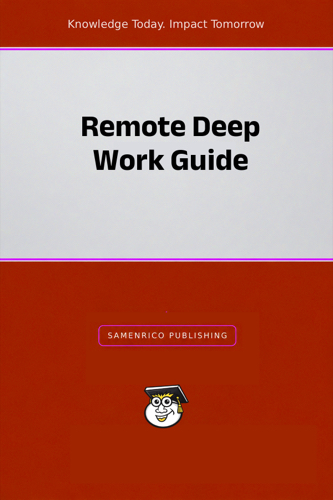
Remote Deep Work Guide eBook
undefined
by Gary Cordell
undefined
Formats
Free sample
Chapter 1: The Transparency Trap--The average remote knowledge worker produces only two hours and forty-eight minutes of meaningful output per day. The remaining five hours and twelve minutes are consumed by email, Slack messages, meetings, context switching, and what researchers politely call “administrative overhead.” But the truth is uglier than that. Most of those five hours are not work at all. They are performance.You are reading this book because something feels wrong. You close your laptop after ten hours and cannot name a single thing you accomplished.
You answered sixty emails, attended four meetings, replied to a hundred Slack messages, and moved files from one folder to another. You felt busy. You felt exhausted. You did not feel productive. And somewhere beneath the surface, you are terrified that your manager cannot see you working, so you keep the green Slack light on, you reply to messages at 10 PM, and you attend meetings just to be seen.This is not a failure of character.
This is a failure of architecture. Remote work did not create distraction. It merely removed the environmental guardrails that hid your existing poor attention management. In the office, the commute forced a transition. The closed door signaled focus.
The silent library floor enforced quiet. Your boss walking past your desk provided accountability. At home, all of those guardrails vanished overnight. What remained was you, your laptop, and a psychological nightmare that no one prepared you for: the terrifying freedom to work without being seen.This chapter exposes the hidden forces that are destroying your focus. You will learn why remote work feels harder than office work, why you cannot stop checking notifications, and why your brain has been hijacked by a system designed to keep you shallow.
More importantly, you will discover the single most important concept in this entire book: the Transparency Trap. Once you see it, you cannot unsee it. And once you cannot unsee it, you are ready to escape.The Day the Guardrails Disappeared Let us rewind to March 2020. You were sent home with a laptop and told to “keep working.” No training. No handbook.
No warning about what was coming. For the first few weeks, it felt liberating. No commute. No dress code. No manager hovering over your shoulder.
You could work in sweatpants. You could take a nap at lunch. You could finally breathe.Then something shifted.By June 2020, the novelty had worn off. You noticed that your days felt longer but your output felt shorter. You started working earlier and finishing later.
The boundaries between work and home dissolved. Your kitchen table became your desk. Your bedroom became your office. Your living room became the place where you answered emails while pretending to watch television.By December 2020, you were exhausted in a way you had never experienced before. Not physically exhausted.
Not even mentally exhausted in the way that feels satisfying after solving a hard problem. You were existentially exhausted. You had done so much and accomplished so little.You were not alone. Studies from 2021 through 2024 consistently show that remote workers report higher levels of burnout, longer working hours, and lower feelings of accomplishment than their office-based counterparts. But here is the twist that surprises everyone: remote workers also report having fewer distractions.
Fewer interruptions from coworkers. Fewer noisy open offices. Fewer pointless commutes.How can you have fewer distractions and less output? How can you work longer hours and feel less accomplished?The answer is not about the quantity of distractions. It is about the quality of your attention.
And the invisible architecture of remote work has been quietly rewiring your brain for something far worse than distraction. It has been rewiring you for performance.The Two Types of Work You Did Not Know Existed Before we can understand why remote work is breaking your focus, we need a vocabulary for what you actually do all day. Most people divide work into two categories: “real work” and “other stuff.” But that is too vague to be useful. Researchers who study knowledge work have identified a more precise distinction, and understanding it will change everything.Deep work is professional activity performed in a state of distraction-free concentration that pushes your cognitive capabilities to their limit. These efforts create new value, improve your skill, and are hard to replicate.
Examples include writing a proposal from scratch, analyzing a complex data set, coding a new feature, designing a strategy, or solving a difficult problem that requires sustained thinking. Deep work is what you were hired to do. It is what your resume claims you are good at. It is what separates you from someone who could be replaced by a well-written instruction manual.Shallow work is logistical, non-cognitively demanding tasks that can be performed while distracted. These tasks feel urgent but rarely create unique value.
Examples include answering routine emails, triaging Slack messages, scheduling meetings, filling out expense reports, moving files between folders, and attending status update meetings where no decisions are made. Shallow work is necessary in small doses. It becomes toxic when it consumes your day.Here is the problem. Deep work is invisible. When you are writing a proposal, your Slack status shows as idle.
When you are analyzing data, no one can see your brain working. When you are coding a feature, you appear to be staring at a screen doing nothing. Shallow work, by contrast, is highly visible. When you reply to an email, everyone sees the reply. When you answer a Slack message, the green light stays on.
When you attend a meeting, you appear in the calendar invite. When you send a message at 10 PM, you look dedicated.Remote work did not create the distinction between deep and shallow. But it weaponized the visibility gap between them. And that weapon has been aimed directly at your attention.The Transparency Trap Defined The Transparency Trap is a psychological phenomenon where remote workers feel compelled to prioritize visible activity over valuable output because they fear that invisible work will be mistaken for absence.Let me say that again in simpler terms. You are afraid that if your manager cannot see you working, they will assume you are not working.
So you do work that can be seen. You reply to emails instantly. You send messages after hours. You attend meetings you do not need to attend. You update your Slack status constantly.
You produce a steady stream of visible, shallow, performative activity to prove that you exist.The tragedy is that this works. Studies of remote management consistently show that managers rate employees as more productive when they are highly responsive to messages, even when their actual output is lower. This is called Visibility Bias, and it is the mirror image of the Transparency Trap. Managers suffer from Visibility Bias: they unconsciously trust what they can see. Employees suffer from the Transparency Trap: they consciously perform what can be seen.
Together, they form a vicious cycle that rewards shallow work and punishes deep work.Consider the following experiment conducted by researchers at Harvard Business School. Two groups of remote workers were given identical tasks. One group was instructed to send a status update every hour. The other group…
This is the end of the free sample. Get the eBook to keep going. Buy now
About this book
Details
- Author
- Gary Cordell
- Publisher
- SamEnrico
- Language
- English
- Genre
- Non-Fiction, Self-Help / Deep Work
- Released
- 2026-06-10
- Pages (approx.)
- 135
- Available as
- eBook, Audiobook

Read better in the ZLOADR app
Your eBooks on your phone or tablet. Sign in with your SamEnrico account and start reading.
More by Gary Cordell
 Nonprofit Goal FrameworkGary Cordell$11.99
 Jimmy Hoffa Deathbed Confessions WitnessesGary Cordell$11.99
 Self Esteem for Contract WorkersGary Cordell$11.99
 Burnout Recovery For Yoga TeachersGary Cordell$11.99
 Reward Satisfaction SchedulingGary Cordell$11.99
 Hamstring RecoveryGary Cordell$11.99
 Zillow Home Price EnvyGary Cordell$11.99
 Paper Hearts & PowerPoint NightsGary Cordell$11.99
 The Forgotten Pioneers: How 'Al-Fanous' Lit Up Arab TelevisionGary Cordell$11.99
 How to Produce Sock Knitting MachineryGary Cordell$11.99
 A Collector's Handbook to the Rover 25 (1931-33)Gary Cordell$11.99
 EU VAT on Cross Border ServicesGary Cordell$12.99