
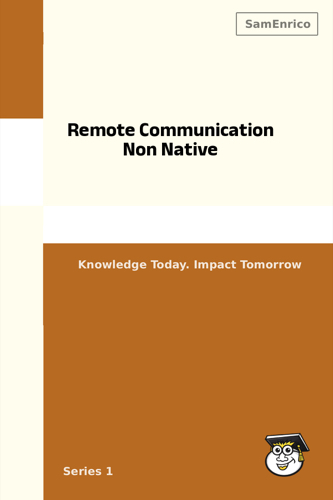
Remote Communication Non Native eBook
Write and speak clearly for colleagues with differ
by Wick Lottie
Write and speak clearly for colleagues with different language proficiencies.
Formats
Free sample
Chapter 1: The Exhaustion Gap--Every morning, Maria opens her laptop in São Paulo to join a meeting with colleagues in London, Singapore, and California. She is a brilliant supply chain analyst with fifteen years of experience. She speaks three languages. And by 10 a.m., she is completely exhausted.Not because the work is hard. Because the listening is hard.Maria’s story is not unique.
It is the story of 1.5 billion people who speak English as a second or additional language, working remotely across time zones, cultures, and video calls. And here is the truth that no one tells them: remote work was not designed for you.The platforms were built by native English speakers. The meeting cultures were shaped in London and New York. The “best practices” for virtual communication assume that everyone processes spoken language at the same speed, catches every idiom, and never needs to ask for clarification without feeling ashamed.But you are not the problem. The problem is the hidden tax that remote work places on non-native English speakers—a tax that is invisible to your native colleagues, quietly draining your energy, distorting your professional reputation, and leaving you wondering why you are so tired after a day of nothing but meetings.This chapter names that tax for the first time.
We call it the Exhaustion Gap.The Anatomy of Remote Injustice Let us start with a simple experiment. Imagine two employees in the same remote meeting: Anna, a native English speaker from Chicago, and Priya, a non-native speaker from Bangalore with excellent C1-level English.Both are listening to a fast-talking colleague from London who says: “We need to circle back on the Q3 deliverables before we bite the bullet on the new CRM rollout, but let’s not boil the ocean—just give me the thirty-thousand-foot view for now.”Anna hears: “We need to revisit Q3 work before committing to the new customer management system, but let’s not overcomplicate it—just give me the high-level summary.”Priya hears: “We need to… go in a circle? Something about bullets? Do not boil the ocean? Thirty thousand feet?
Is that a plane?”By the time Priya has finished translating the idioms, the meeting has moved on to the next agenda item. She missed the decision. She does not know what was asked of her. She feels slow. She says nothing.This is not a language problem.
This is a scaffolding problem.In a physical office, Priya would have had scaffolding—the whiteboard with bullet points, the handouts passed around, the ability to glance at a colleague’s notes, the quick whispered question after the meeting. Remote work has removed all of that. The video call is a bare wire: pure language, no context, no safety net.And for non-natives, that bare wire is electrified.Introducing the PING Framework To understand why remote work is disproportionately harder for non-natives, we need a shared language to diagnose the problem. Throughout this book, we will return to the PING framework—four specific gaps that create the Exhaustion Gap:Letter Gap What It Means PProductivity Gap Asynchronous tools (email, Slack) lack immediate clarification IImpression Gap Slower processing is mistaken for lower competence Ni Nterruption Gap Lag, noise, and overlap hurt non-natives more GGhost Gap Anxiety about being “left on read” or misunderstood Each chapter in this book will close one or more of these gaps. But first, we must understand how they operate.The Productivity Gap: Why Email Is Actually Harder Common sense says that asynchronous communication—email, Slack, project management tools—should be easier for non-natives.
You have time to think. You can use a dictionary. You can rewrite before sending.Common sense is wrong.The Productivity Gap is the hidden cost of not being able to ask for immediate clarification. In a live conversation, if you do not understand something, you can say “Sorry, what do you mean?” and get an answer in three seconds. In an email, that same question creates a twelve-hour delay—and that is if the person replies promptly.Consider this scenario: Your manager sends an email at 5 p.m.
your time: “Can you update the Jones deck with the new numbers and circle back before EOD?”You see it at 5:05 p.m. You do not know what “circle back” means in this context. Do they want a new meeting? A reply email? A comment in the deck?
You cannot ask—everyone else is offline until tomorrow morning. So you guess.You guess wrong. Tomorrow morning, you wake up to an annoyed message: “I said EOD. Where is the update?”The Productivity Gap is not about your English level. It is about the asymmetry of time.
Native speakers underestimate how long it takes non-natives to decode ambiguous messages, and they overestimate your ability to ask clarifying questions in real time.Closing the gap: In Chapter 3, we will introduce the BLUF method and the 3-sentence Slack rule to make your own writing unambiguous. In Chapter 12, we will explore AI tools that can help you decode ambiguous messages faster. But for now, recognize that the Productivity Gap is real, and it is not your fault.The Impression Gap: When Slower Looks Slower Here is a difficult truth. When a native speaker pauses for three seconds before answering a question, their colleagues think: “Thoughtful. Careful.
Measured.”When a non-native speaker pauses for three seconds, their colleagues think: “Slow. Unsure. Maybe they do not understand.”The Impression Gap is the systematic bias where the same behavior—taking time to process language—is interpreted differently based on whether the speaker has an accent or a perceived language gap. This is not conscious prejudice; it is cognitive fluency bias. Humans naturally trust things that are easy to process.
Fluent speech is easy to process. Slower, accented, or halting speech feels harder, and our brains mistakenly equate “harder to listen to” with “less competent.”This bias has measurable career consequences. A study by the Harvard Business Review found that non-native speakers with perfectly good English were rated as 20% less competent than native speakers delivering the exact same content, solely because of accent and pacing differences.In remote work, the Impression Gap is magnified. Without physical presence, body language, or informal interactions to build your reputation, every pause feels longer. Every request for repetition feels like an admission of failure.
Every moment of silence feels like a judgment.Closing the gap: In Chapter 6, we will transform your relationship with pauses—turning them from liabilities into leadership tools. In Chapter 9, we will give you scripts to interrupt bias directly. But for now, know that the Impression Gap is a bias against you, not a deficiency in you.The i Nterruption Gap: Why Lag Is Your Enemy Remote meetings have three enemies: audio lag, background noise, and overlapping speech. For native speakers, these are annoyances. For non-natives, they are barriers to comprehension.Consider the cognitive load of listening in your non-native language.
Your brain is already doing three things simultaneously: (1) decoding individual words, (2) parsing grammar and sentence structure, and (3) assembling meaning. Add a 0.5-second audio delay, and your brain must also hold the first half of the sentence in…
This is the end of the free sample. Get the eBook to keep going. Buy now
About this book
Details
- Author
- Wick Lottie
- Publisher
- SamEnrico
- Language
- English
- Genre
- Non-Fiction, Self-Help, ESL
- Released
- 2026-06-09
- Pages (approx.)
- 126
- Available as
- eBook, Audiobook

Read better in the ZLOADR app
Your eBooks on your phone or tablet. Sign in with your SamEnrico account and start reading.
More by Wick Lottie
 Menstrual Health Myths DebunkedWick Lottie$11.99
 Prostitution Solicitation Addiction Recovery WorkbookWick Lottie$11.99
 Jungian Dreamwork for TraumaWick Lottie$11.99
 The MBSR for Veterans GuideWick Lottie$11.99
 The Spy of Olympus: Athena’s Shadow NetworkWick Lottie$11.99
 Hops & Heists: The Untold Story of the Great Beer Robbery of 1974Wick Lottie$11.99
 Green Hydrogen Derivatives OutlookWick Lottie$12.99
 Regional Australia PR After Study ManualWick Lottie$12.99
 How to Become a Needle PolisherWick Lottie$11.99
 Ecommerce AssociateWick Lottie$11.99
 Understanding HelminthiasisWick Lottie$17.99
You may also like
 Self Esteem for English LearnersFaulkner Treena$11.99
 The Non Native Speaker GuidePipkin Regan$11.99
 The EQ for Non Native SpeakersCowan Normand$11.99
 NVC For Non Native English SpeakersTran Roderick$11.99
 NVC for ESL LearnersGoodwin Natasha$11.99
 The Assertiveness for Non Native SpeakersFreund Tyree$11.99
 English Second Language EsteemEnnis Lynwood$11.99
 Assertive Communication for ESL SpeakersBrill Tonie$11.99
 Assertiveness for ESL SpeakersLeyva Elene$11.99
 Public Speaking for Non Native SpeakersDortch Bertie$11.99