
Non-FictionSelf-HelpEmail Etiquette
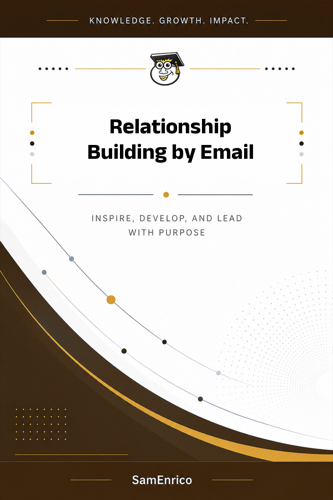
Relationship Building by Email eBook
Craft professional messages that get responses and
by Hardin Rocio
Craft professional messages that get responses and build rapport.
Formats
Free sample
Chapter 1: The Ghosting Epidemic...--Chapter 1: The Ghosting Epidemic You have been ghosted.Not on a dating app. Not by a friend who stopped returning texts. In your professional life, by people who owe you answers, approvals, or simply the courtesy of a reply. You sent what you thought was a clear, polite, perfectly reasonable email. And then nothing.
Silence. The digital equivalent of someone turning around and walking away while you are mid-sentence.It feels personal. It feels disrespectful. And if you are like most professionals, you have responded to this silence in one of two ways. Either you sent a passive-aggressive follow-up—“Just circling back on my email from last week”—which made you feel small and annoyed.
Or you sent nothing at all, assuming the person is rude, disorganized, or both, and quietly resented them ever since.Here is the truth that will transform how you write every email from this moment forward: They were not ignoring you. They were overwhelmed by you.This chapter is about why that happens, why it is almost never malicious, and how a single shift in mindset—from broadcasting to designing, from assuming laziness to assuming busyness—will turn you into the kind of email writer people actually want to reply to. By the end of this chapter, you will understand the psychology of ghosting, the anatomy of the emails that cause it, and a simple ninety-second exercise that will change how you approach every message you send.The Million-Dollar Email That Died in an Inbox Let me tell you about Sarah. Sarah was a senior account director at a mid-sized marketing agency. She had been trying to close a deal for eight months with a potential client—let us call them Global Retail.
The deal was worth $2.3 million annually. Sarah had done everything right. She had flown to their headquarters. She had taken their leadership team to dinner. She had revised the proposal six times based on their feedback.Then came the final email.Sarah spent two hours crafting it.
She included the revised scope of work, three case studies, a detailed timeline, pricing options A and B, a list of references, and a warm note about how much she had enjoyed getting to know the team. She hit send at 4:47 PM on a Thursday.She never heard from them again.Not a “no.” Not a “let us think about it.” Nothing. When she finally reached out to her contact via Linked In two weeks later, he said: “Oh, sorry. That email was so dense I kept meaning to get back to it, and then it just got buried. I assumed you would follow up.”Sarah’s $2.3 million email did not die because her proposal was bad.
It died because it was overwhelming. It asked the recipient to do too much work—to read, to analyze, to compare, to decide—without any clear signal of what action mattered most or why the recipient should care enough to act.This is the ghosting epidemic. And it is costing businesses billions of dollars a year in lost opportunities, delayed projects, and fractured relationships.Why Your Clear Email Is Not Actually Clear Here is the uncomfortable truth that every professional needs to hear: You are not as clear as you think you are.Psychologists call this the curse of knowledge. Once you know something—once you have spent two hours thinking about a proposal, once you have reviewed a document four times, once you have lived inside a project for three months—you literally cannot remember what it was like not to know it. Your brain fills in gaps automatically.
You assume the reader shares your context, your urgency, your understanding of what matters.They do not.When you write an email, you are standing at the center of your own universe. Every detail feels important. Every background fact feels necessary. Every option you include feels like helpful flexibility. You are broadcasting information, and you believe you are being generous with your clarity.When the recipient opens that email, they are standing at the center of their universe.
They have eleven other unread emails. Their boss just pinged them about a different project. They have forty-three minutes until their next meeting. They are not looking for generosity. They are looking for a reason to care or an excuse to defer.Your densely packed email, full of options and context and case studies, does not look clear to them.
It looks like work. And human beings are exquisitely designed to avoid work that does not come with an immediately obvious reward.This is the intention-impact gap. You intended clarity. Your dense paragraph created confusion. You intended collaboration.
Your open-ended question created paralysis. You intended respect. Your long email created a feeling of being burdened.The gap between intention and impact is where relationships go to die.The Psychology of Ghosting: It Is Not About You Let me be very direct about something that most email guides dance around. When someone does not reply to your email, it is almost never because they are a bad person, or they hate you, or they are deliberately trying to make your life difficult.It is because of one of three psychological forces, all of which are predictable, all of which are avoidable, and none of which are personal.Force One: Analysis Paralysis The human brain has a limited amount of cognitive bandwidth—what psychologists call working memory. When you present someone with too many options, too much information, or too many requests, their brain does not think, “How helpful, let me carefully consider each option.” Their brain thinks, “This is too much.
I will deal with it later.”Later never comes.If your email asks someone to choose between Option A and Option B, review three attachments, consider two different timelines, and then get back to you with their thoughts, you have not sent a request. You have sent a homework assignment. And people hate homework.Force Two: Unclear Benefit Every email the recipient opens triggers an unconscious calculation: What is in this for me? If the answer is not immediately obvious—within the first five seconds—the email gets deferred or deleted.Most professionals write emails that answer the question “What do I need?” They rarely answer the question “Why should you care?” Your email might say: “Please review the attached Q3 budget and provide feedback.” That tells the recipient what you need. It does not tell them why they should care.
The unspoken, and often correct, assumption is: “If I do not review this, nothing bad will happen to me. If I do review this, nothing good will happen to me either. So I will do it never.”Force Three: Low Psychological Safety This is the sneakiest and most damaging force. Many emails go unanswered not because the recipient is busy, but because the email felt vaguely threatening. A phrase like “As I mentioned in our last conversation” creates a defensive posture.
An opening like “I am concerned about the timeline” without a clear invitation to collaborate creates anxiety. When people feel unsafe—even in the mild, professional sense of “I might be blamed for something”—they do…
This is the end of the free sample. Get the eBook to keep going. Buy now
About this book
Details
- Author
- Hardin Rocio
- Publisher
- SamEnrico
- Language
- English
- Genre
- Non-Fiction, Self-Help, Email Etiquette
- Released
- 2026-06-09
- Pages (approx.)
- 137
- Available as
- eBook, Audiobook

Read better in the ZLOADR app
Your eBooks on your phone or tablet. Sign in with your SamEnrico account and start reading.
More by Hardin Rocio
 Med Student Stress ManagementHardin Rocio$11.99
 Binge Eating Shame Resilience WorkbookHardin Rocio$11.99
 Caregiver Time ManagementHardin Rocio$11.99
 TENS Unit for Menstrual PainHardin Rocio$11.99
 The Golden Key: Ahmed Zewail and the Birth of FemtochemistryHardin Rocio$11.99
 The Last Dance of the FirewalkersHardin Rocio$11.99
 Director of Customer ExperienceHardin Rocio$11.99
 Voiceover Headphone GuideHardin Rocio$12.99
 Breach Notification ChecklistHardin Rocio$12.99
 How to Become a Automobile UpholstererHardin Rocio$11.99
 Understanding Ectodermic Dysplasia Anhidrotic Cleft LipHardin Rocio$17.99
You may also like
 Hong Kong Handover 1997Dunn Johnnie$11.99
 Zumba For Postnatal Recovery CourseNeal Christian$11.99
 Zumba for BeginnersLadner Nikia$11.99
 YouTube Comment Mining GuideHumes Pandora$12.99
 Worry Box MeditationCarlin Rudy$11.99
 Workplace Stress MeditationNguyen Lynn$11.99
 Workplace Stress and Sleep RepairHawley Ivory$11.99
 Workplace Perfectionism CureDelaney Jeffry$11.99
 Workplace Injustice Anger GuideWallen Isabelle$11.99
 Work Addiction and Burnout LinkGreenwood Ester$11.99
 Women in Yoga and WellnessBeattie Galina$11.99
 Women in Stand Up ComedyChun Evangeline$11.99