
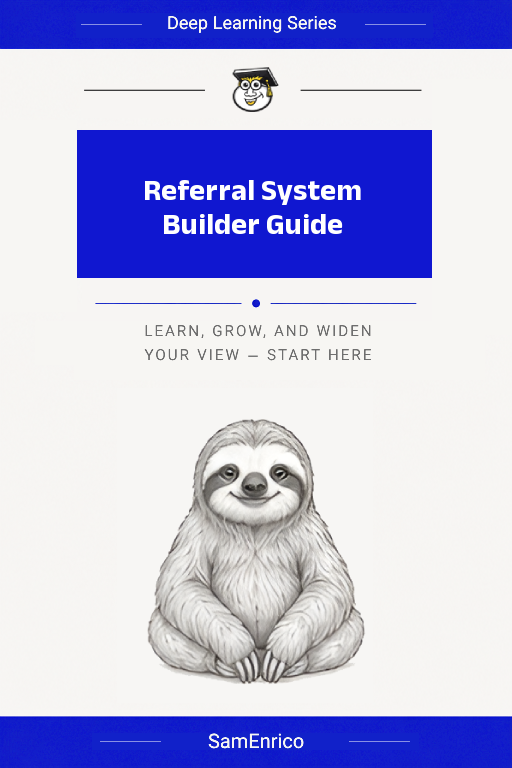
Non-FictionSide Hustle ArchitectReferrals
Referral System Builder Guide eBook
Get Chinese students through parent referrals and
Get Chinese students through parent referrals and word of mouth. Offer referral bonuses, sibling discounts, and showcase testimonials from happy families.
Formats
Free sample
Chapter 1: The ¥500,000 Mistake--–- Principal Li sat in his empty office on a Sunday afternoon, staring at a spreadsheet that made his stomach turn. Three years ago, he had opened the doors to "Li's Elite English Academy" with twenty eager students and a heart full of optimism. Now, he had ninety students—and a mountain of regret.The spreadsheet showed his marketing expenses for the past twelve months. Douyin ads: ¥180,000. Baidu search placements: ¥120,000.
We Chat Moments ads: ¥95,000. Various agencies and consultants: ¥105,000. Total: ¥500,000. And what had that half a million yuan bought him? Twelve new students.
Twelve.That was ¥41,666 per student.Across town, a school called "Sunrise English" had opened the same month as Li's. They had no marketing budget to speak of. No Douyin ads, no Baidu placements, no agency fees. In three years, they had grown from twenty students to two hundred. Their secret?
They didn't have one. They simply asked happy parents to tell their friends—and then made it easy for them to do so.Principal Li had never asked for a referral. He thought it felt desperate. He thought his results should speak for themselves. He was wrong.
And that ¥500,000 mistake would become the opening case study of this book.The Trust Deficit You Didn't Know You Had Every education entrepreneur in China faces the same hidden enemy. It is not competitors, not government regulations, not even the dreaded "double reduction" policies. The real enemy is something far more insidious: the widening gap between what you claim and what parents believe.Call this the Trust Deficit.For the past decade, the Chinese education market has been flooded with scandals. Tutoring centers that promised Ivy League admissions but delivered nothing. English programs that claimed "native speaker teachers" who could barely hold a conversation.
Test prep academies that took millions in prepayments and vanished overnight. Each scandal added another brick to the wall of skepticism that now surrounds every parent's decision-making process.Consider the data. A 2023 survey of 2,500 urban Chinese parents asked a simple question: "When you see an advertisement for an education service, what is your first reaction?" Seventy-eight percent responded with some version of "They are trying to trick me." Only twelve percent said "I am curious to learn more." The remaining ten percent said "I ignore all ads."This is not paranoia. This is learned behavior. Chinese parents have been burned too many times.
Their psychological armor against advertising is now so thick that even the most well-produced Douyin commercial barely registers. They scroll past, swipe away, or—worst of all—actively distrust the very schools that could actually help their children.But here is the paradox that will define everything in this book: those same parents absolutely trust other parents.When a friend recommends a school, the skepticism evaporates. The armor comes off. The parent listens, asks questions, and—most importantly—acts. A referral from a trusted peer bypasses every defense mechanism that advertising triggers.
It is not marketing. It is not selling. It is simply one human helping another avoid a mistake.The Blame-Shifting Formula To understand why referrals work in China—and why ads fail—you must understand what keeps parents awake at night.For a Chinese parent, the worst-case scenario is not wasting money. Money can be earned again. The worst-case scenario is losing face by choosing the wrong school for their child.
Face—mianzi—is not vanity. It is social currency. It is the reputation that follows a parent through We Chat groups, school pickup lines, and family gatherings. Choose a bad school, and that reputation takes a hit that can last for years.Now watch how this psychology interacts with different sources of information.When a parent follows an advertisement, they bear 100% of the risk. If the school fails, the parent cannot say, "But the ad told me to go there." That excuse holds no social weight.
Everyone knows ads are biased. The parent made the choice alone, and they suffer the consequences alone. This is Solo Risk.When a parent follows a friend's recommendation, the risk is shared. If the school fails, the parent can say, "But Li Wei's mother said it was excellent." The blame diffuses. The recommending parent shares the burden of the bad outcome.
This is Shared Risk.Here is the formula that every school owner must memorize:Ad = Solo Risk → Parent avoids at all costs Referral = Shared Risk → Parent actively seeks out This is not subtle psychology. It is survival instinct. Chinese parents are not being difficult when they ignore your beautifully produced ads. They are being rational. They are protecting their family's social standing.
And until you accept this reality, every yuan you spend on performance marketing is likely wasted.The Bamboo Network vs. The Concrete Square Information travels differently in China than in almost any other market. Understanding these channels is the difference between spending money and making money.Public forums—Douyin, Xiaohongshu, Weibo, Baidu—are what we call "Concrete Squares." They are open, visible, and searchable. Anyone can post. Anyone can view.
But here is the critical insight: Concrete Squares are for discovery, not validation. A parent might see your school on Xiaohongshu. They might even save the post. But they will not enroll based on that alone.Private channels—We Chat groups, in-person conversations, voice messages between friends—are the "Bamboo Network." They are invisible to outsiders, flexible, and built on existing relationships. Information travels through the Bamboo Network slowly but powerfully.
And here is the truth that most marketing books get wrong: validation happens exclusively in the Bamboo Network.A parent might see your ad on Douyin. Then they will open We Chat and ask their mom group: "Has anyone heard of Li's Elite English Academy?" If three people say, "Yes, my child goes there and loves it," the deal is half done. If zero people respond, the ad might as well have never existed.This is why your advertising budget is largely wasted if you do not have a corresponding presence in the Bamboo Network. You are driving parents to a question—"Is this school any good?"—without giving them a place to find the answer.The Queen Bee in Every Hive Not all parents are created equal. In every We Chat group, every school pickup line, every neighborhood gathering, there is a parent whom other parents silently follow.
Call her the Queen Bee.You can spot her by four characteristics:First, she posts frequently. Not spam, but valuable content. Links to educational resources. Questions about teaching methods. Announcements about school events.
She is visible.Second, she asks sharp questions. When the school sends a notification, she is the one who asks for clarification. When a policy changes, she asks about the rationale. Other parents read her questions and her answers.Third, she shares resources. A study guide she found.
A video her child loved. A tip for managing homework stress. She gives value without being asked.Fourth—and most importantly—her child is visibly successful. The Queen Bee's child does not need to be the top of the class, but there must be clear evidence of progress. Better grades.
More confidence. A prize from a competition. Other parents see the results and want the same for their children.The Queen…
This is the end of the free sample. Get the eBook to keep going. Buy now
About this book
Details
- Author
- Hamilton Karla
- Publisher
- SamEnrico
- Language
- English
- Genre
- Non-Fiction, Side Hustle Architect, Referrals
- Released
- 2026-05-29
- Pages (approx.)
- 124
- Available as
- eBook, Audiobook

Read better in the ZLOADR app
Your eBooks on your phone or tablet. Sign in with your SamEnrico account and start reading.
More by Hamilton Karla
 The Art of Giving Without ExpectationHamilton Karla$11.99
 Stress and New Parent RelationshipHamilton Karla$11.99
 Enteric Nervous System Second BrainHamilton Karla$11.99
 Diaphragm Fitting GuideHamilton Karla$11.99
 The Scholars of Great Zimbabwe: Architects of Stone and KnowledgeHamilton Karla$11.99
 How to Produce Basketball Hoop PostsHamilton Karla$11.99
 How to Start a Hobby in CartooningHamilton Karla$11.99
 Data Science AnalystHamilton Karla$11.99
You may also like
 Hong Kong Handover 1997Dunn Johnnie$11.99
 Zumba For Postnatal Recovery CourseNeal Christian$11.99
 Zumba for BeginnersLadner Nikia$11.99
 YouTube Comment Mining GuideHumes Pandora$12.99
 Worry Box MeditationCarlin Rudy$11.99
 Workplace Stress MeditationNguyen Lynn$11.99
 Workplace Stress and Sleep RepairHawley Ivory$11.99
 Workplace Perfectionism CureDelaney Jeffry$11.99
 Workplace Injustice Anger GuideWallen Isabelle$11.99
 Work Addiction and Burnout LinkGreenwood Ester$11.99
 Women in Yoga and WellnessBeattie Galina$11.99
 Women in Stand Up ComedyChun Evangeline$11.99