
Non-FictionStrategic AtlasReferral Programs
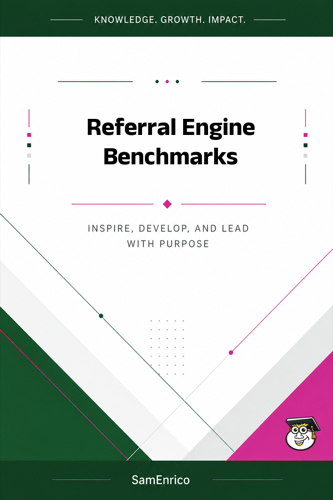
Referral Engine Benchmarks eBook
Study employee referral programs of firms that fil
by Chun Roselyn
Study employee referral programs of firms that fill over 40 percent of roles internally.
Formats
Free sample
Chapter 1: The Seven Numbers...--–- Most companies measure their referral program by exactly one number: how many people were hired. That is like flying a commercial airliner using only a single altimeter while ignoring fuel, speed, heading, and weather. You will eventually crash.The head of talent acquisition at a mid-sized software company once told me, with genuine pride, that her referral program had delivered forty-seven hires in the past year. She had a bar chart. She had a pie chart showing which departments those hires entered.
She had calculated the average bonus paid per hire. She believed she was running a world-class program.Then I asked her three questions she could not answer.What percentage of referred candidates received an interview within forty-eight hours? She did not track that. What was the retention difference between her referral hires and her agency hires at the eighteen-month mark? She had never compared.
And most tellingly, what percentage of her employees had referred even one person in the past twelve months? She guessed. Her guess was wrong by a factor of six.Her company was leaving approximately two million dollars on the table every year. Not because they had a bad program. Because they were measuring the wrong things.This chapter fixes that.You will learn the seven key performance indicators that separate elite referral programs—the ones that fill over forty percent of roles internally—from the ninety-five percent of companies that muddle along with mediocre results.
You will learn the specific benchmark targets for each metric. You will learn how to calculate them with data you almost certainly already have. And you will learn why measuring the wrong numbers is worse than measuring nothing at all.The Lagging Indicator Trap Most recruiting organizations suffer from what measurement experts call lagging indicator bias. They focus on outcomes that have already happened—hires made, bonuses paid, time elapsed—rather than leading indicators that predict future performance.A lagging indicator tells you what happened. A leading indicator tells you what is about to happen.In referral programs, the ultimate lagging indicator is "referral hires." It is important.
You cannot run a business without eventually counting revenue. But by the time you count referral hires, the decisions that produced them happened weeks or months ago. You cannot intervene. You cannot correct course. You can only celebrate or regret.Leading indicators, by contrast, give you leverage.
They show you the health of the system before results manifest. They allow you to turn the steering wheel rather than just reading the crash report.The seven KPIs in this chapter are leading indicators. Each one predicts something about your future referral performance. Each one can be measured weekly or even daily. Each one has a clear benchmark drawn from the top five percent of companies—the ones we call the 40 Percent Club.A brief note before we dive into the numbers.
Throughout this book, we distinguish between three tiers of referral program maturity. Tier One companies fill ten to twenty percent of roles via referrals. They have a program but it is inconsistent. Tier Two companies fill twenty to thirty percent. They have momentum but have not achieved escape velocity.
Tier Three companies fill over thirty percent, with the elite among them exceeding forty percent. These benchmarks are drawn from Tier Three performance. If you are in Tier One or Tier Two, do not be discouraged. These targets are aspirational. They are also achievable.Let us begin.KPI Number One: Time-to-Hire for Referrals Versus Other Sources The single most expensive variable in recruiting is not the cost of a job board posting or even the size of a referral bonus.
It is time.Every day a role remains unfilled, work does not get done. Revenue is not generated. Projects are delayed. Other employees shoulder the load, risking burnout. For a sales role, each vacant day might represent tens of thousands of dollars in lost opportunity.
For a software engineering role, each vacant day pushes product launches further into the future.Here is the data point that should be on every CEO's dashboard: referral hires take a median of twenty-nine days from submission to offer acceptance. Job board hires take fifty-five days. Agency-placed candidates take even longer, often sixty to ninety days depending on the search firm's contract structure.The twenty-six day difference is not trivial. It is transformative.Let me put numbers on this. Assume a role with an annual salary of one hundred twenty thousand dollars.
The fully loaded cost of that role—including benefits, workspace, equipment, and management overhead—is typically one point five to two times base salary. Let us use one point eight times, or two hundred sixteen thousand dollars per year. That breaks down to approximately eight hundred thirty dollars per working day.If a referral fills that role twenty-six days faster than a job board hire, the organization saves approximately twenty-one thousand five hundred eighty dollars in vacancy cost. That is before counting the referral bonus, which we will discuss later. That is before counting the quality difference, which we will also discuss later.
That is just the cost of the seat being empty.Here is the benchmark: Tier Three companies measure time-to-hire separately for each sourcing channel. They know, to the day, how long referrals take compared to job boards, compared to agencies, compared to career site applicants. And they use that data to allocate recruiter attention. When a referral comes in, it gets prioritized because the data shows it will fill faster.How to calculate this metric. For each hire, record the date the referral was submitted and the date the offer was accepted.
Subtract. Take the median—not the average, because outliers will distort—across all referral hires in the past quarter or past year. Do the same for job board hires, agency hires, and any other channel you use. Compare.The target is under thirty days for referrals. Tier Three companies often achieve twenty-five or even twenty-two days for high-priority roles.
If your referral time-to-hire is above forty days, you have a process problem, not a people problem. Candidates are slipping through cracks. Recruiters are moving too slowly. Or your ATS is creating delays. We will address all of these in Chapter Five.KPI Number Two: Quality of Hire Through Retention and Performance Speed matters.
But speed without quality is just fast failure.The most reliable proxy for quality of hire is retention. Not retention at ninety days, when most referral bonuses vest, but retention at one year and two years. A hire who stays for twelve months is a good investment. A hire who stays for twenty-four months is a great investment. A hire who leaves at month six was a mistake, regardless of how fast they were hired.Here is the data that should stop every recruiting leader from relying on job boards alone: referral hires have forty-six percent higher one-year retention than hires from all other sources combined.Let me repeat that because it is easy to skim past.
Forty-six percent higher. Not four point six percent. Forty-six percent.Across the dataset of over five hundred companies analyzed for this book, referral hires stayed…
This is the end of the free sample. Get the eBook to keep going. Buy now
About this book
Details
- Author
- Chun Roselyn
- Publisher
- SamEnrico
- Language
- English
- Genre
- Non-Fiction, Strategic Atlas, Referral Programs
- Released
- 2026-06-09
- Pages (approx.)
- 125
- Available as
- eBook, Audiobook

Read better in the ZLOADR app
Your eBooks on your phone or tablet. Sign in with your SamEnrico account and start reading.
More by Chun Roselyn
 Mindful Coffee Drinking GuideChun Roselyn$11.99
 The Complicated Grief Art Therapy GuideChun Roselyn$11.99
 Charles Spurgeon Prince of PreachersChun Roselyn$11.99
 The Zoom Body Language PrimerChun Roselyn$11.99
 The Phantom of the Andes: The Amnesiac Bandit Who Vanished into LegendChun Roselyn$11.99
 Understanding Strumpell–lorrain DiseaseChun Roselyn$17.99
 MSC Certification Export GuideChun Roselyn$12.99
 Shopping Channel PreferencesChun Roselyn$12.99
 How to Start a Cider Pectin Business (Beginners Guide)Chun Roselyn$11.99
 CPR InstructorChun Roselyn$11.99
You may also like
 Hong Kong Handover 1997Dunn Johnnie$11.99
 Zumba For Postnatal Recovery CourseNeal Christian$11.99
 Zumba for BeginnersLadner Nikia$11.99
 YouTube Comment Mining GuideHumes Pandora$12.99
 Worry Box MeditationCarlin Rudy$11.99
 Workplace Stress MeditationNguyen Lynn$11.99
 Workplace Stress and Sleep RepairHawley Ivory$11.99
 Workplace Perfectionism CureDelaney Jeffry$11.99
 Workplace Injustice Anger GuideWallen Isabelle$11.99
 Work Addiction and Burnout LinkGreenwood Ester$11.99
 Women in Yoga and WellnessBeattie Galina$11.99
 Women in Stand Up ComedyChun Evangeline$11.99