
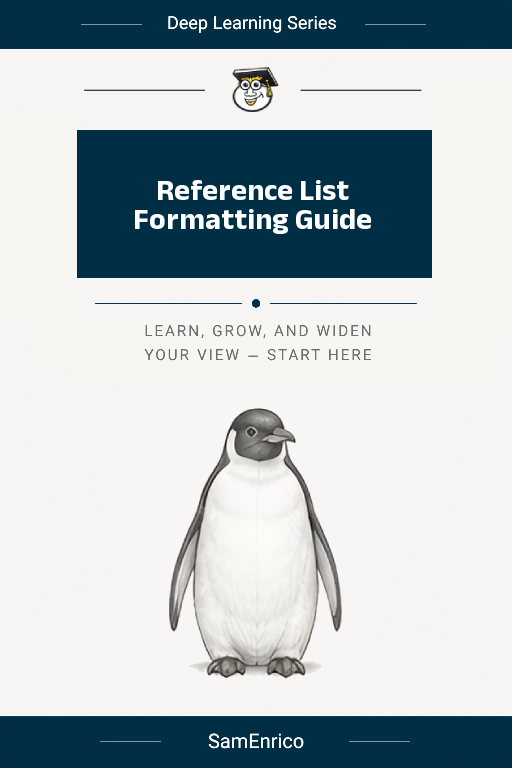
Reference List Formatting Guide eBook
Alphabetize, indent, and space reference lists cor
Alphabetize, indent, and space reference lists correctly for APA, MLA, and Chicago.
Formats
Free sample
Chapter 1: The Silent Killer--Every semester, millions of students lose points on papers they worked dozens of hours to complete. Professors deduct grades for reasons that have nothing to do with research quality, argument strength, or writing clarity. The culprit is almost invisible, hiding at the very end of the document where few people look carefully. It is the reference list. And it is failing you.Consider Sarah, a third-year psychology major at a large state university.
She spent six weeks researching her literature review on attachment theory in adolescent development. She read forty-seven peer-reviewed articles. She wrote twelve pages of original analysis. Her argument was sharp. Her prose was clean.
Her professor returned the paper with a B-minus. The margin note read: "Excellent content. Multiple formatting errors in References section. Review APA 7th edition guidelines."Sarah lost nearly two full letter grades. Not because her research was flawed.
Not because her writing was weak. Because her reference list had inconsistent spacing, incorrectly alphabetized entries, and hanging indents that were applied to only half the citations.Sarah is not alone. A 2023 survey of college writing centers across the United States found that reference list formatting errors are the single most common reason students visit for help after receiving graded papers—more common than thesis development, paragraph structure, or even grammar. The same survey found that 68 percent of professors consider reference list formatting when assigning final grades, and 42 percent admit they have lowered a paper's grade solely due to citation and formatting errors.This book exists because that should never happen to you again.The Hidden Cost of Formatting Errors Reference list formatting seems like a small thing. A few spaces here.
A few indentations there. What difference could it possibly make? The answer, surprisingly, is enormous. And the reasons go far beyond simple grade grubbing.First, formatting errors signal something deeper to professors and editors. When a student submits a paper with a perfectly formatted reference list, it communicates attention to detail, respect for the assignment, and mastery of academic conventions.
When a student submits a paper with obvious formatting errors, it communicates the opposite: carelessness, rushing, or a lack of basic competence. Fair or not, professors interpret formatting as a proxy for the quality of your thinking. If you couldn't be bothered to learn where the period goes in a journal article citation, the reasoning goes, how can I trust the precision of your analysis?Second, reference list formatting errors create real barriers to communication. The entire purpose of a reference list is to allow readers to locate your sources. When formatting is inconsistent or incorrect, readers waste time deciphering what you meant instead of finding the source.
A missing issue number, an incorrectly italicized title, a misplaced publication year—any of these can send someone hunting through database searches for ten minutes when it should have taken thirty seconds.Third, in professional academic contexts, formatting errors can kill your career before it starts. Journal editors receive thousands of submissions each year. They spend an average of ninety seconds on the initial screening of each manuscript. A paper that arrives with obvious citation formatting errors is often rejected without review. The editor assumes that if you didn't follow the journal's reference guidelines, you probably didn't follow other submission requirements either.
Your brilliant research never even reaches peer review.I have seen this happen to graduate students submitting their first journal articles. I have seen it happen to postdoctoral fellows applying for academic positions. I have seen it happen to established researchers who got lazy or overconfident. Formatting errors do not discriminate by experience level.The Truth About Academic Citation Styles Before we dive into the mechanics of fixing your reference list, you need to understand why citation styles exist in the first place. They are not arbitrary inventions designed to torture students.
They emerged organically from different academic disciplines, each with its own values, priorities, and ways of knowing.APA Style: The Social Sciences Standard The American Psychological Association created its citation style in 1929. The original goal was simple: create a set of rules that would make scientific writing more readable and consistent. APA style prioritizes the currency of research, which is why the publication date appears immediately after the author's name in citations. Social scientists care deeply about how recent a study is because knowledge in fields like psychology, sociology, and education evolves rapidly. A study from 1985 might be completely obsolete; a study from 2023 might be cutting edge.
The date positioning reflects that value.APA style also emphasizes the systematic accumulation of knowledge. Every citation includes enough information for another researcher to locate the exact source you used. This allows for replication, verification, and extension of findings. APA is used primarily in psychology, education, nursing, business, communication studies, and the social sciences more broadly.MLA Style: The Humanities Standard The Modern Language Association developed its citation style for a very different purpose. Humanities disciplines like literature, philosophy, and language studies care less about publication dates and more about the integrity and provenance of texts.
In MLA style, the author's name and page number appear in parenthetical citations, not the publication date. This reflects the humanistic value of engaging directly with the source text itself, regardless of when it was written.MLA style also emphasizes the concept of "containers"—the idea that sources are often nested within larger sources. A journal article is contained within a journal. A chapter is contained within a book. A television episode is contained within a series.
The ninth edition of the MLA Handbook, published in 2021, refined this container system to handle the complexities of digital sources. MLA is used primarily in literature, languages, composition studies, cultural studies, and related humanities fields.Chicago Style: The History and Publishing Standard The Chicago Manual of Style, first published in 1906 by the University of Chicago Press, serves two distinct audiences: academic writers and professional publishers. Chicago offers two citation systems: the notes-bibliography system (preferred in history, arts, and humanities) and the author-date system (similar to APA, preferred in some social sciences).The notes-bibliography system is distinctive because it uses footnotes or endnotes for in-text citations rather than parenthetical references. This reflects historical practice—footnotes have been used for centuries to provide commentary and citations without interrupting the main text. Historians value this approach because it allows them to provide extensive commentary on sources, evaluate conflicting evidence, and direct readers to archival materials that may not follow standard citation formats.
Chicago is used primarily in history, some humanities fields, and book publishing.Why Three Styles When One Would Do?If you are frustrated by the existence of three major citation styles, you are not alone. Many students ask why they cannot simply learn one system and use it for every class. The answer lies in the different values of academic disciplines.A psychologist and a literary critic approach sources differently. The psychologist asks: "Is this research current? Does it build on previous findings?
Can I replicate it?" The literary critic asks: "What edition of this text is authoritative? How does this passage relate to the whole work? What is the textual history?" These different questions require different citation conventions.Learning…
This is the end of the free sample. Get the eBook to keep going. Buy now
About this book
Details
- Author
- Mccombs Londa
- Publisher
- SamEnrico
- Language
- English
- Genre
- Non-Fiction, Student's Shortcut, Reference List
- Released
- 2026-06-01
- Pages (approx.)
- 155
- Available as
- eBook, Audiobook

Read better in the ZLOADR app
Your eBooks on your phone or tablet. Sign in with your SamEnrico account and start reading.
More by Mccombs Londa
 Experiencing Mental ObjectsMccombs Londa$11.99
 DBT Emotion Regulation BasicsMccombs Londa$11.99
 Pelvic Floor Yoga SequenceMccombs Londa$11.99
 Emotion Regulation For Empty NestMccombs Londa$11.99
 The 80 20 Priority MatrixMccombs Londa$11.99
 Antwerp Heist Insurance PayoutMccombs Londa$11.99
 Statin Therapy GuideMccombs Londa$11.99
 Gregg Braden MatrixMccombs Londa$11.99
 The Lost Druids of Anglesey: Blood Moon RebellionMccombs Londa$11.99
 The Great Emoji Heist: How a Tiny Image Sparked a Global ScandalMccombs Londa$11.99
 How to Produce Hair Permanents and StraightenersMccombs Londa$11.99
 Retail and Sales Student HandbookMccombs Londa$12.99