
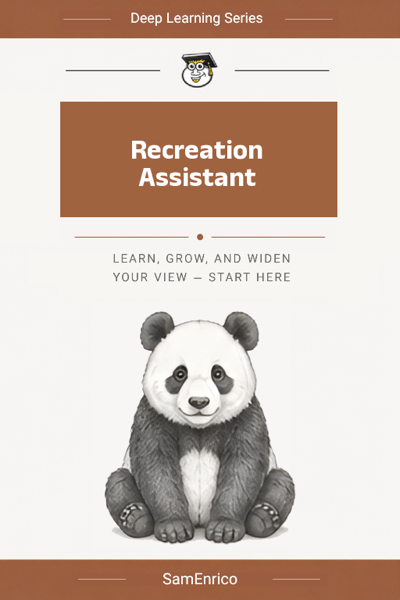
Non-FictionInformativeEducational
Recreation Assistant eBook
A Coursebook on Recreation Assistant
A Coursebook on Recreation Assistant
Formats
Free sample
Chapter 1: The Fun Paradox--–- On a Tuesday morning in a dimly lit activity room at Meadowbrook Senior Living, a seventy-three-year-old retired engineer named Harold sat slouched in his wheelchair, arms crossed, refusing to look at the table where a stack of puzzle pieces waited. The Recreation Assistant on duty, a twenty-two-year-old named Maya who had been on the job for just three weeks, had been told by her supervisor that Harold "never participates." She had also been told, in the same breath, that her job was to "keep residents engaged." For three weeks, Maya had tried everything she could think of: bingo, music trivia, balloon volleyball, even a pet therapy visit. Harold refused every single one. On that Tuesday morning, Maya sat down next to Harold, not across from him, and said something that no one had said to him in the six months since his stroke: "I don't blame you. Most of these activities are boring." Harold turned his head.
He looked at her. And for the first time in half a year, he spoke a full sentence. "Finally," he said. "Someone who gets it."This book is for Maya. It is for every Recreation Assistant who has ever stood in front of a room full of blank faces, wondering if what they do matters.
It is for the assistant who has been told to "just run the games" while sensing, deep down, that something more is happening in that room. And it is for the Harold of the world—the participants who are waiting, often silently, for someone to see them as more than a body to be occupied.What Is a Recreation Assistant, Really?If you search online job postings for "Recreation Assistant," you will find a dizzying array of descriptions. Some will say you need to be a "high-energy team player who loves having fun." Others will list responsibilities like "assisting with activities of daily living" or "monitoring participant safety." A few will mention documentation, risk management, or behavioral support. This inconsistency is not an accident. It reflects a fundamental confusion in the field about what Recreation Assistants actually do—and why that work matters.Let us clear up that confusion right now.A Recreation Assistant is not an entertainer.
An entertainer performs for an audience. The audience watches. The audience consumes. The entertainer measures success by applause, laughter, or ticket sales. A Recreation Assistant, by contrast, facilitates participation.
The participants are not an audience; they are co-creators of the experience. When a Recreation Assistant does their job well, no one watches. Everyone does. This distinction is the single most important idea in this entire book. If you forget everything else, remember this: You are not there to be watched.
You are there to make watching impossible because everyone is too busy doing.The entertainer asks, "Did they like me?" The Recreation Assistant asks, "Did they feel like themselves?"The second question is infinitely harder. It is also infinitely more important.Three Roles, One Mission In the recreation field, three job titles often overlap, causing confusion for new assistants and even for some employers. Let us distinguish them clearly.The Activity Director (sometimes called the Recreation Director or Program Manager) is the strategic planner. This person designs the overall program philosophy, manages the budget, hires staff, reports to state regulators or corporate leadership, and makes high-level decisions about what kinds of activities will be offered. In many facilities, the Activity Director also handles grant writing (see Chapter 8 for how you can help with this), community outreach, and long-term calendar planning.
If the recreation department were a restaurant, the Activity Director would be the executive chef who designs the menu and orders the ingredients.The Recreation Assistant is the hands-on implementer. This person runs the activities, adapts them in real time, builds relationships with participants, handles behavioral challenges, documents participation, and provides the moment-to-moment presence that makes participants feel seen and safe. Using the restaurant metaphor, the Recreation Assistant is the line cook and the server combined—the person who actually makes the meal and brings it to the table, adjusting for dietary restrictions and personal preferences on the fly.The Coordinator (sometimes called the Program Coordinator or Activities Coordinator) occupies a middle space. This person schedules activities, manages volunteers, tracks supplies, and handles logistics. They may also run some activities, especially in smaller facilities.
The Coordinator is the restaurant manager who ensures the schedule is covered and the supplies are stocked.Here is where confusion most often arises: in small facilities, one person may fill two or even all three of these roles. In large facilities, the roles are strictly separated. As a Recreation Assistant, you need to know which model you are working in. Read your job description carefully. Ask your supervisor: "Am I expected to plan activities, or only to implement existing plans?" There is no wrong answer, but there is a wrong assumption.
Never assume you have authority you do not have, and never assume you lack authority you actually possess.Throughout this book, we will use the term "Recreation Assistant" to mean the hands-on implementer. However, every skill we teach—from the S.E.T. adaptation method in Chapter 5 to the SOAP documentation in Chapter 10—is useful regardless of your specific title. A good Activity Director knows how to adapt activities. A good Coordinator knows how to document outcomes.
The roles differ in scope, not in core competence.The Historical Shift You Need to Understand To understand why your job exists in its current form, you need to know a little history. Do not skip this section. It will explain why some of your coworkers still call activities "therapy" while others call them "enrichment" and why that distinction matters more than you might think.In the mid-twentieth century, recreational therapy emerged as a clinical discipline. The core idea was simple but powerful: structured leisure activities could produce measurable therapeutic outcomes. A person who played catch after a stroke might regain arm strength.
A person who participated in a group game after a psychiatric hospitalization might relearn social cues. This was revolutionary. For the first time, play was taken seriously as medicine.Over time, however, the clinical model began to show its limits. When recreation is framed as therapy, participants become patients. The goal becomes treatment, not enjoyment.
Activities are prescribed, not chosen. Success is measured in clinical metrics, not in moments of genuine joy. This approach works well in acute rehabilitation settings and some psychiatric units. But it feels hollow in a senior living community where residents have already been poked, prodded, and diagnosed enough for one lifetime.Enter lifestyle enrichment. This newer model shifts the focus from treatment to quality of life.
The question is no longer "What therapeutic outcome does this activity produce?" but rather "Does this activity make the participant feel more like themselves?" The difference is subtle but profound. Under the therapeutic model, a resident who refuses bingo might be labeled "noncompliant" or "depressed." Under the enrichment model, the same resident might simply dislike bingo. The assistant's job is to find something they actually enjoy.Most facilities today operate somewhere between these two models. You will encounter both…
This is the end of the free sample. Get the eBook to keep going. Buy now
About this book
Details
- Author
- Pringle Charolette
- Publisher
- SamEnrico
- Language
- English
- Genre
- Non-Fiction, Informative, Educational
- Released
- 2026-05-18
- Pages (approx.)
- 146
- Available as
- eBook, Audiobook

Read better in the ZLOADR app
Your eBooks on your phone or tablet. Sign in with your SamEnrico account and start reading.
More by Pringle Charolette
 Self Esteem And Partnership EqualityPringle Charolette$11.99
 Social Casino App DangersPringle Charolette$11.99
 Legacy Storytelling GuidePringle Charolette$11.99
 Dreams After Foster Care ExitPringle Charolette$11.99
 Anansi's Lyrical Web: The Spider Who Sang the World into BeingPringle Charolette$11.99
 Frozen Fury: The Race to the South Pole and the Science of SurvivalPringle Charolette$11.99
 How to Become a Clarifying-plant OperatorPringle Charolette$11.99
 E-Commerce Tax Compliance OutlookPringle Charolette$12.99
 Portfolio-Building MOOC ManualPringle Charolette$12.99
 Understanding Hemorrhagic ProctocolitisPringle Charolette$17.99
You may also like
 Hong Kong Handover 1997Dunn Johnnie$11.99
 Zumba For Postnatal Recovery CourseNeal Christian$11.99
 Zumba for BeginnersLadner Nikia$11.99
 YouTube Comment Mining GuideHumes Pandora$12.99
 Worry Box MeditationCarlin Rudy$11.99
 Workplace Stress MeditationNguyen Lynn$11.99
 Workplace Stress and Sleep RepairHawley Ivory$11.99
 Workplace Perfectionism CureDelaney Jeffry$11.99
 Workplace Injustice Anger GuideWallen Isabelle$11.99
 Work Addiction and Burnout LinkGreenwood Ester$11.99
 Women in Yoga and WellnessBeattie Galina$11.99
 Women in Stand Up ComedyChun Evangeline$11.99