
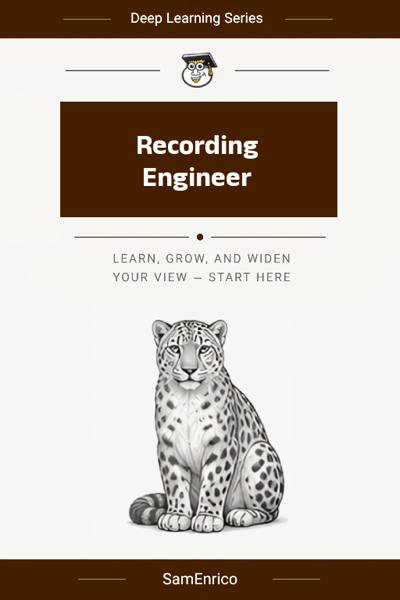
Non-FictionInformativeEducational
Recording Engineer eBook
A Coursebook on Recording Engineer
A Coursebook on Recording Engineer
Formats
Free sample
Chapter 1: Why Your Ears Are Liars--– You are about to discover something that will either frustrate you beyond measure or set you free. There is no in-between.Here it is: everything you have ever heard about sound is incomplete. Not wrong, exactly. Just incomplete in ways that have been sabotaging your recordings without you knowing why.You have spent hours tweaking a mix, getting the bass to thump just right, the vocals to sit perfectly on top, the cymbals to shimmer without hurting. You bounce the track, burn it to your phone, rush to the car, turn the key, press play, and… disaster.
The bass has vanished. The vocals are buried. The cymbals sound like someone frying eggs in the next room. You drive home defeated, convinced that you need better monitors, better converters, better acoustic treatment, better everything.You are wrong. The problem is not your gear.
The problem is not your room. The problem is not your talent.The problem is that your ears are lying to you. They have been lying to you your entire life, and you never noticed because everyone else's ears are lying to them in exactly the same way.This chapter is the foundation upon which your entire engineering career will be built. Before you place a single microphone, before you move a single fader, before you even turn on your speakers, you must understand what sound actually is, how your ears process it, and why your brain constantly misinterprets the information. Master this, and you will hear things that other engineers miss.
Ignore it, and you will spend years fighting invisible enemies.The Physics of Vibration: What Sound Actually Is Close your eyes for a moment. Listen. What do you hear? Perhaps the hum of a refrigerator, the distant rumble of traffic, the click of your keyboard, your own breathing. All of these sounds share one thing in common: they began as physical movement.Sound is not magic.
It is not mysterious. Sound is vibration moving through a medium—usually air, sometimes water, occasionally a solid object like a wall or a floor. When something vibrates, it pushes against the air molecules next to it, compressing them together. Those compressed molecules push against their neighbors, and so on, creating a chain reaction that travels outward in all directions like ripples on a pond. When those ripples reach your ear, they cause your eardrum to vibrate at the exact same frequency as the original source.
Your brain interprets those vibrations as sound.This is non-negotiable: there is no sound on your hard drive. There are no sounds inside your computer. There are only numbers representing air pressure over time. There is no sound in your studio monitors until their drivers move air. Sound is a physical, mechanical event.
Everything you will ever record, mix, or master is ultimately about controlling air movement.Every sound wave has four fundamental properties. Learn them. Love them. They will appear in every chapter of this book.Frequency: The Speed of Vibration Frequency measures how many times per second something vibrates. It is expressed in hertz (Hz), named after Heinrich Hertz, the German physicist who proved the existence of electromagnetic waves.
One hertz equals one cycle per second.When a guitar string vibrates slowly, say 82 times per second, you hear a low E. When it vibrates quickly, 330 times per second, you hear an E an octave and a half higher. Your eardrum vibrates at the same rate as the string, and your brain translates that vibration rate into pitch.The human hearing range is approximately 20 Hz to 20,000 Hz (20 k Hz). Below 20 Hz is infrasound—you feel it in your chest more than you hear it. Above 20 k Hz is ultrasound—dogs can hear it; you cannot.
As you age, your upper limit drops. A teenager might hear 18 k Hz. A forty-year-old engineer is doing well to hear 15 k Hz. This is not a moral failing. It is biology.Here is how frequency breaks down into musical and practical terms:20 Hz to 40 Hz is sub-bass.
You feel this more than hear it. The lowest rumble of a kick drum, the deepest note of a pipe organ, the thud of a movie explosion. Too little and your mix lacks power. Too much and your mix sounds like a boomy mess.40 Hz to 80 Hz is bass. The fundamental frequency of kick drum, bass guitar, and low toms.
This range gives music its physical impact. It is also the hardest range to control in small rooms because the wavelengths are enormous—a 60 Hz wave is nearly 19 feet long. You will learn how to wrestle this monster in Chapter 2.80 Hz to 250 Hz is low mids. This is the danger zone. This range gives instruments warmth and body, but too much creates mud.
When engineers complain about a mix being "cloudy" or "muffled," the problem is almost always an excess of energy somewhere between 120 Hz and 250 Hz. When you learn to hear this range and control it with EQ (Chapter 6), your mixes will suddenly sound clear and open.250 Hz to 2 k Hz is mids. The human ear is most sensitive here because this is where speech lives. Most instruments have their fundamental frequencies in this range. This is where intelligibility, presence, and punch are determined.
If your mix sounds harsh, the problem is usually an excess in the 2 k Hz to 4 k Hz region. If your mix sounds hollow, the problem is usually a deficiency in the 500 Hz to 1 k Hz region.2 k Hz to 5 k Hz is high mids. The "bite" range. Snare drum crack, guitar pick noise, vocal consonants (the "t," "p," and "k" sounds that make words understandable). Too much here and your mix sounds aggressive and fatiguing.
Too little and your mix sounds dull and distant.5 k Hz to 10 k Hz is presence and brilliance. Cymbal shimmer, vocal air, string harmonics. This range creates openness and detail. Too much here and your mix sounds thin and brittle. Too little and your mix sounds dark and closed-in.10 k Hz to 20 k Hz is air.
The highest overtones, the sheen on a well-mastered recording. Most consumer systems struggle to reproduce this range accurately. Many engineers roll off everything above 16 k Hz to avoid harshness and save headroom.Amplitude: The Height of Vibration Amplitude measures how forcefully something vibrates. A guitar string plucked gently moves a small distance and sounds quiet. The same string plucked hard moves a large distance and sounds loud.
Amplitude is measured in decibels (d B), named after Alexander Graham Bell, the inventor of the telephone.Here is where things get messy. The decibel is not an absolute unit like inches or grams. It is a ratio, a comparison between two values. A decibel has no meaning without a reference point. In recording, you will encounter three different decibel scales, and confusing them is one of the fastest ways to ruin a session.d B SPL (Sound Pressure Level) measures actual acoustic pressure in the air.
0 d B SPL is the threshold of human hearing—the quietest sound a perfect young ear can detect. 120 d B SPL is the threshold of pain—a jet engine at takeoff, a rock…
This is the end of the free sample. Get the eBook to keep going. Buy now
About this book
Details
- Author
- Francois Erna
- Publisher
- SamEnrico
- Language
- English
- Genre
- Non-Fiction, Informative, Educational
- Released
- 2026-05-04
- Pages (approx.)
- 127
- Available as
- eBook, Audiobook

Read better in the ZLOADR app
Your eBooks on your phone or tablet. Sign in with your SamEnrico account and start reading.
More by Francois Erna
 Learning To Cook In CareFrancois Erna$11.99
 A Great Leap MemoirFrancois Erna$11.99
 MDD Terminology GuideFrancois Erna$11.99
 Teen Journaling Prompts GuideFrancois Erna$11.99
 The Cortisol Awakening Response GuideFrancois Erna$11.99
 The Golden Galleons: Spain's Maritime Empire and the Age of ExplorationFrancois Erna$11.99
 Startup Runway CalculatorFrancois Erna$12.99
 Domain Name Web Hosting BundleFrancois Erna$12.99
 The Breeder's Guide to Tennessee Fainting GoatFrancois Erna$11.99
 How to Become a Overhauler HelperFrancois Erna$11.99
You may also like
 Hong Kong Handover 1997Dunn Johnnie$11.99
 Zumba For Postnatal Recovery CourseNeal Christian$11.99
 Zumba for BeginnersLadner Nikia$11.99
 YouTube Comment Mining GuideHumes Pandora$12.99
 Worry Box MeditationCarlin Rudy$11.99
 Workplace Stress MeditationNguyen Lynn$11.99
 Workplace Stress and Sleep RepairHawley Ivory$11.99
 Workplace Perfectionism CureDelaney Jeffry$11.99
 Workplace Injustice Anger GuideWallen Isabelle$11.99
 Work Addiction and Burnout LinkGreenwood Ester$11.99
 Women in Yoga and WellnessBeattie Galina$11.99
 Women in Stand Up ComedyChun Evangeline$11.99