
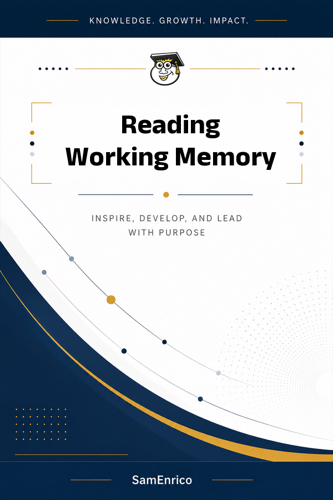
Free sample
Chapter 1: The Velcro Fallacy...--Every morning, millions of children walk into classrooms, open their reading books, and fail. Not because they cannot sound out words. Not because they lack vocabulary. Not because they are lazy, or distracted, or unmotivated. They fail because the words slip through their minds like water through a sieve, leaving nothing behind.Consider Sarah.
At age nine, Sarah could read any Dr. Seuss book aloud with perfect pronunciation. Her teachers praised her fluency. Her parents bought her more books. But when asked what she had just read, Sarah would stare blankly and say, "I don't know." Not because she was being difficult.
Not because she wasn't trying. Because the words she had spoken so beautifully never stuck. They arrived, hung in the air for a moment, and vanished.Sarah's teachers assumed she had a comprehension problem. They gave her vocabulary lists. They asked her to summarize paragraphs.
They tested her on main ideas. Nothing worked. Sarah grew more anxious. She began hiding in the back of the classroom during reading time. She told her mother, "I'm just not a reader."Sarah was wrong.
She was very much a reader. She had perfectly functional eyes, ears, and a voice that could decode any word placed in front of her. What Sarah did not have was sufficient working memory—the brain's temporary workspace, the place where words go to be held, connected, and transformed into meaning. Without enough working memory, decoding is not reading. It is just noise.The Invisible Bottleneck Here is a truth that most reading instruction ignores: you can teach a child every phonics rule in the English language, drill every sight word, and build a vocabulary that would impress a lexicographer, and that child can still fail to understand a single sentence.
Not because they lack knowledge. Because their brain's workspace is too small to hold the words long enough to use that knowledge.Working memory is the cognitive mechanism that holds information in an active, accessible state for a brief period—typically seconds—while you do something with it. Think of it as a mental desk. The desk has a limited surface area. You can spread out a few pieces of paper, maybe a book and a pencil.
But if you try to pile on too much, things start falling off. You lose the first item while reaching for the last.Reading places extraordinary demands on this desk. Every word you read consumes a bit of desk space. Every clause adds another sheet of paper. Every sentence requires you to hold the beginning in mind while processing the end.
For readers with smaller desks—weaker working memory—the system collapses. They forget what they just read not because they weren't paying attention, but because attention alone cannot expand the surface area of the desk.This chapter opens with a provocative question that will drive the entire book: Why can a child sound out every word in a sentence but have no idea what the sentence means? The answer, as we will see, lies in the hidden bottleneck of the human mind—a bottleneck that traditional reading instruction has almost entirely ignored.The Limits of Phonics and Vocabulary For decades, reading instruction in most English-speaking countries has focused on two things: decoding (sounding out words) and vocabulary (knowing what words mean). These are important. No one disputes that children need to recognize words and understand their definitions.
But here is the uncomfortable truth: decoding and vocabulary are necessary for reading, but they are not sufficient.You can give a child perfect phonics instruction. They can sound out "antidisestablishment" on the first try. You can give them a vocabulary curriculum that would make a dictionary jealous. They can define "ubiquitous," "ephemeral," and "sesquipedalian" without hesitation. And they can still read a sentence like "The boy who the girl who the dog chased knew called" and have absolutely no idea what happened to whom.Why?
Because understanding that sentence does not require knowing what "boy" or "girl" or "dog" means. It requires holding a nested structure in mind while unpacking its meaning. The words themselves are simple. The structure is not. And structure demands working memory.Traditional reading instruction has operated under what I will call the Velcro Fallacy: the mistaken belief that if you give a child enough words—enough vocabulary, enough phonics rules—those words will naturally stick to each other and form meaning.
But Velcro only works if there is a surface to stick to. Working memory is that surface. If the surface is too small, no amount of Velcro will help.Introducing the Velcro for Ideas Working memory is the Velcro for ideas—the cognitive mechanism that holds individual words in suspension long enough for the brain to attach meaning, context, and relationship. Without this Velcro, every word arrives alone, is recognized, and then departs. The reader understands each word in isolation but cannot assemble them into a sentence.
The child who says "I read the words but I don't know what they mean" is not describing a paradox. They are describing the natural consequence of a working memory bottleneck.Here is a simple demonstration. Read this sentence:"The man who the woman who the child saw called left."You probably understood the individual words. You know what a man is, what a woman is, what a child is. You know what it means to see someone, to call someone, to leave.
But do you understand the sentence? Who left? Who called? Who saw whom?Most readers need to read that sentence two or three times before the structure becomes clear. (For the curious: the child saw the woman, the woman called the man, and the man left.) The difficulty is not vocabulary.
The difficulty is holding three nested clauses in working memory simultaneously while unpacking their relationships. The sentence exceeds the Velcro's holding power.This is not an edge case or a laboratory trick. Every day, struggling readers encounter sentences that are far simpler than this example but that still exceed their working memory capacity. A sentence like "The big red dog ran fast" might be fine. But "The big red dog that lived next door ran fast toward the park" might already be too much.
The added clauses—"that lived next door," "toward the park"—consume desk space. For a reader with limited working memory, each added word increases the risk that the sentence will collapse.A Brief History of a Forgotten Component How did reading instruction come to ignore such a fundamental cognitive mechanism? The answer lies in the history of memory research itself.For most of the 20th century, psychologists studied memory as a storage problem. They were interested in how information got into long-term storage (encoding), how it stayed there (consolidation), and how it came back out (retrieval). Short-term memory was seen as a simple holding tank—a passive bucket that held information until it either decayed or was transferred to long-term storage.This changed in the 1970s with the work of two British psychologists, Alan Baddeley and Graham Hitch.
They proposed that short-term memory was not a single passive system but multiple active systems working together. They called this…
This is the end of the free sample. Get the eBook to keep going. Buy now
About this book
Details
- Author
- Savoy Fatima
- Publisher
- SamEnrico
- Language
- English
- Genre
- Non-Fiction, Self-Help
- Released
- 2026-06-07
- Pages (approx.)
- 144
- Available as
- eBook, Audiobook

Read better in the ZLOADR app
Your eBooks on your phone or tablet. Sign in with your SamEnrico account and start reading.
More by Savoy Fatima
 Road Rage Reporting GuideSavoy Fatima$11.99
 Eczema Ayurveda GuideSavoy Fatima$11.99
 Loving Kindness for a Aging ParentSavoy Fatima$11.99
 Depreciation of Intangible AssetsSavoy Fatima$11.99
 Stress And Seizure FrequencySavoy Fatima$11.99
 Kim Dae JungSavoy Fatima$11.99
 Immigrant Beauty Brand Founder MemoirSavoy Fatima$11.99
 NVC For Teen CommunicationSavoy Fatima$11.99
 The Last Voyage of the Phoenix: How a 19th-Century Ship Defied the ImpossibleSavoy Fatima$11.99
 The Golden Voice of Axum: A Love Song for the Queen of ShebaSavoy Fatima$11.99
 The Pink Panther Heist: A Diamond’s Deadly TrailSavoy Fatima$11.99
 The Complete Guide to French Women Don't Get FatSavoy Fatima$11.99
You may also like
 Hong Kong Handover 1997Dunn Johnnie$11.99
 Zumba For Postnatal Recovery CourseNeal Christian$11.99
 Zumba for BeginnersLadner Nikia$11.99
 YouTube Comment Mining GuideHumes Pandora$12.99
 Worry Box MeditationCarlin Rudy$11.99
 Workplace Stress MeditationNguyen Lynn$11.99
 Workplace Stress and Sleep RepairHawley Ivory$11.99
 Workplace Perfectionism CureDelaney Jeffry$11.99
 Workplace Injustice Anger GuideWallen Isabelle$11.99
 Work Addiction and Burnout LinkGreenwood Ester$11.99
 Women in Yoga and WellnessBeattie Galina$11.99
 Women in Stand Up ComedyChun Evangeline$11.99