
Non-FictionSelf-Help / Observation
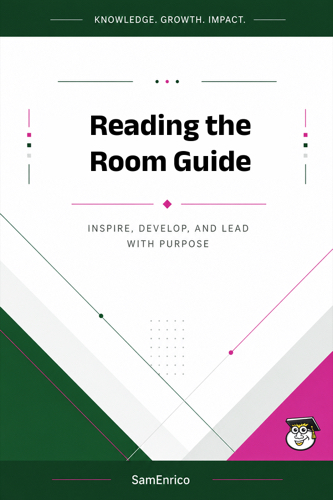
Reading the Room Guide
undefined
by Purvis Shad
undefined
Formats
About this book
Free sample
Chapter 1: The Second Brain--–- Sarah had just finished her MBA from a top-tier program. She had perfect grades, flawless analytical skills, and a resume that made recruiters salivate. On paper, she was the most intelligent person in every room she entered.On paper.Her first week as a junior strategist at a mid-sized consulting firm was a disaster. Not because she couldn't solve the problems—she solved them faster than anyone. Not because she didn't know the material—she had memorized the case studies weeks before starting.
The problem was far more subtle and far more devastating: Sarah couldn't read the room.In her first team meeting, she interrupted a senior partner to correct a minor data point. She was right. The partner was wrong. But the room went cold. No one made eye contact with her for the rest of the day.In her second week, she presented a brilliant solution to a client's problem—three weeks ahead of schedule.
She laid out the data, the logic, the implementation timeline. It was flawless. The client nodded politely, then hired another firm.Sarah's boss pulled her aside afterward. "Your analysis was perfect," he said. "But you made the client feel stupid.
You didn't mean to. But you did."Sarah was confused. She had been right. Wasn't that the point?By the end of her third month, Sarah was put on a performance improvement plan. Not because her work was bad—it was excellent.
But because no one wanted to work with her. She was technically brilliant and socially toxic. The room, it turned out, had been reading her all along.This book is for everyone who has ever been Sarah. And for everyone who has ever worked with her.The Myth of the Lone Genius For the past century, Western culture has celebrated a particular kind of intelligence: the lone genius who cracks the code, solves the equation, or builds the empire through sheer brainpower. We tell stories of Einstein in the patent office, Jobs in the garage, Musk staying up all night writing code.
These stories share a common assumption: that raw intellectual horsepower is enough.It is not.Research spanning decades and thousands of organizations…
This is the end of the free sample. Get the eBook to keep going. Buy now
Contents
- Chapter 1
- Chapter 2
- Chapter 3
- Chapter 4
- Chapter 5
- Chapter 6
- Chapter 7
- Chapter 8
- Chapter 9
- Chapter 10
- Chapter 11
- Chapter 12
Details
- Author
- Purvis Shad
- Publisher
- SamEnrico
- Language
- English
- Genre
- Non-Fiction, Self-Help / Observation
- Released
- 2026-06-07
- Pages (approx.)
- 142
- Available as
- eBook, Audiobook

Read better in the ZLOADR app
Your eBooks on your phone or tablet. Sign in with your SamEnrico account and start reading.
More by Purvis Shad
 English Learner CEO MemoirPurvis Shad$11.99
 Processing Nightmares During PregnancyPurvis Shad$11.99
 DoorDash Dasher Direct Card GuidePurvis Shad$11.99
 The Meditation vs HypnosisPurvis Shad$11.99
 Resilience for HealthcarePurvis Shad$11.99
 Taylor Swift EraPurvis Shad$11.99
 Bladder Urgency GuidePurvis Shad$11.99
 The Fur Trade King: Simon McTavish and the Birth of Canadian EnterprisePurvis Shad$11.99
 The Admiral of the Seas: Michiel de Ruyter and the Rise of Dutch Naval SupremacyPurvis Shad$11.99
 Growing Casuarina (Sheoak)Purvis Shad$11.99
 How to Produce Asia and Pacific Islands ClothingPurvis Shad$11.99
 A Collector's Handbook to the Singer Vogue IvPurvis Shad$11.99
You may also like
 Hong Kong Handover 1997Dunn Johnnie$11.99
 Zumba For Postnatal Recovery CourseNeal Christian$11.99
 Zumba for BeginnersLadner Nikia$11.99
 YouTube Comment Mining GuideHumes Pandora$12.99
 Worry Box MeditationCarlin Rudy$11.99
 Workplace Stress MeditationNguyen Lynn$11.99
 Workplace Stress and Sleep RepairHawley Ivory$11.99
 Workplace Perfectionism CureDelaney Jeffry$11.99
 Workplace Injustice Anger GuideWallen Isabelle$11.99
 Work Addiction and Burnout LinkGreenwood Ester$11.99
 Women in Yoga and WellnessBeattie Galina$11.99
 Women in Stand Up ComedyChun Evangeline$11.99