
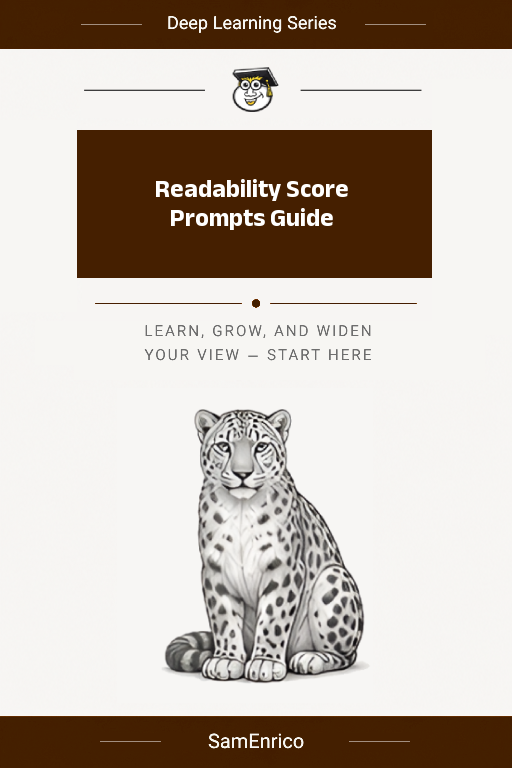
Readability Score Prompts Guide
Assess and improve your essay's reading level usin
Assess and improve your essay's reading level using GPT prompts that test Flesch-Kincaid and suggest accessibility improvements.
Formats
About this book
Free sample
Chapter 1: The Bias You Never Noticed...--–- Imagine you are a jury member. You have just spent three days listening to a complex fraud trial. The judge hands you the written instructions for deliberation. They are dense, filled with phrases like "preponderance of the evidence" and "circumstantial inference," and most sentences run past forty words. You read them once.
You read them twice. You are reasonably intelligent—you hold a college degree—but you are not a lawyer. After twenty minutes of re-reading, you still cannot confidently say what the law requires you to decide. Across the room, another juror has already given up and is waiting for someone else to explain it.Now imagine a different scene. You are a patient receiving a diagnosis.
The doctor has rushed out, but the after-visit summary in your patient portal says: "The etiology of your symptomatology suggests a non-malignant neoplasm requiring longitudinal surveillance." You have no idea if you have cancer. You call the office. The receptionist reads the same note back to you. You hang up more anxious than before the call.One more scene. You are a first-generation college student, the first in your family to attend university.
Your political science professor assigns a twenty-page essay on voting behavior. The rubric mentions "heuristic processing" and "socioeconomic covariates." You have never heard these words. You spend two hours on Wikipedia just to understand the prompt. By then, you are too exhausted to write a good essay. You get a C.
You tell yourself maybe you are not cut out for this.In all three scenarios, the problem is not your intelligence. The problem is not your effort. The problem is the text.This book exists because inaccessible writing is not a victimless crime. Every day, dense prose excludes people from justice, from healthcare, from education, from opportunity. And the cruelest part is that most writers never intend this harm.
They were taught that long words signal expertise, that complex sentences demonstrate rigor, that a high reading level is a mark of intelligence worth defending. They were taught wrong.This chapter will…
This is the end of the free sample. Get the eBook to keep going. Buy now
Contents
- Chapter 1
- Chapter 2
- Chapter 3
- Chapter 4
- Chapter 5
- Chapter 6
- Chapter 7
- Chapter 8
- Chapter 9
- Chapter 10
- Chapter 11
- Chapter 12
Details
- Author
- Livingston Kyong
- Publisher
- SamEnrico
- Language
- English
- Genre
- Non-Fiction, Student's Shortcut
- Released
- 2026-06-01
- Pages (approx.)
- 143
- Available as
- eBook, Audiobook

Read better in the ZLOADR app
Your eBooks on your phone or tablet. Sign in with your SamEnrico account and start reading.
More by Livingston Kyong
 Luxury Goods ApproachLivingston Kyong$11.99
 MeToo Movement Historical ContextLivingston Kyong$11.99
 Corporate Psychopathy in White CollarLivingston Kyong$11.99
 Interruption Batching Practice GuideLivingston Kyong$11.99
 Nutrition Habit GuideLivingston Kyong$11.99
 Data Security OutsourcingLivingston Kyong$11.99
 Low Testosterone Master GuideLivingston Kyong$11.99
 Finding a Sponsor WorkbookLivingston Kyong$11.99
 The Iron Falcon: Ezz ad-Din Usama's Siege of Ascalon (1153 AD)Livingston Kyong$11.99
 Prince Gwanjeong: The Korean Sculptor Who Defied TimeLivingston Kyong$11.99
 How to Start a Ending and Mending of Textiles Business (Beginners Guide)Livingston Kyong$11.99
 Bootcamp vs Degree Job TitlesLivingston Kyong$12.99
You may also like
 Hong Kong Handover 1997Dunn Johnnie$11.99
 Zumba For Postnatal Recovery CourseNeal Christian$11.99
 Zumba for BeginnersLadner Nikia$11.99
 YouTube Comment Mining GuideHumes Pandora$12.99
 Worry Box MeditationCarlin Rudy$11.99
 Workplace Stress MeditationNguyen Lynn$11.99
 Workplace Stress and Sleep RepairHawley Ivory$11.99
 Workplace Perfectionism CureDelaney Jeffry$11.99
 Workplace Injustice Anger GuideWallen Isabelle$11.99
 Work Addiction and Burnout LinkGreenwood Ester$11.99
 Women in Yoga and WellnessBeattie Galina$11.99
 Women in Stand Up ComedyChun Evangeline$11.99