
Non-FictionSelf-HelpQuick Techniques
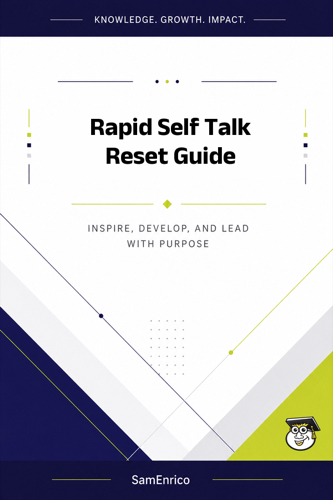
Rapid Self Talk Reset Guide Audiobook
Use one minute statement shifts during high stress
Use one minute statement shifts during high stress moments.
Formats
Free sample
Chapter 1: Name The Monster--–- You cannot fix what you will not name. This is the first law of self-talk repair, and it is the only law that matters before you learn a single reset. Most people who buy a book about stress already know they talk to themselves harshly. They already know they spiral. But they have never stopped to ask a very simple question: What exactly am I saying?
Not in general. Not “I’m so hard on myself.” That is a confession, not data. The exact words. The actual sentence that plays in your head right before your chest tightens, your face flushes, and your brain offers you a front-row seat to your own disaster film.If you cannot quote your own toxic self-talk verbatim, you are trying to fight an enemy whose face you have never seen. And that is why this chapter exists before any reset, any script, or any 60-second shift.
You are going to name the monster. Not metaphorically. Literally. You are going to catch your inner voice in the act, write down its favorite lines, and sort them into one of three toxic dialects that every best-selling book on cognitive behavior has identified but rarely names this plainly. By the end of this chapter, you will not have stopped your negative self-talk.
That is not the goal. The goal is to recognize it so quickly, so automatically, that its authority crumbles before it can finish its sentence. Naming reduces authority. That is the principle. Now let us prove it.The Three Toxic Dialects You Use Every Day After synthesizing decades of cognitive-behavioral research from Meichenbaum, Burns, Beck, and the more recent work of Ethan Kross on inner speech, a clear pattern emerges.
The human brain, under stress, defaults to three distinct linguistic patterns. These are not random negative thoughts. They are dialects. Each has its own grammar, its own emotional signature, and its own specific vulnerability. Once you learn to hear the dialect, you can stop reacting to the content and start noticing the form.
And that small shift—from content to form—is the difference between drowning in your thoughts and watching them float by.Dialect One: The Catastrophizer The Catastrophizer deals in magnification. It takes a small event, a minor mistake, or a single piece of ambiguous feedback and blows it up until it fills your entire field of vision. The grammar of…
This is the end of the free sample. Get the Audiobook to keep going. Buy now
About this book
Details
- Author
- Mcinnis Blaine
- Publisher
- SamEnrico
- Language
- English
- Genre
- Non-Fiction, Self-Help, Quick Techniques
- Released
- 2026-06-10
- Pages (approx.)
- 137
- Available as
- eBook, Audiobook

Listen in the VoxFlicks app
Audiobooks and audio dramas wherever you go. Sign in with your SamEnrico account and press play.
More by Mcinnis Blaine
 Loving Kindness for Divorce Recovery WorkbookMcinnis Blaine$11.99
 Addiction Recovery for WomenMcinnis Blaine$11.99
 Cognitive Reserve Building GuideMcinnis Blaine$11.99
 Beginner Mindfulness for Public SpeakingMcinnis Blaine$11.99
 Screams on the Skyride: The 1984 AstroWorld TragedyMcinnis Blaine$11.99
 The Edge of the Sky: Joseph Kittinger and the Stratos ProjectMcinnis Blaine$11.99
 How to Become a Check CashierMcinnis Blaine$11.99
 Student Mobile Phone TurkeyMcinnis Blaine$12.99
 Crypto Asset Regulation GuideMcinnis Blaine$12.99
 Understanding Deletion 6q16 Q21Mcinnis Blaine$17.99
 Microsoft Dynamics Crm DeveloperMcinnis Blaine$11.99
You may also like
 Hong Kong Handover 1997Dunn Johnnie$11.99
 Zumba For Postnatal Recovery CourseNeal Christian$11.99
 Zumba for BeginnersLadner Nikia$11.99
 YouTube Comment Mining GuideHumes Pandora$12.99
 Worry Box MeditationCarlin Rudy$11.99
 Workplace Stress MeditationNguyen Lynn$11.99
 Workplace Stress and Sleep RepairHawley Ivory$11.99
 Workplace Perfectionism CureDelaney Jeffry$11.99
 Workplace Injustice Anger GuideWallen Isabelle$11.99
 Work Addiction and Burnout LinkGreenwood Ester$11.99
 Women in Yoga and WellnessBeattie Galina$11.99
 Women in Stand Up ComedyChun Evangeline$11.99