
Non-FictionSelf-HelpInterpersonal Skills
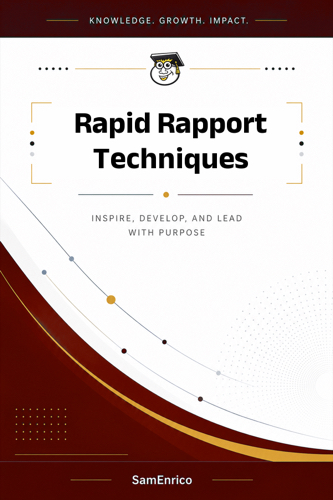
Rapid Rapport Techniques eBook
Establish trust and likeability in first conversat
by Boren Chance
Establish trust and likeability in first conversations quickly.
Formats
Free sample
Chapter 1: The First 90 Seconds--You have ninety seconds. Maybe fewer.From the moment you enter someone's field of vision—or they enter yours—a silent, ancient process begins inside their brain. Their amygdala, a small almond-shaped cluster of neurons deep in the temporal lobe, is running a threat-detection algorithm that has been refined over three hundred million years of evolution. It does not care about your intentions, your résumé, or how much you practiced that opening line in the mirror. It cares about one thing and one thing only: Friend or foe?This judgment happens before a single word is spoken.
Before a handshake. Before a smile is fully formed. And once it locks in, it is extraordinarily difficult to reverse.This is not a metaphor. This is neuroscience.The Primacy Effect, first documented by the Polish-born psychologist Solomon Asch in the 1940s and repeatedly validated across decades of research, shows that the first information we receive about a person disproportionately shapes everything we subsequently learn about them. If the first ninety seconds of an interaction signal "threat" or "untrustworthy" or "awkward," every subsequent smile, every intelligent comment, every gesture of goodwill will be filtered through that initial negative frame.
The brain looks for evidence to confirm its first impression, not to contradict it.But here is what most people never realize: the judgment is not really about you. It is about safety.The Three Pillars of Instant Judgment When another person's amygdala evaluates you, it scans for three specific signals. These are not conscious decisions. They are automatic, pre-cognitive, and happening whether you want them to or not. Understanding these three pillars is the difference between accidentally triggering a threat response and deliberately broadcasting safety.Pillar One: Safety The most primitive question the brain asks is: Will this person hurt me?
This does not only mean physical harm. Social harm—embarrassment, rejection, humiliation, status loss—triggers the same neural pathways as physical pain. Research using functional MRI (f MRI) has shown that social rejection activates the same brain regions (the anterior cingulate cortex and the insula) as physical pain. Your body does not distinguish between a punch and a public shaming.When someone feels unsafe in a conversation, their cortisol levels rise. Cortisol is the body's primary stress hormone, and when it is elevated, the ability to trust, learn, and bond shuts down.
You cannot build rapport with someone whose brain is in survival mode. It is biologically impossible.Most people unintentionally trigger a safety alert within the first few seconds of an interaction. They approach too quickly. They orient their body away from the other person while speaking. They smile too late or too early.
They exhale audibly through their nose—a sound the brain subconsciously interprets as irritation or impatience. They do not know they are doing any of this. Neither does the person on the receiving end. But the amygdala knows.Pillar Two: Predictability The second question the brain asks is: Can I anticipate what this person will do next? Predictability is calming.
Unpredictability is threatening. This is why people with erratic emotional reactions, sudden movements, or inconsistent vocal tones are perceived as untrustworthy even when they have done nothing wrong. The brain simply cannot model their behavior, and an unmodelable person is a potential risk.Conversely, when someone's behavior is steady, rhythmic, and predictable—when their movements are smooth, their vocal tempo is consistent, their emotional responses are proportional—the brain releases a small amount of oxytocin, the bonding hormone. Oxytocin is the antidote to cortisol. It lowers defenses.
It creates the feeling of warmth. It makes rapport possible.Think about the last time you met someone who immediately put you at ease. You probably described them as "calm," "grounded," or "present." These are all words for predictability. They were not doing anything unusual. They were not performing.
They were simply steady, and your brain rewarded you for recognizing a safe, predictable presence.Pillar Three: Intent The third question is the most sophisticated: Does this person want something from me, and if so, is it aligned with my wellbeing? The brain is exquisitely sensitive to mismatched intent. When someone's words say "I'm here to help" but their body says "I'm here to sell," the amygdala flags the inconsistency. This is why pushy salespeople, desperate daters, and nervous networkers all trigger the same defensive response. Their intent is not clean.Clean intent is rare.
Most people enter conversations with a hidden agenda: to be liked, to impress, to close a deal, to get a phone number, to prove a point, to avoid looking stupid. None of these are malicious, but they are still agendas, and the other person's brain can detect them. Not consciously, not as a thought, but as a feeling. "Something feels off about this person." That is the amygdala detecting mismatched intent.The Heart-First Greeting: Broadcasting Safety Before You Speak If the first ninety seconds are this consequential, and if the brain scans for safety, predictability, and intent, then the obvious question is: What do I actually do?The answer is a three-step micro-behavioral routine called the Heart-First Greeting. It is called "heart-first" because it prioritizes signaling warmth and safety over signaling competence or status.
Most people lead with competence—they want to look smart, capable, and in control. But competence without warmth triggers a different response: respect, perhaps, but not trust. As the social psychologist Susan Fiske demonstrated in her research on stereotype content, warmth is judged before competence. The brain asks "Is this person a friend or enemy?" before it asks "Is this person capable?" A competent enemy is simply a more dangerous enemy.The Heart-First Greeting happens before you speak a single word. It takes approximately three seconds.
And it signals all three pillars simultaneously.Step One: Full-Body Orientation When you turn to face someone, most people turn only their head. This is a subtle but potent signal of partial attention. A head turn says "I am looking at you." A full-body turn—rotating from the hips so your shoulders, chest, and feet all align toward the other person—says "I am with you."Research on nonverbal communication shows that full-body orientation is one of the strongest signals of affiliation. It is also rare. Most people, especially in professional settings, keep their body angled toward an exit or toward their previous task while turning only their head toward the new person.
This creates a subliminal message: "I am ready to leave." The Heart-First Greeting requires you to override this default. Turn your whole body. Plant your feet. Face them directly. Not aggressively—you are not squaring up for a fight.
But directly, with your sternum aligned with theirs.This broadcasts predictability. Your movement is deliberate, not jerky. It broadcasts safety. An open, oriented body is a non-threat display, evolutionarily equivalent to a dog showing its belly. And it broadcasts intent.
You are not half-leaving. You are fully here.Step Two: The Slow Blink-and-Smile Sequence The second step combines two signals that the brain reads as deeply affiliative: the slow blink and the Duchenne smile.The slow blink is a signal of trust and comfort across many mammal species. Cats do it to…
This is the end of the free sample. Get the eBook to keep going. Buy now
About this book
Details
- Author
- Boren Chance
- Publisher
- SamEnrico
- Language
- English
- Genre
- Non-Fiction, Self-Help, Interpersonal Skills
- Released
- 2026-06-07
- Pages (approx.)
- 136
- Available as
- eBook, Audiobook

Read better in the ZLOADR app
Your eBooks on your phone or tablet. Sign in with your SamEnrico account and start reading.
More by Boren Chance
 Bergman Light in DarknessBoren Chance$11.99
 Gardening Season PriorityBoren Chance$11.99
 CSGO Skin Gambling RecoveryBoren Chance$11.99
 Upwork Client Interview PreparationBoren Chance$11.99
 Masada: The Last Stand of the ZealotsBoren Chance$11.99
 Project Management Glossary GuideBoren Chance$12.99
 Workforce Skills Long Term GuideBoren Chance$12.99
 Understanding MeningomyeloceleBoren Chance$17.99
 How to Become a Tube RepairerBoren Chance$11.99
 Robotics Team MentorBoren Chance$11.99
You may also like
 Hong Kong Handover 1997Dunn Johnnie$11.99
 Zumba For Postnatal Recovery CourseNeal Christian$11.99
 Zumba for BeginnersLadner Nikia$11.99
 YouTube Comment Mining GuideHumes Pandora$12.99
 Worry Box MeditationCarlin Rudy$11.99
 Workplace Stress MeditationNguyen Lynn$11.99
 Workplace Stress and Sleep RepairHawley Ivory$11.99
 Workplace Perfectionism CureDelaney Jeffry$11.99
 Workplace Injustice Anger GuideWallen Isabelle$11.99
 Work Addiction and Burnout LinkGreenwood Ester$11.99
 Women in Yoga and WellnessBeattie Galina$11.99
 Women in Stand Up ComedyChun Evangeline$11.99