
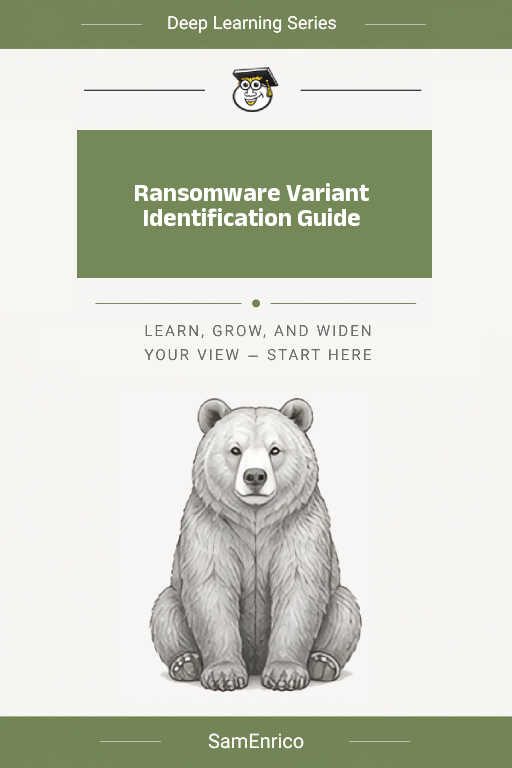
Ransomware Variant Identification Guide eBook
Use ID Ransomware and NoMoreRansom tools to identi
by Newsom Ines
Use ID Ransomware and NoMoreRansom tools to identify the specific strain, finding free decryption tools before considering payment.
Formats
Free sample
Chapter 1: The 5:47 AM Discovery--–- The screensaver was wrong.That was the first thought. Not “I’ve been hacked.” Not “Oh God, my files.” Just a quiet, almost annoyed recognition that something on the computer looked different. The family photo—the one from the beach last summer, with the wind blowing everyone’s hair into chaos—had been replaced by a black rectangle with red text.It was 5:47 AM. Sarah, a 42-year-old freelance graphic designer, had poured her coffee and sat down to finish a client presentation due at 9 AM. Her three kids were still asleep.
The house was quiet. This was her window.She clicked a file.client_presentation_final.pptx.encrypted Nothing happened. Well, not nothing. Power Point tried to open, then spat out an error: “The file is corrupted or cannot be opened.”She clicked another.kids_birthday_2024.mp4.encrypted Same error.She clicked a third.taxes_2024.pdf.encrypted Same error.Her hand stopped moving. The coffee grew cold.
She read the black screen with red text:“YOUR FILES HAVE BEEN ENCRYPTED.”Below that, in smaller text: “All your documents, photos, videos, and databases have been secured with military-grade encryption. Do not attempt to decrypt files with third-party software. You will lose your data permanently.”Below that, a Bitcoin address and a demand: $3,000 within 48 hours. After that, the price doubles. After 72 hours, the decryption key is destroyed.Below that, an email address: restorefiles@onionmail.org Sarah had $400 in her checking account.This is not a hypothetical.By the time you finish this chapter, approximately 1,200 more ransomware attacks will have occurred somewhere in the world.
That is not an exaggeration. Ransomware attacks happen roughly every 14 seconds. By the time you finish reading this book, tens of thousands of people will be staring at their own black screens with red text, asking the same question Sarah asked:What do I do now?Most of them will get it wrong.They will panic. They will click around frantically. They will Google “how to fix ransomware” and find conflicting advice.
They will call a friend who knows computers, who will suggest running antivirus—which will quarantine the evidence they need. Or they will reboot the machine, erasing the clues still sitting in memory. Or, worst of all, they will immediately pay the ransom, believing it is their only option.Some will pay and get nothing back. Some will pay and get only half their files restored. Some will pay and find themselves targeted again a month later because their email address was sold to another ransomware group as a “willing payer.”And a small number—a very small number—will pause.They will take a breath.
They will recognize that panic is not a strategy. They will follow a methodical, step-by-step process that has already helped over six million victims recover their data for free.This book is that process.The Panic Trap: Why Your Brain Betrays You The ransom note is designed to do one thing: trigger your amygdala.The amygdala is the part of your brain responsible for the fight-or-flight response. It is ancient, fast, and powerful. It is also terrible at nuanced decision-making. When the amygdala activates, your prefrontal cortex—the rational, planning part of your brain—effectively goes offline.
You stop thinking strategically. You start reacting.The ransom note exploits this biological reality with ruthless precision.Notice the language: “Your files HAVE BEEN encrypted.” (Past tense. Irreversible. Done.) “Do NOT attempt to decrypt.” (Fear of making it worse.) “48 hours.” (Artificial scarcity.) “Price doubles.” (Loss aversion.) “Key destroyed.” (Permanent consequence.)Every single sentence is a psychological weapon aimed at your amygdala.The criminals behind ransomware have studied human behavior. They know that when people panic, they make bad decisions.
They know that when people feel desperate, they will pay almost anything. They know that the average ransomware victim makes the decision to pay within the first 60 minutes of discovery—long before they have gathered any meaningful information.Here is what the criminals do not want you to know:In most cases, you do not need to pay.Over 165 ransomware families have free decryption tools available. These tools were created by security researchers, law enforcement agencies, and antivirus vendors working through initiatives like No More Ransom. They are free. They are legal.
And they work.But they only work if you know which variant you are dealing with.And you can only know which variant you are dealing with if you follow a systematic identification process instead of panicking.The Gand Crab Story: Proof That Identification Works In April 2018, a new ransomware family appeared. It called itself Gand Crab. Within weeks, it became one of the most prolific Ransomware-as-a-Service (Raa S) operations in history.Here is how Gand Crab worked: The developers created the ransomware, then recruited “affiliates” who paid a cut of each ransom in exchange for using the software. The affiliates spread Gand Crab through phishing emails, exploit kits, and compromised websites. The developers handled the infrastructure—the payment sites, the customer support (yes, ransomware had customer support), and the decryption keys.Gand Crab infected over 500,000 victims in its first year.
The ransom demands ranged from 500to500 to 500to5,000. The criminals made an estimated $2 billion.Then something unexpected happened.Security researchers, led by the team at Emsisoft, discovered a flaw in Gand Crab’s encryption algorithm. It was a subtle flaw—something about the way the random number generator was seeded—but it was enough. Within weeks, they had developed a free decryptor. They submitted it to No More Ransom, and on July 18, 2018, it was published for anyone to download.Victims who had already paid lost their money.
Victims who had not yet paid—and who took the time to identify the variant—downloaded the free tool and recovered everything.Gand Crab’s operators eventually shut down the operation, announcing their retirement in a message that read, in part: “We have worked for two years and during this time we earned a lot of money. We are finishing our activity. Goodbye.”But the lesson remains: Identification works.Not every ransomware family has a free decryptor. Some—like Lock Bit 3.0—have resisted decryption for years. But you will never know if a free tool exists until you identify the variant.
And if you pay before identifying, you have thrown away your chance to find out.The Identification-First Workflow (IFW)This book is built around a simple, repeatable process called the Identification-First Workflow, or IFW.The IFW has four stages. You will see these stages throughout the book, marked by a magnifying glass icon in the margin. Memorize them. They will save you time, money, and stress.Stage 1: Collect Do not do anything else. Do not reboot.
Do not run antivirus. Do not connect a backup drive. Do not rename files. Do not Google anything on the infected machine.Instead, collect three things:The ransom note. Every variant names it differently—HELP_DECRYPT.txt, _readme.txt, DECRYPT_INSTRUCTION.html.
Find it. Copy it to a clean USB drive. Do not move it—copy it. The original file contains metadata that may be useful later.Three encrypted files. Choose different file types: a .jpg, a .docx, and a .pdf.
Do not choose executables (.exe, .dll, .msi). Copy these to the same clean USB drive.A photograph of the screen. Use…
This is the end of the free sample. Get the eBook to keep going. Buy now
About this book
Details
- Author
- Newsom Ines
- Publisher
- SamEnrico
- Language
- English
- Genre
- Non-Fiction, Crisis Management
- Released
- 2026-05-30
- Pages (approx.)
- 138
- Available as
- eBook, Audiobook

Read better in the ZLOADR app
Your eBooks on your phone or tablet. Sign in with your SamEnrico account and start reading.
More by Newsom Ines
 Making Amends Step Nine Recovery HandbookNewsom Ines$11.99
 Resilience Building AffirmationsNewsom Ines$11.99
 Forgiveness Therapy WorkbookNewsom Ines$11.99
 Goal Setting for SleepNewsom Ines$11.99
 Parent Loss and DepressionNewsom Ines$11.99
 Lawrence Krauss BioNewsom Ines$11.99
 Phishing Attack That Started YahooNewsom Ines$11.99
 Anniversary of SuicideNewsom Ines$11.99
 The Teahouse of the Singing Cranes: Japan's Forgotten Melodic RevolutionNewsom Ines$11.99
 The Butcher of Toronto: Canada's Forgotten Victorian CannibalNewsom Ines$11.99
 How to Produce Microphone StandsNewsom Ines$11.99
 How to Produce WristbandsNewsom Ines$11.99
You may also like
 Hong Kong Handover 1997Dunn Johnnie$11.99
 Zumba For Postnatal Recovery CourseNeal Christian$11.99
 Zumba for BeginnersLadner Nikia$11.99
 YouTube Comment Mining GuideHumes Pandora$12.99
 Worry Box MeditationCarlin Rudy$11.99
 Workplace Stress MeditationNguyen Lynn$11.99
 Workplace Stress and Sleep RepairHawley Ivory$11.99
 Workplace Perfectionism CureDelaney Jeffry$11.99
 Workplace Injustice Anger GuideWallen Isabelle$11.99
 Work Addiction and Burnout LinkGreenwood Ester$11.99
 Women in Yoga and WellnessBeattie Galina$11.99
 Women in Stand Up ComedyChun Evangeline$11.99