
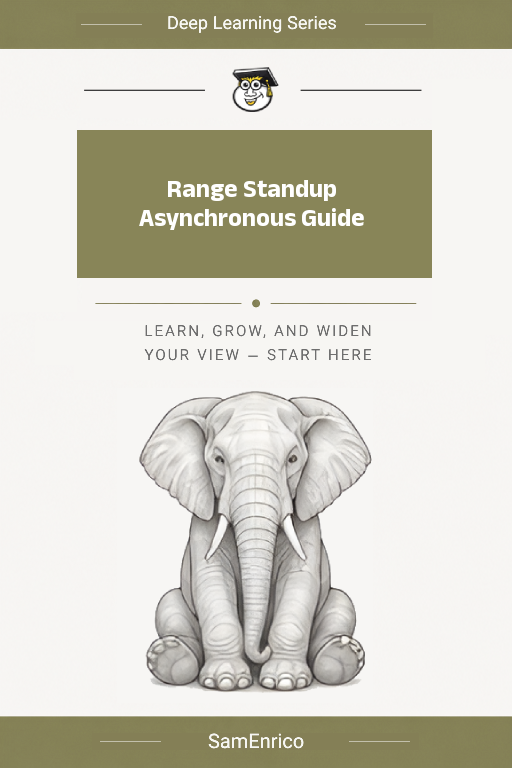
Non-FictionStartup GuideAsync Standups
Range Standup Asynchronous Guide eBook
Replace daily standups with Range asynchronous upd
by Koehler Yong
Replace daily standups with Range asynchronous updates for remote startup kanban teams.
Formats
Free sample
Chapter 1: The 15-Minute Lie--–- Maya’s alarm went off at 5:47 AM. Not because she was an early riser by choice, but because her team’s daily standup was scheduled for 9 AM Eastern Time. Maya lived in São Paulo. The math was simple: 9 AM ET meant 6 AM PT, 9 AM ET meant 2 PM GMT, and 9 AM ET meant 11 PM for her colleague in Bali. But for Maya in São Paulo, it meant 11 AM—which was actually fine for her, except that her teammate in San Francisco was yawning through the meeting at 6 AM, and the contractor in Bangkok was joining from his bedroom at 11 PM in his pajamas, careful not to wake his sleeping family.One meeting.
Fifteen minutes. Three timezones. Four ruined mornings, evenings, and everything in between.Maya had been at this remote startup for eighteen months. She loved the mission, respected her colleagues, and genuinely believed in the product. But every single morning, at 11 AM her time, she sat through a ritual that had become the most expensive fifteen minutes of her day.
Not because the meeting was long—fifteen minutes is nothing. But because the meeting was a lie. A lie dressed up in Agile clothing, sold to her team as “best practice,” and defended by managers who said, with complete sincerity, “But how will we know what everyone is working on?”The answer, Maya had come to realize, was painfully obvious: look at the Kanban board. The board already knew everything. The board had always known everything.
The board sat there, silently, in Jira, updated in real time, containing every commit, every comment, every status change, every blocker, every victory. The board was the single source of truth. And yet, every morning, eleven people logged into Zoom to verbally recite what the board already said out loud.This chapter is for Maya. And for her manager. And for the contractor in Bangkok.
And for every person who has ever sat through a daily standup and thought, “This could have been an email—or, more accurately, this could have been nothing at all.”The Origin Story of a Sacred Cow To understand why the daily standup has become the most stubbornly defended meeting in all of remote work, we have to go back to 1993. A small team of software developers in Utah was experimenting with a lightweight development methodology they would later call “Extreme Programming” (XP). Among their many innovations—test-driven development, pair programming, continuous integration—was a simple morning check-in. They called it the “daily standup” because everyone literally stood up, which had the psychological effect of keeping the meeting short. No chairs meant no comfort.
No comfort meant no long-winded updates.The original standup had three questions:What did you do yesterday?What will you do today?Is anything blocking you?That was it. Fifteen minutes maximum. Everyone standing. No laptops. No phones.
No sitting down.Here’s what the inventors of the standup did not have: remote teams. Timezone differences. Asynchronous communication tools. Kanban boards that updated in real time. Slack, Teams, or Zoom.
They had a whiteboard, a few sticky notes, and a room full of people who had all arrived at the same physical location at the same time of day.The standup was designed for co-location. It worked beautifully for co-location. And then, thirty years later, the entire world went remote, and someone said, “Let’s just do the same thing but on Zoom.”No one stopped to ask whether the assumptions still held. No one asked whether the visual board had rendered the verbal update obsolete. No one asked whether the timezone tax was worth paying.
The standup became a sacred cow—not because it was effective, but because it was familiar. And in the chaos of transitioning to remote work, familiarity felt like safety.The Three Questions That Fail Asynchronously Let us examine the three sacred questions through the lens of an asynchronous, distributed team. What we find is not a minor mismatch. We find a fundamental incompatibility.Question One: “What did you do yesterday?”In a co-located team, this question served a real purpose. The board might not have been updated.
People might have forgotten what their neighbor was working on. Verbal recaps filled information gaps.In a remote team with a properly maintained Kanban board, this question is not just redundant. It is insulting. The board already knows what you did yesterday. Every commit is logged.
Every ticket status change is timestamped. Every comment is recorded. When a manager asks this question, they are either (a) not looking at the board, or (b) testing you to see if you remember what the board already says. Neither is a good look.The developer who hears this question learns a dangerous lesson: the board does not matter. What matters is what I say in the standup.
And so they stop updating the board diligently. Why bother, when the real communication happens in the meeting? The board becomes a ghost town, and the standup becomes the only source of truth—a verbal, unrecorded, unsearchable source of truth that disappears the moment the Zoom call ends.Question Two: “What will you do today?”In a co-located team, this question enabled coordination. “I’m working on the login screen” meant someone else could say, “Oh, I’m working on the API that login screen needs—let’s sync afterward.”In a remote team, this question creates false precision. A developer’s plan for the day is already in their ticket—or should be.
The commitment is already made, visible to everyone. Asking them to recite it verbally adds no new information. Worse, it encourages over-commitment. The social pressure of saying “I’ll finish three tickets today” in front of nine peers is very different from writing “I’ll aim for two tickets today, but one is risky” in a ticket comment. Verbal standups reward optimistic lying.
Written updates reward honest estimation.Question Three: “Is anything blocking you?”In a co-located team, this question was the most valuable. A blocker identified in the morning could be resolved by lunch.In a remote team, this question fails because of time. If a developer in Bangkok is blocked at 11 PM their time, they cannot raise that blocker in a standup that happens at 9 AM Eastern. They must wait eight to twelve hours. A blocker that could have been resolved overnight instead festeres for a full day.
The standup introduces delay into the unblocking process. The very mechanism designed to remove blockers becomes a blocker itself.The alternative, as we will see in Chapter 5, is the Blocked Column Protocol: a written, asynchronous, time-bounded process that resolves blockers in hours, not days, without requiring anyone to stay up past midnight.The Timezone Tax: A Hidden Burnout Accelerant Let us return to Maya. Her standup is at 11 AM. That’s fine for her. But her colleague in San Francisco?
6 AM. Her colleague in London? 2 PM—actually fine, but their contractor in Bangkok? 11 PM.The timezone tax is not evenly distributed. It is paid most heavily by the people on the edges of the team’s geographic distribution.
And because remote teams often hire globally to access talent, someone is always on the edge.Research from Git Lab, one…
This is the end of the free sample. Get the eBook to keep going. Buy now
About this book
Details
- Author
- Koehler Yong
- Publisher
- SamEnrico
- Language
- English
- Genre
- Non-Fiction, Startup Guide, Async Standups
- Released
- 2026-05-30
- Pages (approx.)
- 144
- Available as
- eBook, Audiobook

Read better in the ZLOADR app
Your eBooks on your phone or tablet. Sign in with your SamEnrico account and start reading.
More by Koehler Yong
 London Seasonal Pop UpsKoehler Yong$11.99
 Tone of Voice De escalationKoehler Yong$11.99
 Workplace Burnout RecoveryKoehler Yong$11.99
 Virtual Collaboration ToolkitKoehler Yong$11.99
 Loneliness Recovery Through Faith CommunitiesKoehler Yong$11.99
 Honoring Parent Legacy GuideKoehler Yong$11.99
 Morning Mindfulness GuideKoehler Yong$11.99
 Grit for ConstructionKoehler Yong$11.99
 The Silk Road Scam: How Ross Ulbricht’s Empire FellKoehler Yong$11.99
 Chevalier de Saint-Georges: The Virtuoso Who Conquered VersaillesKoehler Yong$11.99
 Service Providers Guide to Embossed StationeryKoehler Yong$11.99
 How to Produce Video Game SoftwareKoehler Yong$11.99
You may also like
 Hong Kong Handover 1997Dunn Johnnie$11.99
 Zumba For Postnatal Recovery CourseNeal Christian$11.99
 Zumba for BeginnersLadner Nikia$11.99
 YouTube Comment Mining GuideHumes Pandora$12.99
 Worry Box MeditationCarlin Rudy$11.99
 Workplace Stress MeditationNguyen Lynn$11.99
 Workplace Stress and Sleep RepairHawley Ivory$11.99
 Workplace Perfectionism CureDelaney Jeffry$11.99
 Workplace Injustice Anger GuideWallen Isabelle$11.99
 Work Addiction and Burnout LinkGreenwood Ester$11.99
 Women in Yoga and WellnessBeattie Galina$11.99
 Women in Stand Up ComedyChun Evangeline$11.99