
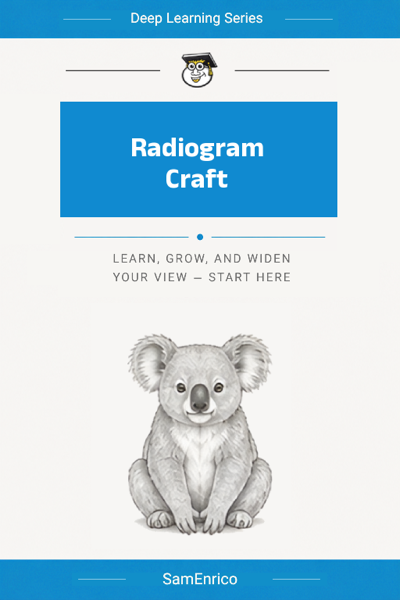
Radiogram Craft eBook
A Coursebook on Radiogram Craft
by Pride Cammy
A Coursebook on Radiogram Craft
Formats
Free sample
Chapter 1: The Shrinking Story...–- The radiogram is not a short story that has been cut down. It is a different animal entirely, one that was born short.You have likely heard the bad advice a hundred times: “Write your radio piece, then cut it in half. Then cut it again. There you go—a short audio story.” This approach, well-meaning but disastrous, treats brevity as subtraction. It assumes a 60-second radiogram is simply a 10-minute podcast episode that lost weight, like a traveler who packed too many suitcases and had to leave half at the train station.
The result, all too often, is a piece that feels rushed, breathless, and shallow—a summary of an emotion rather than the emotion itself.The truth, which this chapter will spend the next several thousand words proving, is the opposite. The radiogram is not a diminished longer work. It is a form that was born short. Its architecture, its rhythm, its relationship with silence, and its use of sound design are fundamentally different from longer audio narratives. Think of the difference between a novel and a haiku.
A haiku is not a novel with most of its words removed. A haiku is a haiku—a form whose power derives entirely from its constraints. The radiogram is the haiku of audio storytelling.This chapter will give you the conceptual framework necessary to build radiograms from the ground up, not from the top down. You will learn the psychology of audio-only media—why listeners fill in visual gaps with their own memories, making short audio more immersive than video. You will learn the three-part narrative arc adapted to 45–75 seconds, with concrete examples of setups that fit in a breath, conflicts that arrive by the third sentence, and resolutions that land like a closing door.
You will learn why silence is not empty space but a structural material, as real as wood or steel. And you will complete an exercise that forces you to write a complete story in fewer than 120 words—learning, through the pain of that constraint, why every word in a radiogram must earn its place.Let us begin with a confession. The author of this book once spent three weeks editing a radiogram about a grandfather’s pocket watch. The original script was 450 words, lyrical and sprawling, with descriptions of brass gears and the weight of the watch against a chest. The author cut it to 300 words.
Then to 200. Then to 140. Each cut felt like a small amputation. But at 118 words, something strange happened. The radiogram stopped feeling like a summary and started feeling whole.
A listener later wrote, “I could feel the watch in my hand.” Those six words—I could feel the watch in my hand—taught the author everything: the radiogram’s power is inversely proportional to its length, up to a point. Too long, and it becomes diluted. Too short, and it becomes cryptic. The sweet spot—45 to 75 seconds, 110 to 180 words—is where the listener’s imagination is most active because it has just enough information to build the world but not enough to do all the work. The listener becomes a co-creator.
And that co-creation is the secret engine of the form.The Psychology of the Incomplete Image Why does short audio feel more immersive than video? The answer lies in what neuroscientists call the “completion instinct.” When the human brain receives partial information—a voice without a face, a sound without a source, a description without a photograph—it automatically fills in the missing pieces using memory and imagination. This process is not a bug; it is a feature. It is the same mechanism that makes reading a novel more personally affecting than watching its film adaptation. In your mind’s eye, the character looks exactly as you imagine them, not as the casting director chose.Video, by contrast, provides complete information.
You see the actor’s face, the room’s wallpaper, the color of the sky. There is nothing left for you to build. You are a spectator, not a co-creator. This is why a horror film’s monster is rarely as frightening after it appears on screen; the imagination-produced monster was always scarier.The radiogram exploits this completion instinct ruthlessly. Consider two versions of the same story.
Version A (a podcast clip, 90 seconds): “I walked into my grandmother’s kitchen. The linoleum was yellowed and cracked near the stove. A blue enamel pot sat on the back burner, the same one she used for Sunday gravy. The smell of garlic and oregano hung in the air, thick enough to touch.” Version B (a radiogram, 45 seconds): “The kitchen still smelled like her. I didn’t look at the stove.” Notice the difference.
Version A describes everything, leaving nothing to the listener’s imagination. Version B describes almost nothing, forcing the listener to build the kitchen from their own grandmother’s kitchen, their own smells, their own stove. Version A is reportage. Version B is an invitation.The radiogram’s job is not to tell the listener what to see. It is to make the listener see something—and to trust that what they see will be more powerful than anything you could have described.
This requires a profound shift in mindset for writers trained in long-form narrative. You must learn to be comfortable with incompleteness. You must learn to stop describing after the second or third detail, leaving the rest as negative space. In visual art, negative space is the area around and between subjects. In audio, negative space is the unsaid, the implied, the detail you trust the listener to supply.A practical test: after writing a draft of a radiogram, underline every adjective and every specific noun (blue enamel pot, cracked linoleum).
Then remove half of them. Read the result aloud. Nine times out of ten, the shorter version will feel more intimate, not less. The listener will lean in, filling the gaps with their own lived experience. That leaning in—that small physical movement toward the speaker—is the radiogram’s primary physiological effect.
You are not broadcasting to a passive audience. You are whispering to someone who has turned their head to hear you better.The Three-Sentence Arc Traditional narrative structure—setup, conflict, resolution—works beautifully for the radiogram, but the timing is radically compressed. In a 20-minute podcast episode, the setup might last several minutes. In a radiogram, the setup often lasts three sentences. Do not mistake this for rushing.
Rushing is when you cram too much information into too little time. Compression is when you choose exactly the right information and no more.Let us examine a complete radiogram that follows this structure. The piece, titled “Keys,” runs 52 seconds and 128 words. It was produced by a student in a radiogram workshop and later aired on a public radio affiliate.Setup (first three sentences, 12 seconds):“My father lost his keys every morning. Not misplaced.
Lost, as in the house could not continue until the keys were found. I would watch from the stairs as he patted his pockets, each pat more desperate than the last.”Conflict (next four sentences, 20 seconds):“One morning, I hid them. I was seven. I thought…
This is the end of the free sample. Get the eBook to keep going. Buy now
About this book
Details
- Author
- Pride Cammy
- Publisher
- SamEnrico
- Language
- English
- Genre
- Non-Fiction, Informative, Educational
- Released
- 2026-05-11
- Pages (approx.)
- 130
- Available as
- eBook, Audiobook

Read better in the ZLOADR app
Your eBooks on your phone or tablet. Sign in with your SamEnrico account and start reading.
More by Pride Cammy
 Incubation For Perfectionism CoursePride Cammy$11.99
 Active Listening For PilotsPride Cammy$11.99
 Making Amends After Angry ParentingPride Cammy$11.99
 The IBS and Migraine GuidePride Cammy$11.99
 The Values And Mission Alignment OnboardingPride Cammy$11.99
 Whispers of the Forgotten Ones: The Lost Children of PompeiiPride Cammy$11.99
 How to Become a Plastics-spreading-machine OperatorPride Cammy$11.99
 Cultural Fit Customer SupportPride Cammy$12.99
 Small Exporter Payment HacksPride Cammy$12.99
 Understanding Thoracolaryngopelvic DysplasiaPride Cammy$17.99