
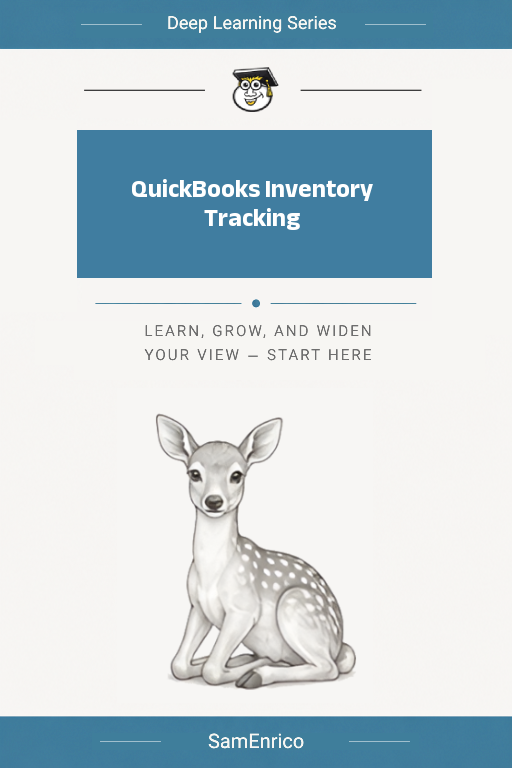
QuickBooks Inventory Tracking
Set up inventory tracking in QuickBooks Online. Ad
Set up inventory tracking in QuickBooks Online. Add products, track quantities, and calculate COGS.
Formats
About this book
Free sample
Chapter 1: The Cash Trap--– You are probably sitting on more cash than you realize. You are also probably losing more cash than you realize. And the strange thing is, both statements can be true about the exact same pile of boxes stacked in your garage, your back office, or your third-party warehouse.Let me show you what I mean.Imagine you own a small business that sells handmade leather bags. Last month, you bought 20,000worthofleather,hardware,andpackaging.Youwrotethecheck.Yourbankaccountbalancedroppedby20,000 worth of leather, hardware, and packaging. You wrote the check.
Your bank account balance dropped by 20,000worthofleather,hardware,andpackaging.Youwrotethecheck.Yourbankaccountbalancedroppedby20,000. You feel poorer. Your spouse asks why you spent so much. You stay up late worrying about cash flow.But here is what your bank account does not know. Those raw materials are now inventory.
And that inventory is still an asset. It is just cash in a different costume—one that cannot pay rent or make payroll, but one that will eventually turn back into cash when a customer buys a bag. The $20,000 is not gone. It has shapeshifted.Now imagine you sell ten bags for 500each.Totalrevenue:500 each. Total revenue: 500each.Totalrevenue:5,000.
You deposit the money. Your bank account goes up. You feel richer. You take your team out for lunch to celebrate.But here is what your bank account does not know. Each bag used 200ofmaterials.Thatmeansyourtrueprofitisnot200 of materials.
That means your true profit is not 200ofmaterials.Thatmeansyourtrueprofitisnot5,000. It is 5,000minus5,000 minus 5,000minus2,000, or 3,000.Theother3,000. The other 3,000.Theother2,000 is not profit. It is reimbursement for the inventory you gave up. That $2,000 is called Cost of Goods Sold, or COGS.If you do not track COGS correctly, you will make two catastrophic mistakes.
First, you will think you are richer than you actually are. Second, you will pay taxes on money that was never really yours.This chapter exists because that scenario—the cash trap—plays out thousands of times every day in small businesses across the country. Business owners watch their bank accounts bounce up and down, but they have no idea which transactions are genuinely profitable and which are…
This is the end of the free sample. Get the eBook to keep going. Buy now
Contents
- Chapter 1
- Chapter 2
- Chapter 3
- Chapter 4
- Chapter 5
- Chapter 6
- Chapter 7
- Chapter 8
- Chapter 9
- Chapter 10
- Chapter 11
- Chapter 12
Details
- Author
- Torrence Steffanie
- Publisher
- SamEnrico
- Language
- English
- Genre
- Non-Fiction, First 30 Days, Bookkeeping
- Released
- 2026-05-29
- Pages (approx.)
- 141
- Available as
- eBook, Audiobook

Read better in the ZLOADR app
Your eBooks on your phone or tablet. Sign in with your SamEnrico account and start reading.
More by Torrence Steffanie
 The Zen Commuter PodcastTorrence Steffanie$11.99
 Deep Work Interruption Protection CourseTorrence Steffanie$11.99
 IELTS Task 2 Essay PromptsTorrence Steffanie$11.99
 Divorce and Sibling RelationshipTorrence Steffanie$11.99
 The Nutrition Sleep Memory LinkTorrence Steffanie$11.99
 The Phantom of the Grand Canal: Venice's Architectural EnigmaTorrence Steffanie$11.99
 How to Start a Temporary Shelters BusinessTorrence Steffanie$11.99
 Association ManagerTorrence Steffanie$11.99
 Banking M&A GuideTorrence Steffanie$12.99
 Understanding Piussan–lenaerts–mathieu SyndromeTorrence Steffanie$17.99
You may also like
 QuickBooks Reconciliation GuideGriswold Christian$12.99
 Wave Tax Reports GuideLogsdon Maryanne$12.99
 Wave Reconciliation GuideCase Paulina$12.99
 QuickBooks vs Wave Comparison GuideBaugh Asuncion$12.99
 QuickBooks Tax Preparation GuideSessions Lavonia$12.99
 QuickBooks Payroll Setup GuideShaver Stephnie$12.99
 QuickBooks Mobile App GuideEbert Emery$12.99
 QuickBooks for Retail GuideKnapp Lanny$12.99
 QuickBooks for Contractors GuideFairbanks Ferne$12.99
 QuickBooks Error Fixing GuidePridgen Waldo$12.99
 QuickBooks Desktop vs Online GuideMccauley Lenora$12.99
 QuickBooks Data Backup GuideHoang Joeann$12.99