
Non-FictionInformativeEducational
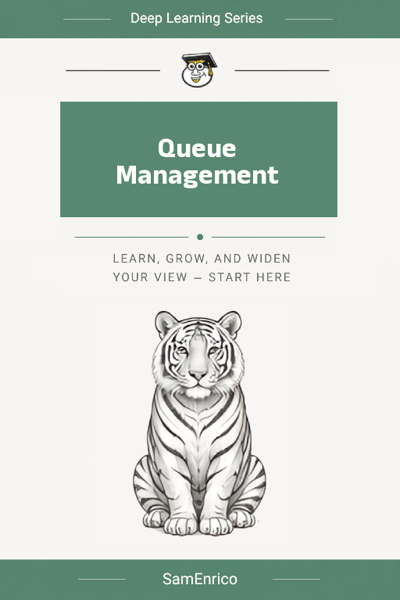
Queue Management Audiobook
A Coursebook on Queue Management
A Coursebook on Queue Management
Formats
Free sample
Chapter 1: The Hidden Cost--“Why do we tolerate waiting?”This question, posed by a frustrated bank manager to a young consultant in 1978, sparked a revolution in how we think about queues. The manager had noticed something puzzling: his bank had the fastest tellers in the district, yet customer complaints about “slow service” were higher than ever. He had installed new computers, streamlined processes, and measured transaction times obsessively. By every objective metric, his bank was excellent. But his customers disagreed.The consultant—a psychologist named David Maister who would later codify the principles in this chapter—watched the lobby for an afternoon.
He noticed that customers arrived, glanced at the length of the line, and immediately tensed up. They stood in silence, watching the tellers’ every move, checking their watches every thirty seconds. When they finally reached the window, they were already irritated. The transaction itself, which took forty-five seconds on average, felt like an eternity to them.Maister’s diagnosis changed everything: the bank had focused entirely on actual wait time while ignoring perceived wait time. The customers weren’t angry about how long they waited.
They were angry about how the waiting felt.This chapter opens our journey into queue management by establishing a fundamental truth that most textbooks overlook: before you can solve a queue, you must understand why waiting matters in the first place. Queues are not merely mathematical abstractions or computer science problems. They are economic engines and psychological battlegrounds. A queue that is mathematically optimal can still be a business disaster if it feels unfair. A queue that is technically inefficient can still delight customers if it manages their perception skillfully.We will explore three interconnected domains in this chapter: the economics of waiting (what does a minute of customer time actually cost?), the psychology of waiting (why do two identical waits feel completely different?), and the hidden architecture of queues (where do waiting lines actually exist in modern life?).
By the end, you will see queues everywhere—not as nuisances, but as opportunities.The Economics of Waiting: Why a Minute Costs More Than a Minute Every queue imposes two costs: one borne by the customer (time) and one borne by the provider (resources). The interplay between these costs determines whether a queueing system is profitable, sustainable, or destined for failure.Direct Costs: What You Lose When Customers Wait Let us begin with a simple question: what…
This is the end of the free sample. Get the Audiobook to keep going. Buy now
About this book
Details
- Author
- Samples Carie
- Publisher
- SamEnrico
- Language
- English
- Genre
- Non-Fiction, Informative, Educational
- Released
- 2026-06-02
- Pages (approx.)
- 150
- Available as
- eBook, Audiobook

Listen in the VoxFlicks app
Audiobooks and audio dramas wherever you go. Sign in with your SamEnrico account and press play.
More by Samples Carie
 Elastic Cloud Outage GuideSamples Carie$11.99
 Effortless Transcending TechniqueSamples Carie$11.99
 The Anki Flashcard Memory GuideSamples Carie$11.99
 Selling Inherited Property in RetirementSamples Carie$11.99
 Work Stress Spillover PreventionSamples Carie$11.99
 Starlight Odyssey: The Lost Mission of Pioneer 10Samples Carie$11.99Starlight Odyssey: The Lost Mission of Pioneer 10Samples Carie$11.99
 Understanding W SyndromeSamples Carie$17.99
 Third Party Links TermsSamples Carie$12.99
 Startup Visa Community GuideSamples Carie$12.99
 How to Start a Basins Made of Fibre-cement Business (Beginners Guide)Samples Carie$11.99
You may also like
 Hong Kong Handover 1997Dunn Johnnie$11.99
 Zumba For Postnatal Recovery CourseNeal Christian$11.99
 Zumba for BeginnersLadner Nikia$11.99
 YouTube Comment Mining GuideHumes Pandora$12.99
 Worry Box MeditationCarlin Rudy$11.99
 Workplace Stress MeditationNguyen Lynn$11.99
 Workplace Stress and Sleep RepairHawley Ivory$11.99
 Workplace Perfectionism CureDelaney Jeffry$11.99
 Workplace Injustice Anger GuideWallen Isabelle$11.99
 Work Addiction and Burnout LinkGreenwood Ester$11.99
 Women in Yoga and WellnessBeattie Galina$11.99
 Women in Stand Up ComedyChun Evangeline$11.99