
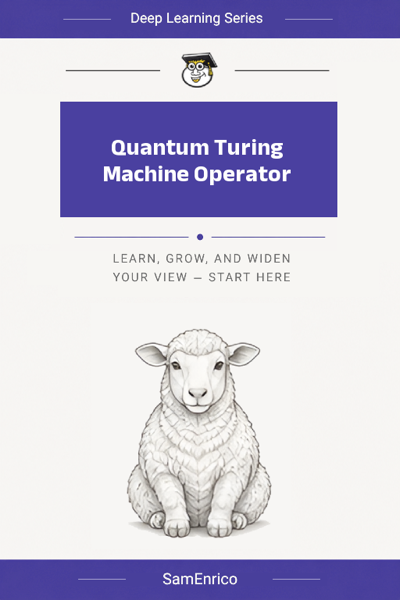
Quantum Turing Machine Operator Audiobook
A Coursebook on Quantum Turing Machine Operator
A Coursebook on Quantum Turing Machine Operator
Formats
Free sample
Chapter 1: The Last Question--It was 1936, and a young Cambridge mathematician named Alan Turing asked a question so strange, so unsettling, that most of his contemporaries didn't fully grasp its implications for decades. He didn't ask what computers could do. He asked what they could never do. He imagined a machine — not a physical machine of gears and relays, but a mathematical ghost — that could read symbols from an infinite paper tape, move left or right one cell at a time, and change its internal state according to a simple table of rules. This imaginary device, which history would call the Turing machine, was deliberately, almost insultingly simple.
It had no personality, no cleverness, no shortcuts. It was the dumbest possible machine that could still be called a computer.And yet, from that lowly starting point, Turing proved something breathtaking: a single universal Turing machine could simulate any other Turing machine. In other words, one machine could run any program. Every algorithm, every computation, every piece of software you have ever used — from a pocket calculator to a weather simulation on a supercomputer — is, in a very real mathematical sense, just a particular Turing machine running on that universal engine. This insight became the bedrock of the digital age.
Every computer you have ever touched is a physical approximation of Turing's ghost.But Turing also found the door that cannot be opened. He proved that there are questions the machine cannot answer. The most famous is the halting problem: given a program and its input, can you decide whether the program will eventually stop or run forever? Turing proved that no Turing machine can solve this problem for all possible programs. It's not that we haven't found the clever algorithm yet.
It's that no such algorithm can exist. Ever. The halting problem is undecidable. This was not a failure of engineering. It was a law of the mathematical universe, as fixed as gravity.Now fast forward nearly a century.
We are building a new kind of machine, one that Turing himself glimpsed in a second paper in 1947, but that no one fully understood until the 1980s. The Quantum Turing Machine (QTM) replaces the classical tape of bits with a tape of qubits. The head doesn't just read 0 or 1 — it enters a superposition of reading both. The state of the machine becomes a cloud of possibilities, interfering with…
This is the end of the free sample. Get the Audiobook to keep going. Buy now
About this book
Details
- Author
- Farnsworth Milan
- Publisher
- SamEnrico
- Language
- English
- Genre
- Non-Fiction, Informative, Educational
- Released
- 2026-06-02
- Pages (approx.)
- 153
- Available as
- eBook, Audiobook

Listen in the VoxFlicks app
Audiobooks and audio dramas wherever you go. Sign in with your SamEnrico account and press play.
More by Farnsworth Milan
 Indifference Curve AnalysisFarnsworth Milan$11.99
 The Real Housewives ReunionFarnsworth Milan$11.99
 Menopause Instagram AccountsFarnsworth Milan$11.99
 Body Scan for CaregiversFarnsworth Milan$11.99
 The Vanishing Prince: The Unresolved Kidnapping of a Royal Heir in Ottoman SyriaFarnsworth Milan$11.99
 How to Produce Activity Monitor AccessoriesFarnsworth Milan$11.99
 Learning Resources for DevelopmentFarnsworth Milan$12.99
 How to Start a Billets Made of Aluminium Business (Beginners Guide)Farnsworth Milan$11.99