
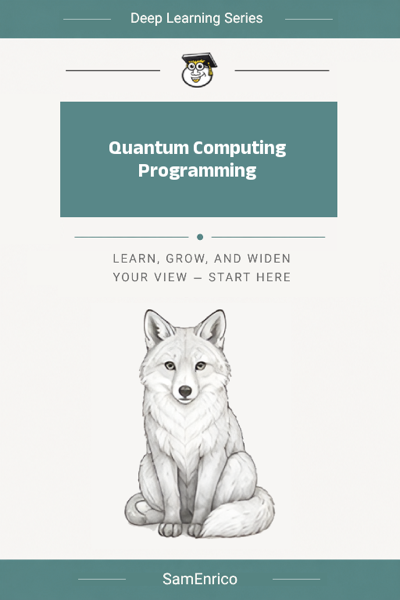
Quantum Computing Programming Audiobook
A Coursebook on Quantum Computing Programming
A Coursebook on Quantum Computing Programming
Formats
Free sample
Chapter 1: The Exponential Abyss...--–- Imagine standing at the edge of a canyon so vast that the opposite rim is invisible, even with the strongest telescope. Now imagine that each step you take forward doubles the width of the canyon. That is the problem classical computers face when trying to simulate quantum mechanics. It is not a matter of building faster processors or adding more memory chips. It is a fundamental, mathematical wall that grows exponentially with every single qubit you add. This chapter will show you why that wall exists, why it matters for quantum computing, and how the qubit—a radical departure from everything you know as a programmer—lets us step past it.The Memory Wall No One Talks About In classical computing, we are spoiled by linear scaling. If you need to process twice as much data, you buy twice as much RAM or wait twice as long. Your laptop with 16 gigabytes of memory can handle a photo with 20 million pixels. A server with 256 gigabytes can handle a 4K video stream. This linear relationship between resources and problem size feels like a law of nature, but it is only an accident of classical physics.Quantum mechanics breaks that accident.Consider a single classical bit. It can be 0 or 1. To simulate its state, your computer needs exactly one bit of memory. Two classical bits require two bits of memory. One thousand classical bits require one thousand bits. The relationship is perfectly linear: memory equals the number of bits. This is why classical simulation feels so predictable.Now consider a single qubit. Its state is not just 0 or 1. It is a complex vector ∣ψ⟩=α∣0⟩+β∣1⟩|\psi\rangle = \alpha|0\rangle + \beta|1\rangle∣ψ⟩=α∣0⟩+β∣1⟩, where α\alphaα and β\betaβ are complex numbers satisfying ∣α∣2+∣β∣2=1|\alpha|^2 + |\beta|^2 = 1∣α∣2+∣β∣2=1. To store this single qubit accurately in classical memory, you need to store two complex numbers. Each complex number requires two floating-point values (real and imaginary parts). Using standard 64-bit precision, that is 32 bytes for a single qubit. That is already 32 times larger than a classical bit, but the real problem comes next.Two qubits require storing four complex coefficients: α00∣00⟩+α01∣01⟩+α10∣10⟩+α11∣11⟩\alpha_{00}|00\rangle + \alpha_{01}|01\rangle + \alpha_{10}|10\rangle + \alpha_{11}|11\rangleα00∣00⟩+α01∣01⟩+α10∣10⟩+α11∣11⟩. That is four complex numbers, or 64 bytes. The memory requirement doubled from one qubit to two. Three qubits require eight coefficients—128 bytes. Four qubits require sixteen coefficients—256 bytes.You see the pattern. The number of coefficients grows as…
This is the end of the free sample. Get the Audiobook to keep going. Buy now
About this book
Details
- Author
- Wilks Deandra
- Publisher
- SamEnrico
- Language
- English
- Genre
- Non-Fiction, Informative, Educational
- Released
- 2026-05-08
- Pages (approx.)
- 132
- Available as
- eBook, Audiobook

Listen in the VoxFlicks app
Audiobooks and audio dramas wherever you go. Sign in with your SamEnrico account and press play.
More by Wilks Deandra
 The Empathy in Customer Service GuideWilks Deandra$11.99
 Creativity TriggerWilks Deandra$11.99
 PCOS Inflammatory Type GuideWilks Deandra$11.99
 HRT For Skin Hair Aging HandbookWilks Deandra$11.99
 Semiconductor Investment StrategyWilks Deandra$11.99
 The Painter Who Captured the Soul of Africa: William John Burchell’s Unseen LandscapesWilks Deandra$11.99
 Understanding Pentalogy of CantrellWilks Deandra$17.99
 Illumina SequencingWilks Deandra$12.99
 Stripe vs Paystack Comparison GuideWilks Deandra$12.99
 How to Become a Tumor RegistrarWilks Deandra$11.99