
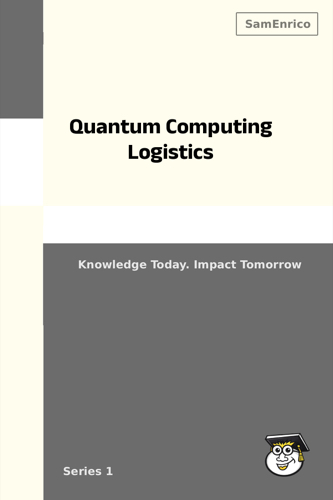
Quantum Computing Logistics eBook
Solve complex routing and network optimization wit
Solve complex routing and network optimization with emerging quantum systems.
Formats
Free sample
Chapter 1: The Midnight Crash...–- Maria Torres stared at her screen, watching the spinning wheel of death. It was 11:47 PM on the Tuesday before Thanksgiving, and her route optimization software had just frozen for the third time in two hours. Outside her window, the Port of Los Angeles glittered like a trapped constellation—containers stacked ten high, trucks idling in endless queues, and somewhere in that chaos, $47 million worth of holiday inventory that was supposed to be on shelves by Friday.The spinning wheel continued to spin.She picked up her phone and dialed her counterpart at Nexa Logix, a rival she both respected and resented. "Tell me the truth," she said when he answered. "How are you doing it?"There was a long pause.
"Maria, I can't—""Tom, please. My system just tried to route 847 vehicles with 3,200 stops and a flash snowstorm moving through the Rockies. It's been 38 minutes. I still don't have routes. Your trucks are on the road.
How?"Another pause, longer this time. Then Tom lowered his voice. "We started a quantum pilot six months ago. Hybrid annealing. It's not perfect, but our re-optimization latency is down to eleven seconds."Maria felt the floor drop beneath her feet.
"Eleven seconds?""The board doesn't even ask about logistics costs anymore. They ask when we're expanding the quantum team."He hung up. The spinning wheel continued to spin.Maria leaned back in her chair, the weight of the moment settling into her bones. Nexa Logix wasn't faster or smarter or richer than Axiom Goods. They had just stopped using computers the way everyone else did.
They had stopped guessing.The $47 Million Question This book is about that moment. It is about the mathematical wall that every logistics network hits—and the emerging quantum systems that can climb over it.Before we go any further, let me tell you what this book is not. It is not a physics textbook. You will not need to understand wave functions or Hilbert spaces or the difference between a Hadamard gate and a Pauli-X gate. I am going to translate quantum mechanics into the language of trucks, warehouses, shipping containers, and delivery windows.
If you can understand a spreadsheet, you can understand this book.What this book is is a strategic playbook for the next decade of logistics. It is written for three audiences:Executives (CEOs, VPs of Supply Chain, Logistics Directors) who need to understand why quantum computing is not a science experiment but a competitive weapon—and what to do about it before their rivals figure it out.Practitioners (data scientists, operations research analysts, logistics engineers) who need the technical framework to start piloting hybrid quantum systems today.Researchers (academics, quantum physicists, Ph.D. students) who want to see how their work applies to a $4 trillion global logistics industry.I have written the book so that each audience can find what they need. The Reader's Guide at the front of the book tells executives which chapters to focus on, practitioners which technical appendices to study, and researchers which citations to chase. But every reader should start here, with Chapter 1, because the problem we are solving is the same regardless of your role.The Combinatorial Explosion Let me show you why Maria's software crashed.Imagine you have one delivery truck.
It has five stops to make in a single day. How many possible routes are there? The answer is 120—five factorial, or 5 × 4 × 3 × 2 × 1. That is trivial. A spreadsheet could solve it.Now imagine ten stops.
The number of possible routes is 3,628,800. Your laptop can still solve it, though it might take a few seconds.Fifteen stops. The number of possible routes is 1.3 trillion. Now we are talking about serious computation.Twenty stops. The number of possible routes is 2.4 quintillion.
That is 2.4 × 10¹⁸. For perspective, there are about 7.5 × 10¹⁸ grains of sand on all the beaches on Earth. You are now looking for the best possible route among a number of possibilities roughly equal to every grain of sand on every beach, multiplied by three.Fifty stops. The number of possible routes is roughly 3 × 10⁶⁴. That is more than the number of atoms in the observable universe, which is about 10⁸⁰.
Wait—let me check that math. Actually, 50 factorial is about 3 × 10⁶⁴, and the number of atoms in the universe is about 10⁸⁰, so the routes are fewer than the atoms. But if you push to 60 stops, you get approximately 8 × 10⁸¹—more routes than atoms in the universe.Maria had 847 vehicles and an average of 12 stops per vehicle, but the stops were interdependent because of shared inventory and time windows. Her system was effectively trying to solve a problem with roughly 8,000 variables. The number of possible solutions was not just larger than the number of atoms in the universe.
It was larger by a factor so absurd that the universe does not contain enough atoms to even count the number of zeros.This is the combinatorial explosion. It is the fundamental mathematical barrier that makes logistics optimization so hard.Key Insight: The number of possible routes grows factorially with the number of stops. Factorial growth makes exponential growth look lazy.Traveling Salesman, Vehicle Routing, and Your Daily Reality The purest form of this problem is called the Traveling Salesman Problem (TSP) . A salesman needs to visit a set of cities exactly once and return to the starting point. What is the shortest possible route?
That is TSP. It sounds simple because it is simple to state. But it is monstrously hard to solve optimally once the number of cities exceeds about 20.In the real world of logistics, TSP is not enough. You have multiple vehicles, not one. That is the Vehicle Routing Problem (VRP) .
You have capacity constraints (trucks can only hold so much weight or volume). You have time windows (deliveries that must happen between 2 PM and 4 PM). You have driver hours regulations. You have traffic patterns that change by the hour. You have weather.
You have customers who add or cancel orders after the routes are already planned.The real world is not TSP. The real world is VRP with time windows, capacity constraints, multiple depots, heterogeneous fleets, and stochastic demand—and that is just Tuesday morning.Classical computers are extraordinarily good at solving problems that scale polynomially. If the problem size doubles and the computation time quadruples (quadratic scaling), that is fine. If it octuples (cubic scaling), that is still manageable for small problems.But logistics problems scale exponentially or factorially. Double the number of stops, and the number of possible routes does not double—it squares, then cubes, then explodes.This is not a matter of building faster classical computers.
Moore's Law—the observation that transistor density doubles roughly every two years—has been slowing down for a decade. Even if it were still running at full speed, exponential growth in problem size would outrun exponential growth in computing power. That is the cruel mathematics of NP-Hard problems: making the computer faster only postpones the wall. It does not remove it.Why "Good Enough" Is Costing You a Fortune Most logistics professionals have made peace with this reality. They do not solve VRP optimally.
They solve it heuristically—using rules of thumb, approximations, and clever algorithms that find a good route, not the best route.The…
This is the end of the free sample. Get the eBook to keep going. Buy now
About this book
Details
- Author
- Salcedo Nicolasa
- Publisher
- SamEnrico
- Language
- English
- Genre
- Non-Fiction, Forecast & Outlook, Quantum Logistics
- Released
- 2026-06-06
- Pages (approx.)
- 153
- Available as
- eBook, Audiobook

Read better in the ZLOADR app
Your eBooks on your phone or tablet. Sign in with your SamEnrico account and start reading.
More by Salcedo Nicolasa
 Mindfulness for Grief BeginnersSalcedo Nicolasa$11.99
 Anki For CFA ExamSalcedo Nicolasa$11.99
 The Family Alcoholism GuideSalcedo Nicolasa$11.99
 CrossFit Gymnastics Skills GuideSalcedo Nicolasa$11.99
 Voice Tone Confidence GuideSalcedo Nicolasa$11.99
 Ideal Final Result for BusinessSalcedo Nicolasa$11.99
 Distraction Management for StudentsSalcedo Nicolasa$11.99
 The Wolf of the Steppe: Subutai's Unstoppable Campaigns (1200s AD)Salcedo Nicolasa$11.99
 The Brilliant Mind of Lewis Latimer: Lighting Up the WorldSalcedo Nicolasa$11.99
 How to Produce Engineering and Construction MachinerySalcedo Nicolasa$11.99
 South Africa Business Credit Rehabilitation WorkbookSalcedo Nicolasa$12.99
 Free Event Software ToolkitSalcedo Nicolasa$12.99