
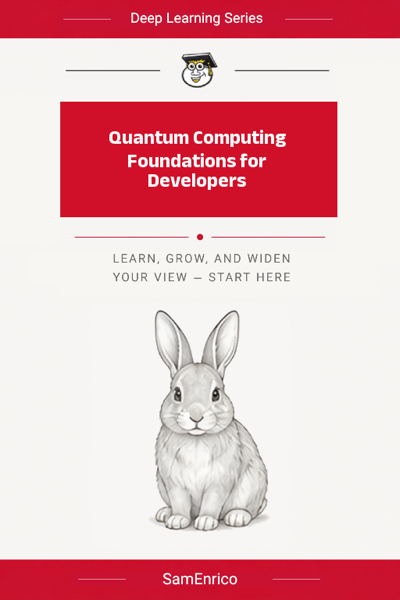
Non-FictionInformativeEducational
Quantum Computing Foundations for Developers eBook
A Coursebook on Quantum Computing Foundations for
by Pitt Cody
A Coursebook on Quantum Computing Foundations for Developers
Formats
Free sample
Chapter 1: The Clock Stops Here--–- The laptop on your desk, even the most powerful one, operates on a lie. It’s a beautiful, practical, century-old lie, but a lie nonetheless. The lie is that information is made of bits—tiny, definitive switches that are either a 0 or a 1. This lie has given us the internet, artificial intelligence, and global financial systems. But deep in the basement of physics, a more fundamental truth was discovered nearly a century ago, a truth that the architects of our classical computers chose to ignore for the sake of practicality. That truth is this: at the smallest scales, a switch can be both 0 and 1 at the same time. A coin can be spinning in the air, neither heads nor tails until it lands. A qubit is that spinning coin. And if you learn to harness that spin, you can perform computations that would take every classical computer on Earth longer than the age of the universe.The End of Free Lunch For over fifty years, the technology industry has enjoyed a free lunch. This lunch was called Moore’s Law. Gordon Moore, a co-founder of Intel, observed in 1965 that the number of transistors on a microchip doubled roughly every two years. This wasn't a law of physics; it was a goal, a pact, an engine of incredible economic and technological growth. Every two years, computers got roughly twice as fast and twice as cheap. Your smartphone today has more computing power than the supercomputers that put a man on the moon. This relentless march of shrinking transistors has defined the modern era.But the lunch is over. The tray is empty. The kitchen is closed.We have hit a wall, a physical barrier that no amount of clever engineering can transcend. Transistors are now so small—measured in nanometers, just a few dozen atoms wide—that the strange, counterintuitive rules of quantum mechanics have begun to interfere with their operation. Electrons “leak” through barriers they shouldn’t be able to cross. Heat dissipation becomes impossible. The act of making a transistor smaller to make it faster is no longer guaranteed to work. Moore’s Law is dead. It died around 2020, give or take a few years, but like a ghost, its expectations still haunt the industry.This is not a temporary slowdown. It is a fundamental end to the era of classical scaling. We cannot build a transistor that is smaller than an atom. We have reached the end of that particular road.The problem, however, is that our desire for computation is not ending. It is exploding. We want to simulate complex molecules for drug discovery, a task that requires keeping track of every electron interacting with every nucleus. A classical computer must approximate this, making guesses. A quantum computer could, in principle, simulate it exactly. We want to break the cryptographic codes that secure the global internet. That task, factoring a large number into its primes, is exponentially hard for a classical computer. We want to build perfect artificial intelligence, optimize global supply chains, and design room-temperature superconductors. These problems are not getting easier; they are getting harder.The classical computer, for all its glory, has a fundamental architectural limitation. It processes information in a long, linear sequence of operations. It’s like a single chef in a kitchen trying to prepare a 100-course meal, one dish at a time. Even if you parallelize with many cores, you are still limited by the physics of how many chefs you can fit in the kitchen. There is a better way. Instead of one chef, imagine a kitchen where every single ingredient is connected to every other ingredient in a superposition of states, and stirring one pot instantly stirs every other pot. That is the quantum promise.The Bit vs. The Qubit: A New Type of Coin Let’s start with the most fundamental unit of computing: the bit. A classical bit is a binary digit. It can be either 0 or 1. There is no in-between. It’s like a coin lying flat on a table. It is either heads or tails. It is a single piece of information. Your computer has billions of these bits, stored as tiny electrical charges in transistors.Now, imagine instead of lying flat on the table, you spin the coin. Flick it high into the air. While it is spinning, is it heads or tails? The answer is philosophically uncomfortable: it is both, and it is neither. It exists in a blur of possibilities. That blur is called superposition, and the spinning coin is a qubit (quantum bit).A qubit is the quantum mechanical analogue of a classical bit. However, instead of existing in a definite state of 0 or 1, a qubit exists in a superposition of both states simultaneously. We write this mathematically as a combination: |ψ⟩ = α|0⟩ + β|1⟩. The Greek letters α and beta (β) are complex numbers (more on that in Chapter 3) that represent the probability amplitudes of the qubit being found in 0 or 1.If you reach out and catch the spinning coin (an act called measurement), the superposition collapses. It becomes definitely heads or definitely tails. There is no memory of the spin. The act of looking forces reality to choose. This is not a metaphor for ignorance—the coin was not secretly heads the whole time. According to quantum mechanics (and verified by countless experiments), the coin was genuinely in a blurry, undecided state until you looked.This bizarre property—the ability to exist in a combination of states—is not a quirk. It is the fuel for quantum computation.How many numbers can a classical bit represent? One: either 0 or 1.How many numbers can a qubit represent? One: when you measure it, you get either 0 or 1.So what’s the difference? The difference is not about storage, but about operation. A single qubit, while in superposition, can participate in a calculation as if it were both a 0 and a 1 at the same time. Two classical bits can represent one of four possible states: 00, 01, 10, 11. They can only be one of those at a time. Two qubits, entangled together in superposition, can represent all four of those states simultaneously. This is not simply 4x more information. It is exponential. An n-qubit quantum computer can operate on 2^n states in parallel. For n=300, that is more states than there are atoms in the observable universe. The classical computer must labor through those states one by one. The quantum computer can, in a sense, consider them all at once.This is why the end of Moore’s Law is not the end of progress. It is the beginning of a new kind of progress, built on a different substrate: the quantum substrate.The NISQ Era: Noisy, Imperfect, and Revolutionary If you’ve read a news article about quantum computers, you might think they are already here, solving problems. The truth is more nuanced and, in some ways, more exciting. We are currently living in the NISQ (Noisy Intermediate-Scale Quantum) era. Let’s break that down:Noisy: Qubits are incredibly fragile. The “spinning coin” is easily disrupted by heat, electromagnetic radiation, cosmic rays, or even just the stray energy from a nearby electron. This disruption is called decoherence.…
This is the end of the free sample. Get the eBook to keep going. Buy now
About this book
Details
- Author
- Pitt Cody
- Publisher
- SamEnrico
- Language
- English
- Genre
- Non-Fiction, Informative, Educational
- Released
- 2026-06-03
- Pages (approx.)
- 153
- Available as
- eBook, Audiobook

Read better in the ZLOADR app
Your eBooks on your phone or tablet. Sign in with your SamEnrico account and start reading.
More by Pitt Cody
 Teen Screentime BalancePitt Cody$11.99
 Famous People With MDDPitt Cody$11.99
 Classic Stand-Up StoriesPitt Cody$11.99
 Glasses Without A ParentPitt Cody$11.99
 The Sleep and Skin Aging GuidePitt Cody$11.99
 The Alchemy of Florence: Machiavelli, Medici, and the Birth of Modern SciencePitt Cody$11.99
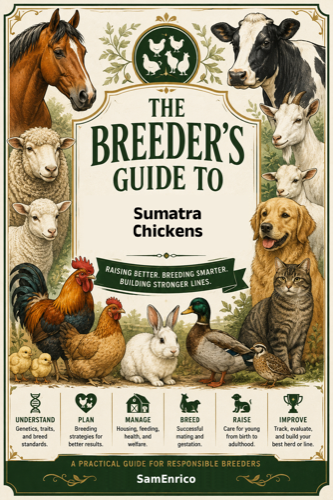 The Breeder's Guide to Sumatra ChickensPitt Cody$11.99
 Startup Profit & Loss GuidePitt Cody$12.99
 Domain Name Escrow ServicePitt Cody$12.99
 A Beginners Guide to Hare and Tortoise (Volume 1)Pitt Cody$11.99
You may also like
 Hong Kong Handover 1997Dunn Johnnie$11.99
 Zumba For Postnatal Recovery CourseNeal Christian$11.99
 Zumba for BeginnersLadner Nikia$11.99
 YouTube Comment Mining GuideHumes Pandora$12.99
 Worry Box MeditationCarlin Rudy$11.99
 Workplace Stress MeditationNguyen Lynn$11.99
 Workplace Stress and Sleep RepairHawley Ivory$11.99
 Workplace Perfectionism CureDelaney Jeffry$11.99
 Workplace Injustice Anger GuideWallen Isabelle$11.99
 Work Addiction and Burnout LinkGreenwood Ester$11.99
 Women in Yoga and WellnessBeattie Galina$11.99
 Women in Stand Up ComedyChun Evangeline$11.99