
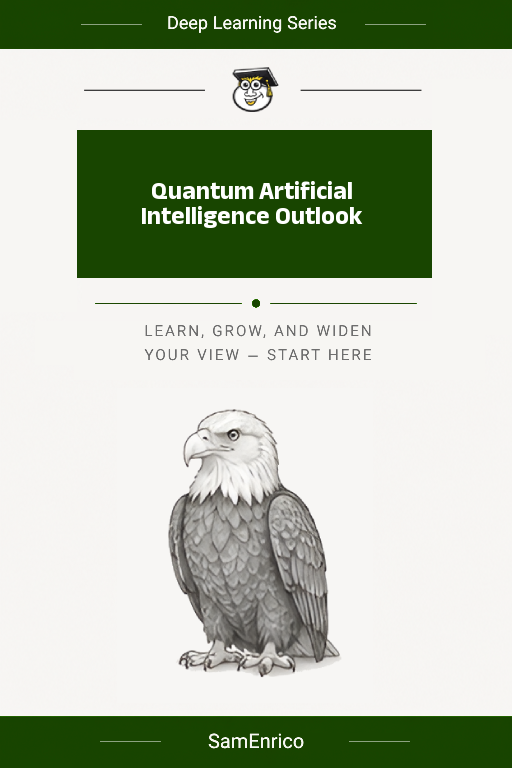
Non-FictionForecast & OutlookQuantum Computing
Quantum Artificial Intelligence Outlook eBook
Project timeline for quantum advantage in ML train
by Shook Keira
Project timeline for quantum advantage in ML training, optimization problems, and cryptography, plus hybrid classical-quantum systems through 2030.
Formats
Free sample
Chapter 1: The Fire Next Time--The first time a human being rubbed two sticks together and produced a flame, they did not understand combustion chemistry, oxidation, or exothermic reactions. They understood only that something impossible had just become possible—and that the world would never be the same. Fire did not replace the hunter's spear or the gatherer's basket. It transformed what those tools could achieve. It turned raw meat into sustenance, dark caves into sanctuaries, and clay into vessels that could hold water and grain.
Fire was not a replacement for the existing technologies of the Paleolithic era. It was an accelerator, a catalyst, a co-processor for the human enterprise.We stand at a similar threshold today. Quantum computing has been called many things: the next industrial revolution, the end of encryption, the birth of artificial superintelligence. But these labels miss the essential truth. Quantum computing is not going to replace the classical computers that run our world.
It is not going to make your laptop obsolete or render your data center irrelevant. What quantum computing will do—what it is already beginning to do—is act as a co-processor for the most computationally intensive problems that classical machines cannot solve alone. This is the Fire Next Time: a new elemental force in computation that does not extinguish the old but rather ignites possibilities that were previously beyond reach.The thesis of this book is simple but urgent. The quantum revolution will not arrive with a single breakthrough, a single "quantum supremacy" headline, or a single day when everything changes. It will arrive through a gradual, strategic, and deeply practical intertwining of classical and quantum systems.
The decade from 2025 to 2030 will not be remembered as the era when quantum computers replaced classical ones. It will be remembered as the Hybrid Decade—the period when organizations learned to orchestrate classical CPUs, GPUs, and quantum processing units (QPUs) into unified computational stacks that solved problems none of them could solve alone.If you are an AI/ML engineer training models on ever-larger datasets, you have already hit the linear algebra wall. If you are an IT architect designing systems that must remain secure for a decade, you are already vulnerable to harvest-now-decrypt-later attacks. If you are a supply chain executive watching your optimization algorithms choke on combinatorial explosions, you have already felt the limits of classical computation. This book is written for you.
It synthesizes roadmaps from Mc Kinsey, Boston Consulting Group, Morgan Stanley, the National Institute of Standards and Technology (NIST), and the major cloud providers—IBM, Google, Amazon Web Services, and Microsoft. It charts a practical course from today's noisy intermediate-scale quantum (NISQ) devices to the fault-tolerant quantum systems of the early 2030s.But before we can talk about timelines, algorithms, and investment strategies, we must first understand what quantum computing actually is—not as a physics lesson, but as a computational paradigm. And we must confront the single most dangerous misconception that threatens to derail every organization's quantum readiness: the belief that quantum is simply "faster classical computing."The Classical Cage To understand why quantum computing is revolutionary, we must first understand what classical computing cannot do. The computers that run our world—from the smartphone in your pocket to the supercomputer simulating climate change—are all built on the same fundamental architecture. They process bits.
A bit is the smallest unit of information, and it can exist in exactly one of two states: 0 or 1. This binary simplicity is the source of classical computing's power. It is also the source of its fundamental limitation.A classical computer with n bits can represent exactly one number at a time. If you have 4 bits, you can represent the number 0000, or 0001, or 0010, and so on, but only one of the 16 possible combinations at any given moment. To explore all 16 possibilities, you must either run 16 sequential operations or build 16 parallel processors.
This is the curse of classical computation: the number of possible states grows exponentially with the number of bits, but the machine can only occupy one state at a time.For most problems, this limitation is invisible. Your laptop does not need to explore every possible state of your spreadsheet simultaneously. But for certain classes of problems—the ones that matter most to AI, optimization, and cryptography—this exponential explosion is catastrophic.Consider a machine learning model training on a dataset with 1,000 features. The number of possible correlations among those features is roughly 2^1000, a number larger than the number of atoms in the observable universe. Classical machine learning algorithms are essentially elaborate heuristics for searching this astronomically large space without visiting every possibility.
They work remarkably well, but they hit fundamental walls. The linear algebra operations at the heart of deep learning—matrix multiplications, inversions, eigenvalue decompositions—scale polynomially with problem size, but the constant factors are enormous, and the underlying search spaces are exponential.Consider an optimization problem like the traveling salesman, where you must find the shortest route visiting 100 cities. The number of possible routes is 100 factorial, or roughly 10^158—again, far beyond the reach of exhaustive classical search. Real-world logistics problems are far larger than 100 cities, and classical solvers rely on approximations and heuristics that can fail catastrophically.Consider cryptography. The security of the entire internet rests on the assumption that factoring a 2,048-bit number—a task that requires exploring an astronomically large space of possible prime factors—is computationally infeasible for classical computers.
This assumption has held for forty years, but it is not a law of physics. It is a statement about the limitations of classical machines.Quantum computing does not break the exponential curse. It does something stranger and more powerful. It learns to live inside it.Qubits, Superposition, and the Expansion of Reality A quantum computer replaces the classical bit with a quantum bit, or qubit. Where a classical bit must be either 0 or 1, a qubit can exist in a superposition of both states simultaneously.
This is not merely a probabilistic "maybe" or a fuzzy analog value. Superposition is a genuine physical state in which the qubit is, in a very real sense, both 0 and 1 at the same time, with a certain probability amplitude attached to each possibility.The mathematics of superposition is straightforward, even if the physics is mind-bending. A qubit's state can be written as α|0⟩ + β|1⟩, where α and β are complex numbers whose squared magnitudes sum to 1. When you measure the qubit, you find |0⟩ with probability |α|^2 and |1⟩ with probability |β|^2. But before measurement, the qubit exists in the superposition—both possibilities simultaneously.This is where the exponential power emerges.
A classical register of n bits can store one number. A quantum register of n qubits can store a superposition of all 2^n possible numbers simultaneously. If you have 300 qubits, you can represent a superposition of more numbers than there are atoms in the observable universe. You are not storing these numbers in the classical sense—you cannot write them down or read them out individually. But you can manipulate the entire superposition at once using quantum gates, the quantum analog of classical logic gates.This is the source of quantum computing's potential speedup.
Where a classical algorithm might need to process each possibility sequentially, a quantum algorithm can process the entire superposition in…
This is the end of the free sample. Get the eBook to keep going. Buy now
About this book
Details
- Author
- Shook Keira
- Publisher
- SamEnrico
- Language
- English
- Genre
- Non-Fiction, Forecast & Outlook, Quantum Computing
- Released
- 2026-06-01
- Pages (approx.)
- 154
- Available as
- eBook, Audiobook

Read better in the ZLOADR app
Your eBooks on your phone or tablet. Sign in with your SamEnrico account and start reading.
More by Shook Keira
 Muharram Protests 1978Shook Keira$11.99
 Cycle Syncing Workouts GuideShook Keira$11.99
 GAD Defusion TechniquesShook Keira$11.99
 Everyday Mindfulness MBSRShook Keira$11.99
 Dream Symbols Trauma TranslationShook Keira$11.99
 Rati and Kamadeva: The Divine Spark of DesireShook Keira$11.99
 The Silent Coup: How One Lawsuit Changed the Internet ForeverShook Keira$11.99
 Microsoft Virtual Internship Success HandbookShook Keira$12.99
 Understanding Hanhart SyndromeShook Keira$17.99
 Aircraft FuelerShook Keira$11.99
 How to Start a Cautery and Light Unit Business (Beginners Guide)Shook Keira$11.99
You may also like
 Hong Kong Handover 1997Dunn Johnnie$11.99
 Zumba For Postnatal Recovery CourseNeal Christian$11.99
 Zumba for BeginnersLadner Nikia$11.99
 YouTube Comment Mining GuideHumes Pandora$12.99
 Worry Box MeditationCarlin Rudy$11.99
 Workplace Stress MeditationNguyen Lynn$11.99
 Workplace Stress and Sleep RepairHawley Ivory$11.99
 Workplace Perfectionism CureDelaney Jeffry$11.99
 Workplace Injustice Anger GuideWallen Isabelle$11.99
 Work Addiction and Burnout LinkGreenwood Ester$11.99
 Women in Yoga and WellnessBeattie Galina$11.99
 Women in Stand Up ComedyChun Evangeline$11.99