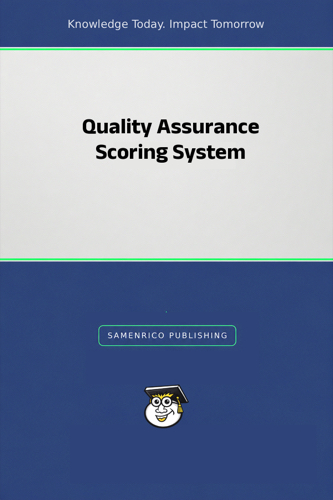
Quality Assurance Scoring System
Evaluate support interactions against standards to
Evaluate support interactions against standards to improve consistency and training.
Formats
About this book
Free sample
Chapter 1: The Score That Lies--–- It was a Tuesday afternoon in the Phoenix call center when Maria, a top-tier agent with three years of perfect attendance, received her QA score for a routine billing dispute. She had scored 98 percent. The checklist showed green checks next to every box: greeting script verified, account verification completed, refund processed within policy, survey offered, call logged correctly. By every official measure, Maria had delivered excellence.The customer, meanwhile, had already canceled his subscription. He had also posted a one-star review on social media, writing, "The agent was polite but useless.
I had to explain my problem four times. No one actually listened." Maria never saw that review. Her manager never connected the 98 percent QA score to the canceled account. The quality assurance system had done exactly what it was designed to do – and it had failed completely.This is the central problem this book exists to solve. Most quality assurance systems in customer support are not merely imperfect; they are systematically designed to produce the wrong information.
They measure what is easy to count rather than what actually matters to customers. They create a comfortable illusion of objectivity while rewarding performative compliance over genuine problem-solving. And perhaps most dangerously, they train agents to prioritize checklists over customers – because the system pays attention to checklists.The phenomenon has a name in QA circles, though it is rarely discussed openly: the Happy Ears fallacy. A reviewer listens to a friendly, polite agent and, feeling positively disposed, gives high marks across the board, even when objective evidence shows the agent failed to resolve the customer's underlying issue. The agent sounds nice, so the score must be high.
The checklist confirms what the reviewer already wanted to believe.This chapter dismantles that fallacy. It reveals why traditional binary checklists are worse than useless, how they create misaligned incentives, and why the cost of inconsistent scoring is measured not in abstract metrics but in lost customers, burned-out agents, and leadership decisions built on sand. By the end of this chapter, you will understand why most QA systems are broken…
This is the end of the free sample. Get the eBook to keep going. Buy now
Contents
- Chapter 1
- Chapter 2
- Chapter 3
- Chapter 4
- Chapter 5
- Chapter 6
- Chapter 7
- Chapter 8
- Chapter 9
- Chapter 10
- Chapter 11
- Chapter 12
Details
- Author
- Gruber Eloisa
- Publisher
- SamEnrico
- Language
- English
- Genre
- Non-Fiction, Business Brief, QA
- Released
- 2026-06-09
- Pages (approx.)
- 152
- Available as
- eBook, Audiobook

Read better in the ZLOADR app
Your eBooks on your phone or tablet. Sign in with your SamEnrico account and start reading.
More by Gruber Eloisa
 The Hillbilly ComedianGruber Eloisa$11.99
 Validation for Anxious Loved OnesGruber Eloisa$11.99
 Tracking for Weight MaintenanceGruber Eloisa$11.99
 The Snoop Dogg Longevity GuideGruber Eloisa$11.99
 The Last Surgeon of CarthageGruber Eloisa$11.99
 How to Become a Stem-dryer MaintainerGruber Eloisa$11.99
 Shipping and Receiving ClerkGruber Eloisa$11.99
 Startup Financial ForecastingGruber Eloisa$12.99
 Construction Climate InsuranceGruber Eloisa$12.99
 Learn to Play the Barrel DrumGruber Eloisa$11.99