
Non-FictionInformativeEducational
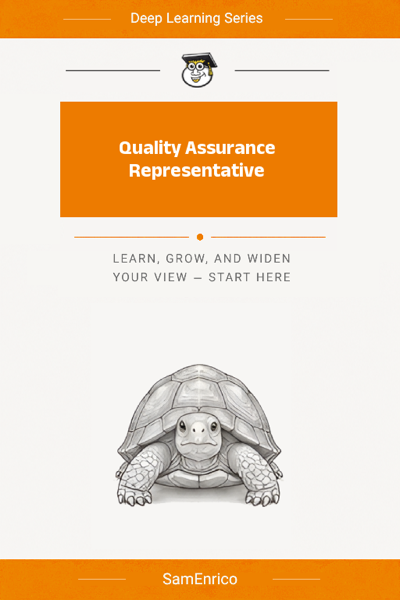
Quality Assurance Representative eBook
A Coursebook on Quality Assurance Representative
by Hitt Otha
A Coursebook on Quality Assurance Representative
Formats
Free sample
Chapter 1: The Blame Stops Here--–- The worst four words in any Quality Assurance Representative’s career are not “the server is down” or “we missed the deadline.” Those are problems, but they are honest problems—the kind that bring teams together to solve them. The worst four words are far more insidious, spoken in a conference room after a long, uncomfortable silence, usually by a project manager who has just realized the full extent of a disaster that has already reached the customer: “Why didn’t you catch this?”Those four words have ended careers. They have turned confident professionals into defensive shadows of themselves. They have been whispered in performance reviews, shouted in post-mortem meetings, and written into termination letters. And if you are reading this book, you have either heard them already, or you live in fear of hearing them tomorrow.This chapter exists to ensure you never hear those words again—not because you will become perfect, because you will not, and no reasonable person should expect you to—but because you will become something far more valuable than a person who never misses a bug.
You will become a Quality Assurance Representative who cannot be fairly blamed, because you will have transformed your role from a reactive checkpoint into a proactive strategic function. The blame stops here. Not by luck. By design. By skill.
By mindset.The Identity Trap: Why Most QA Professionals Get Blamed Before we can fix the problem, we have to understand why QA professionals are so frequently blamed in the first place. The answer is uncomfortable but liberating: most QA professionals are set up to fail by the very definition of their role as it exists in most organizations.Walk into any company and ask ten random employees what QA does. The most common answers will sound something like “they test things,” “they find bugs,” or “they make sure stuff works before it ships.” These answers all share a fatal flaw: they define QA by its output—finding problems—rather than by its function—preventing problems. When your value is defined exclusively as “finding problems,” you are inevitably evaluated on what you missed. And you will always miss something.
No human being, no automated system, no combination of the two can find every possible defect in any moderately complex product. The math simply does not work. The permutations are too many. The time is too short. The requirements are too ambiguous.This is the identity trap.
By accepting the definition of QA as “the people who find problems,” you accept an impossible standard. Then, when the inevitable escape happens—a defect reaches the customer, as it always eventually will—the question “Why didn’t you catch this?” is not just unfair. It is structurally guaranteed to have an answer that makes you look inadequate, regardless of how hard you worked or how many other defects you caught.Think about the asymmetry for a moment. You find ninety-nine bugs. You document them clearly.
You advocate for their repair. You work late to retest the fixes. Then the one hundredth bug—the one you did not find—reaches the customer. Which one will your manager remember? Which one will come up in your annual review?
Which one will be discussed in the post-mortem meeting? The asymmetry is brutal, and it is baked into the traditional conception of the role.The escape of a single defect does not mean QA failed. It means the system that produces and tests the product has a vulnerability. But because QA has been historically positioned as the last line of defense—the final checkpoint before anything reaches the customer—the vulnerability is treated as QA’s failure alone. This is like blaming the fire department for a building burning down when the sprinkler system was empty, the smoke detectors were disconnected, and the fire exits were locked.
The fire department might have been the last responder, but they were never the only line of defense. The fire was already inevitable long before they arrived.Redefining the Role: Quality Control versus Quality Assurance To escape the identity trap, we must draw a clear, bright line between two concepts that are routinely confused in organizations of all sizes, from startups to Fortune 500 companies. Quality Control and Quality Assurance are related, but they are not the same. Confusing them is like confusing “steering wheel” and “engine” because they are both in a car. They work together.
They are not interchangeable.Quality Control is the detection of defects in specific units of work. QC answers the question “Does this specific product, this specific batch, this specific transaction meet the specifications that were defined for it?” When you run a test case and log a bug, you are performing QC. When you measure a manufactured part with a caliper and find it out of tolerance, you are performing QC. When you listen to a recorded customer service call and note that the agent missed a required disclosure, you are performing QC. QC is essential.
Without QC, defects would flow to customers unchecked. QC is not the problem.Quality Assurance is the prevention of defects through systemic improvement. QA answers the question “How did this defect get created in the first place, and what can we change about our processes, our tools, our requirements, or our training to ensure that this entire category of defect never happens again?” When you analyze a cluster of similar bugs and realize they all trace back to a missing requirement in the design phase, you are performing QA. When you notice that a certain type of defect always escapes because the test environment does not accurately mirror production, and you advocate for environment improvements, you are performing QA. When you sit in a requirements meeting and ask “How will we test this?” before a single line of code is written or a single part is fabricated, you are performing QA.Here is the secret that changes everything, and it is worth reading twice: A Quality Assurance Representative who only performs QC will always be blamed.
A Quality Assurance Representative who performs QA can never be fairly blamed.Why? Because QA addresses the system, not the individual. If you have built a robust quality assurance system—with clear requirements, well-defined acceptance criteria, appropriate testing at multiple levels, rapid feedback loops, and a culture that treats escapes as learning opportunities rather than punishments—then the escape of a single defect is not a personal failure. It is a data point. It is evidence of a gap in the system.
And the system can be improved.Notice the pronoun shift that happens in organizations that understand this distinction. The conversation moves from “Why didn’t you catch this?” to “What in our system allowed this to escape, and how do we close that gap?” That shift from accusatory singular to collaborative plural is the difference between being a scapegoat and being a strategic partner. It is the difference between a career defined by fear and a career defined by impact.Total Quality Management: Quality as Everyone’s Responsibility No QA Representative works in a vacuum. The most effective quality professionals understand that quality is not…
This is the end of the free sample. Get the eBook to keep going. Buy now
About this book
Details
- Author
- Hitt Otha
- Publisher
- SamEnrico
- Language
- English
- Genre
- Non-Fiction, Informative, Educational
- Released
- 2026-06-01
- Pages (approx.)
- 137
- Available as
- eBook, Audiobook

Read better in the ZLOADR app
Your eBooks on your phone or tablet. Sign in with your SamEnrico account and start reading.
More by Hitt Otha
 EQ at Work Professional GuideHitt Otha$11.99
 Campfire RelaxationHitt Otha$11.99
 Indoor Fitness PreferrersHitt Otha$11.99
 MMR Vaccine Facts HandbookHitt Otha$11.99
 John Wayne Gacy Media Sensation StudyHitt Otha$11.99
 The Long White Cloud: New Zealand's Scientific and Cultural RenaissanceHitt Otha$11.99
 Understanding Mulibrey NanismHitt Otha$17.99
 Nestle Supply GuideHitt Otha$12.99
 AI Video Production ROI GuideHitt Otha$12.99
 A Beginners Guide to Cross-country skiing (Volume 1)Hitt Otha$11.99
You may also like
 Hong Kong Handover 1997Dunn Johnnie$11.99
 Zumba For Postnatal Recovery CourseNeal Christian$11.99
 Zumba for BeginnersLadner Nikia$11.99
 YouTube Comment Mining GuideHumes Pandora$12.99
 Worry Box MeditationCarlin Rudy$11.99
 Workplace Stress MeditationNguyen Lynn$11.99
 Workplace Stress and Sleep RepairHawley Ivory$11.99
 Workplace Perfectionism CureDelaney Jeffry$11.99
 Workplace Injustice Anger GuideWallen Isabelle$11.99
 Work Addiction and Burnout LinkGreenwood Ester$11.99
 Women in Yoga and WellnessBeattie Galina$11.99
 Women in Stand Up ComedyChun Evangeline$11.99