
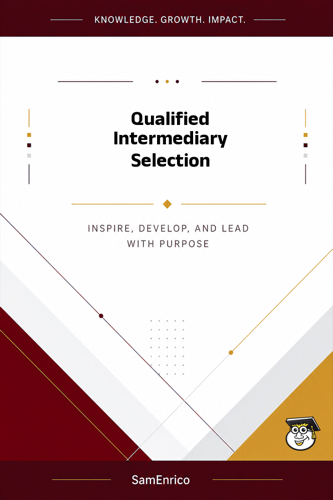
Non-FictionBusiness BriefIntermediary Due Diligence
Qualified Intermediary Selection eBook
Choose safe and insured intermediary for exchange
Choose safe and insured intermediary for exchange funds.
Formats
Free sample
Chapter 1: The Million-Dollar Mistake--–- In 2018, Robert and Linda Chen sold their rental property in Southern California for $1.2 million. They had owned it for fifteen years. The capital gains tax on the sale would have been nearly $300,000—money they needed for retirement. Their real estate agent recommended a 1031 exchange. "It's simple," the agent said.
"You hire a Qualified Intermediary. They hold your money. You find another property. You pay zero tax."The Chens followed the advice. They found a Qualified Intermediary online.
The QI had a professional website, a physical address, and a friendly representative who answered all their questions. The fees were reasonable—$1,200 for the exchange. The Chens signed the agreement. They transferred the $1.2 million from their sale to the QI's account.Ninety days later, the QI declared bankruptcy. The $1.2 million was gone.
Not lost in the market. Not delayed by paperwork. Gone. The QI's owner had been using client funds to finance a lavish lifestyle—private jets, luxury cars, a vacation home. When the scheme collapsed, there was nothing left for the Chens or the dozens of other investors who had trusted him.Then the IRS came.
Because the QI had failed, the exchange was invalid. The Chens had "constructive receipt" of the funds—the IRS determined that the QI was acting as their agent, so the money was treated as if the Chens had received it themselves. They owed $300,000 in capital gains taxes. They did not have $300,000. They had lost everything.The Chens are not hypothetical.
Their story is one of dozens of similar failures. Over the past two decades, investors have lost hundreds of millions of dollars—the "$800 million lesson" that gives this chapter its name. And in almost every case, the investors had one thing in common: they did not know that choosing a QI required due diligence. They thought the QI was regulated, licensed, and insured. They were wrong.This book is the reason you will not make the same mistake.The Two Devastating Consequences When a Qualified Intermediary fails, the investor suffers not one loss but two.
Most investors understand the first loss. They know that if the QI steals or loses their money, that money is gone. But the second loss is often larger and more unexpected.Loss One: The Sale Proceeds The money from your property sale is supposed to be held safely for 45 to 180 days while you identify and acquire replacement property. It is your money. You earned it.
You need it.When a QI fails, that money is often unrecoverable. If the QI commingled funds (mixed your money with other clients' money), your money may have been used to pay another client's exchange or to cover the QI's operating expenses. If the QI made imprudent investments, the money may have been lost in the market. If the QI's owner committed fraud, the money may be in a foreign bank account.In most QI failures, investors recover pennies on the dollar—or nothing at all. The Chens recovered nothing.Loss Two: The Tax Liability The second loss is the one that destroys lives.
Because the QI's failure means the exchange is invalid, the IRS treats the sale as a fully taxable event. You owe capital gains tax on the entire sale amount, often 20 to 30 percent of the proceeds. But you no longer have the proceeds. The QI lost them.Now you owe hundreds of thousands of dollars in taxes that you cannot pay. The IRS does not care that the QI failed.
The IRS cares that you received the funds (even if only "constructively"). You owe the tax. If you cannot pay, you face penalties, interest, liens on your other assets, and potentially bankruptcy.The Chens faced this exact nightmare. They lost $1.2 million. They owed $300,000.
They had no way to pay. They sold their retirement investments at a loss. They went back to work at age sixty-seven. Their retirement plans were destroyed not by a market crash or a bad investment, but by a single bad decision: choosing the wrong QI.The Regulatory Gap Why does this happen? Why are investors so vulnerable?
The answer is a shocking gap in financial regulation.Banks are regulated by the FDIC and state banking authorities. Investment advisors are regulated by the SEC and FINRA. Title companies are regulated by state insurance departments. Even real estate agents must pass exams, maintain licenses, and carry insurance.Qualified Intermediaries have none of this.There is no federal licensing requirement for QIs. No mandatory exam.
No continuing education. No net worth requirement. No bonding requirement. No regulatory body that approves or monitors QIs. No investor protection fund.
No federal oversight whatsoever.Here is the stark reality: anyone can become a QI. Your neighbor with no financial experience. Your cousin who just filed for bankruptcy. Someone with a criminal record. Someone who has never handled a 1031 exchange in their life.
They can print business cards, build a website, and start holding millions of dollars of other people's money—legally.This is not an oversight in the regulations. It was a deliberate choice. The 1991 Treasury Regulations that created the QI safe harbor defined who could serve as a QI, but they explicitly did not create a regulatory scheme. The drafters assumed that the market would police itself through reputation. They assumed that investors would perform due diligence.They were wrong.
Most investors do not perform due diligence because they do not know they need to. They assume that anyone holding their money must be licensed, insured, and regulated. They are wrong. And their assumption costs them billions.The False Sense of Security Why do investors trust QIs without verification? The reasons are predictable, understandable, and tragic.Reason One: The Real Estate Agent's Recommendation Most investors first hear about 1031 exchanges from their real estate agent.
The agent may have a "preferred QI" that they have worked with for years. The agent recommends the QI. The investor assumes the agent has vetted the QI.But real estate agents are not QI experts. They may receive referral fees from the QI—fees that are often not disclosed to the investor. The agent's recommendation is not due diligence.
It is a referral. And referrals can be bought.Reason Two: The Professional Website Fraudulent QIs are skilled at appearing legitimate. They have professional websites. They have physical addresses (often mail-forwarding services). They have testimonials (often fake).
They have brochures and business cards. They look like real companies.But a website costs a few thousand dollars. A physical address costs a few hundred dollars a month. Testimonials can be fabricated. Appearances mean nothing.
Legitimacy must be verified, not assumed.Reason Three: The Friendly Representative Fraudulent QIs hire friendly, knowledgeable people to answer calls. They answer questions. They sound confident. They build trust.But friendliness is not verification. Knowledge is not verification.
Confidence is not verification. Fraudsters are often the most charming people in the room. Do not confuse charm with trustworthiness.Reason Four: The Reasonable Fees The Chens paid $1,200 for their exchange. That is a reasonable fee. Not suspiciously low.
Not suspiciously high. Just... normal.Fraudulent QIs do not always charge low fees. Sometimes they charge market rates. Fee level alone is not a reliable indicator.…
This is the end of the free sample. Get the eBook to keep going. Buy now
About this book
Details
- Author
- Bagwell Corazon
- Publisher
- SamEnrico
- Language
- English
- Genre
- Non-Fiction, Business Brief, Intermediary Due Diligence
- Released
- 2026-06-07
- Pages (approx.)
- 117
- Available as
- eBook, Audiobook

Read better in the ZLOADR app
Your eBooks on your phone or tablet. Sign in with your SamEnrico account and start reading.
More by Bagwell Corazon
 Senior Holiday Family Gathering Self Esteem WorkbookBagwell Corazon$11.99
 EQ For Financial AdvisorsBagwell Corazon$11.99
 The EQ for First Time Managers GuideBagwell Corazon$11.99
 Tall Woman Self Esteem GuideBagwell Corazon$11.99
 The Last Neanderthal: A Genetic Echo in Modern BloodBagwell Corazon$11.99
 How to Start a Penetrating Oil Business (Beginners Guide)Bagwell Corazon$11.99
 Marsh Tacky Horse BreedingBagwell Corazon$11.99
 Purchase Order Terms Negotiation GuideBagwell Corazon$12.99
 Strategy Meeting Silent BrainstormingBagwell Corazon$12.99
 Understanding Malignant Hyperthermia Susceptibility Type 6Bagwell Corazon$17.99
You may also like
 Hong Kong Handover 1997Dunn Johnnie$11.99
 Zumba For Postnatal Recovery CourseNeal Christian$11.99
 Zumba for BeginnersLadner Nikia$11.99
 YouTube Comment Mining GuideHumes Pandora$12.99
 Worry Box MeditationCarlin Rudy$11.99
 Workplace Stress MeditationNguyen Lynn$11.99
 Workplace Stress and Sleep RepairHawley Ivory$11.99
 Workplace Perfectionism CureDelaney Jeffry$11.99
 Workplace Injustice Anger GuideWallen Isabelle$11.99
 Work Addiction and Burnout LinkGreenwood Ester$11.99
 Women in Yoga and WellnessBeattie Galina$11.99
 Women in Stand Up ComedyChun Evangeline$11.99