
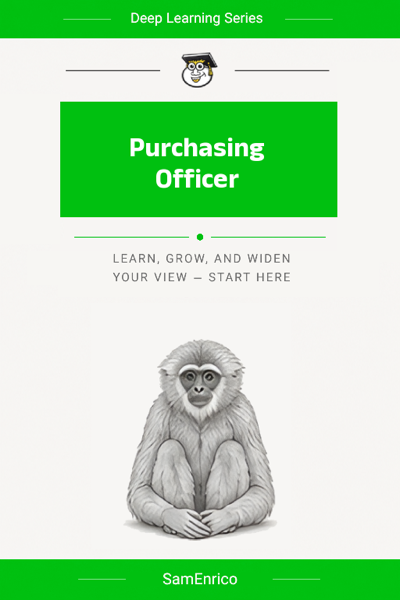
Purchasing Officer eBook
A Coursebook on Purchasing Officer
A Coursebook on Purchasing Officer
Formats
Free sample
Chapter 1: The Million-Dollar Blindspot--The purchasing officer walked into the conference room at 8:47 AM on a Tuesday, clutching a stack of approved purchase orders and a lukewarm coffee. She had no idea that within ninety minutes, she would save her company $1.2 million—not by negotiating harder or finding a cheaper supplier, but by asking a single question that no one had thought to ask in seven years.Her name was Sarah Chen, and she was a senior purchasing officer at Apex Manufacturing, a mid-sized industrial components company with annual revenues of approximately $400 million. Sarah had been in the role for eleven years, having worked her way up from a junior buyer who processed requisitions for office supplies to a position where she managed over $45 million in annual spend across raw materials, packaging, and logistics. She was good at her job—consistently exceeding her cost savings targets, maintaining supplier relationships that ran like clockwork, and rarely generating the kind of urgent escalations that kept her manager awake at night.But on this particular Tuesday morning, she was about to discover that being good at purchasing was not the same as being strategic. And that distinction, she would learn, was worth millions.The meeting was a quarterly business review with one of Apex's largest suppliers, a Taiwanese company called Formosa Components that provided specialized aluminum casings for Apex's flagship product line.
The relationship had been stable for over a decade. Prices increased by 3.5 percent every year like clockwork. Delivery was reliable. Quality was acceptable. No one complained.
No one asked questions.That was the blindspot.The Procurement Trap: When "Good Enough" Becomes a Liability Before we dive into what Sarah discovered in that conference room, we need to understand a fundamental truth about the purchasing profession: most organizations are unknowingly leaving millions of dollars on the table not because their purchasing officers are incompetent, but because the entire function has been systematically undervalued for over a century.Let me take you back to the 1850s. The Industrial Revolution was in full swing. Factories were sprouting across England, Germany, and the United States. Railroads were stitching together continental economies. And the purchasing function—to the extent that it existed at all—was handled by clerks who simply reordered whatever had been ordered last time.
There was no analysis, no strategy, no supplier development. There was only transaction.A purchasing clerk in 1870 did not ask, "Should we be making this component ourselves?" They did not calculate total cost of ownership. They did not negotiate payment terms that would improve working capital. They simply pulled a requisition form, found the last supplier who had provided the item, wrote a purchase order, and filed the paperwork.Fast forward to the 1950s. Post-war industrial expansion created massive demand for raw materials and components.
Companies grew vertically integrated—Ford owned rubber plantations in Brazil and steel mills in Detroit. Purchasing was seen as a necessary evil, a cost center to be minimized. The prevailing attitude was captured by a famous quote attributed to a General Motors executive in 1956: "We don't buy things. We build things. Purchasing just writes the checks."This attitude persisted for decades.
Even as late as the 1990s, many companies located their purchasing departments in basements or windowless back offices. The message was clear: this work was not important enough to deserve natural light.Then everything changed.The COVID-19 pandemic, geopolitical tensions, climate disasters, and a series of high-profile supply chain collapses (remember the toilet paper shortage of 2020? The semiconductor crisis of 2021? The baby formula recall of 2022?) forced corporate boards to confront a terrifying reality: their supply chains were fragile, opaque, and dangerously under-managed. And the people who understood those supply chains—the purchasing officers who knew which suppliers were reliable, which logistics routes were vulnerable, and which components had no substitutes—suddenly became the most valuable people in the room.The Three-Word Distinction That Changes Everything One of the most common sources of confusion in the purchasing profession is the sloppy use of terminology.
If you ask ten executives to define "procurement," you will get ten different answers. Some will say it means buying. Some will say it means strategic sourcing. Some will use it interchangeably with "supply chain." This confusion is not merely semantic—it actively prevents organizations from unlocking the full potential of their purchasing function.Let me draw three clear distinctions.Purchasing is the transactional act of buying. It is the process of issuing purchase orders, receiving goods, matching invoices, and paying suppliers.
Purchasing is essential. Without it, operations grind to a halt. But purchasing alone does not create competitive advantage. It is a commodity skill—like data entry or filing. Important, but not strategic.Procurement is the broader strategic process of identifying, evaluating, selecting, and managing suppliers.
Procurement includes market research, spend analysis, supplier qualification, negotiation, contract management, and performance monitoring. While purchasing asks, "How do we buy this?" procurement asks, "Why are we buying this from this supplier under these terms?" Procurement is not a commodity. It is a source of sustainable competitive advantage.Supply Chain Management is the end-to-end flow of goods, information, and money from raw material suppliers to end customers. Supply chain management encompasses procurement, logistics, inventory management, demand planning, and customer fulfillment. A purchasing officer might manage supplier relationships, but a supply chain manager designs the entire network.Here is a simple way to remember the distinction:Purchasing = the transaction (the "what")Procurement = the strategy (the "why and from whom")Supply Chain = the system (the "how it all connects")Now, here is the critical insight that separates exceptional purchasing officers from average ones: you cannot be strategic until you have mastered the tactical, but mastery of the tactical does not automatically make you strategic.Most purchasing officers spend their entire careers at the transactional level.
They become incredibly efficient at processing requisitions, negotiating small price reductions, and avoiding stock-outs. They are reliable. They are competent. And they are invisible to senior leadership.The purchasing officer who becomes a value creator—who sits at the executive table, who shapes corporate strategy, who drives innovation—is the one who understands that purchasing is not about buying things. It is about managing the interface between the organization and the external supply base.
It is about making decisions that affect profitability, risk, quality, innovation, and sustainability.The Anatomy of a Purchasing Decision: Why Small Choices Have Big Consequences Let me show you how a single purchasing decision ripples through an entire organization.Imagine you are a purchasing officer for a company that manufactures electric bicycles. You are responsible for sourcing lithium-ion battery packs. You receive three quotes:Supplier A: $120 per unit. Delivery in 14 days. 99.5 percent quality rating.
Located in South Korea.Supplier B: $110 per unit. Delivery in 21 days. 98.0 percent quality rating. Located in Vietnam.Supplier C: $100 per unit. Delivery in 35 days.
95.0 percent quality rating. Located in China.Which do you choose?The average purchasing officer—the transactional buyer—would immediately gravitate toward Supplier C. After all, saving $20 per unit on an order of 10,000 units is $200,000 in direct cost savings. That is a number you can put on a performance review. That is a number that gets noticed.But the strategic purchasing…
This is the end of the free sample. Get the eBook to keep going. Buy now
About this book
Details
- Author
- Grossman Wilfredo
- Publisher
- SamEnrico
- Language
- English
- Genre
- Non-Fiction, Informative, Educational
- Released
- 2026-06-03
- Pages (approx.)
- 158
- Available as
- eBook, Audiobook

Read better in the ZLOADR app
Your eBooks on your phone or tablet. Sign in with your SamEnrico account and start reading.
More by Grossman Wilfredo
 Veblen Goods EconomicsGrossman Wilfredo$11.99Veblen Goods EconomicsGrossman Wilfredo$11.99
 Menopause Disclosure GuideGrossman Wilfredo$11.99
 Body Scan and Yoga NidraGrossman Wilfredo$11.99
 Food Addiction and OsteoarthritisGrossman Wilfredo$11.99
 The Seven-Year War of the Joseon: Korea's Forgotten ResistanceGrossman Wilfredo$11.99
 Emerging Market Vendor NegotiationGrossman Wilfredo$12.99
 How to Produce Acrylic LaTeXGrossman Wilfredo$11.99
 How to Become a Machinist ApprenticeGrossman Wilfredo$11.99