
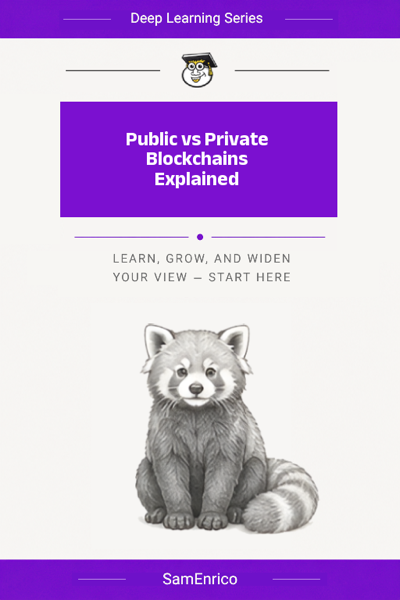
Public vs Private Blockchains Explained eBook
A Coursebook on Public vs Private Blockchains Expl
A Coursebook on Public vs Private Blockchains Explained
Formats
Free sample
Chapter 1: The Billion-Dollar Question...--–- On a rainy Wednesday afternoon in Oslo, a soft-spoken engineer named Håkon Jacobsen did something that would cost his employer—the Norwegian Postal Service, a venerable institution founded in 1647—roughly forty million kroner. He walked into the office of the Chief Digital Officer, placed a single sheet of paper on the desk, and said, "We don't need this."The paper described Project Nordkapp, a twelve-month initiative to build a blockchain-based system for tracking high-value parcels. The project had been approved at the highest levels. A prestigious consulting firm had blessed the architecture. Three blockchain startups had been acquired specifically to provide the necessary talent.
And Håkon, a quiet backend engineer who had spent fifteen years building boring, reliable databases, had just spent his weekend analyzing the requirements. His conclusion was devastating in its simplicity: the same result could be achieved with a Postgre SQL database, four API endpoints, and a weekly backup to a physically separate server. Total cost: approximately one hundred thousand kroner. The blockchain version was projected to cost forty million kroner, plus ongoing maintenance fees that would double that number within three years.The Chief Digital Officer stared at the paper. He had staked his reputation on Project Nordkapp.
The board had celebrated his "forward-thinking vision" at the annual general meeting. Local newspapers had written glowing profiles about how Norway's oldest postal service was reinventing itself for the digital age. And now a mid-level engineer with a receding hairline and a preference for lukewarm coffee was telling him that his signature initiative was, essentially, an expensive solution to a problem that did not exist."Why didn't anyone ask this sooner?" the Chief Digital Officer whispered.Håkon shrugged. "Because everyone was too excited about blockchain to ask if we actually needed it."This book exists because Håkon Jacobsen is the exception, not the rule. In boardrooms, government agencies, and startup pitch meetings across the world, the same scene plays out with different characters but identical consequences.
A team identifies a problem. Someone reads an article about blockchain. Someone else attends a conference where a keynote speaker declares that "blockchain will do for trust what the internet did for information." Consultants are hired. Software licenses are purchased. Developers are recruited.
Millions are spent. And at the end of the process—sometimes after months, sometimes after years—someone finally asks the question that should have been asked at the very beginning: "Why are we using a blockchain for this?"This chapter is the vaccine against that disease. Before we explain how public and private blockchains work, before we debate consensus mechanisms or governance models or scalability solutions, before we spend a single minute on the technical details that fill the remaining eleven chapters, we must answer a more fundamental question. It is not a technical question. It is not a business question.
It is, at its core, a philosophical question about trust, power, and the nature of human cooperation. That question is: does your problem actually require a blockchain at all?The answer, for the vast majority of projects, is no. Roughly ninety percent of the "blockchain projects" launched between 2015 and 2022 could have been implemented more efficiently, more securely, and at a fraction of the cost using technologies that have existed for decades: relational databases, message queues, API gateways, and good old-fashioned spreadsheets. The ten percent that genuinely require a blockchain are fascinating, important, and potentially transformative. But you will never know you are in that ten percent until you pass through the gatekeeper that this chapter provides.So here is the billion-dollar question: how do you know if you need a blockchain?
The answer lies in four simple questions. If you answer "no" to any of them, put this book down and go build a database. You will be richer, your stakeholders will be happier, and the world will have one less over-engineered solution searching for a problem. If you answer "yes" to all four, then read on. The remaining chapters will give you everything you need to choose between public, private, and hybrid architectures, and to implement your solution with confidence.The Four Gatekeeper Questions These questions are deceptively simple.
They have been refined through years of consulting engagements, post-mortem analyses of failed projects, and honest conversations with engineers who, like Håkon Jacobsen, had the courage to speak truth to power. They are not original to this book—variants appear in academic papers, industry white papers, and the collected wisdom of the blockchain community. But they have never been assembled into a single, actionable framework for decision-makers. Until now.Question One: Do you have multiple parties who do not fully trust each other?This is the foundational question. Blockchains exist to solve a specific problem: enabling cooperation among parties who have no reason to trust each other.
This is sometimes called the "Byzantine Generals Problem" in computer science literature—the challenge of reaching consensus in a network where some participants may be malicious, unreliable, or self-interested.Consider a simple example. Three companies want to collaborate on a shared logistics platform. Company A ships goods. Company B warehouses them. Company C delivers them to customers.
Each company has its own database. When a shipment moves from A to B, A updates its database to say "shipped" and B updates its database to say "received." But what happens when these updates disagree? A claims it shipped ten pallets. B claims it received only nine. Who is telling the truth?
In a traditional system, the companies must either trust a central mediator (a fourth company that runs a shared database) or resolve disputes through legal processes (expensive, slow, adversarial). A blockchain offers a third path: a shared, tamper-evident ledger where every participant can verify every transaction without trusting a central authority.Now consider a different example. A single company wants to track inventory across its own warehouses. The warehouse managers are all employees of the same corporation. They report to the same vice president.
They are bound by the same employment contracts. The company has an internal audit department. Disputes can be resolved by managers or escalated to human resources. In this case, you do not have a trust problem. You have a coordination problem.
Coordination problems are solved with databases, not blockchains.The distinction is not merely academic. It has real financial consequences. The Australian Stock Exchange spent approximately $250 million building a blockchain-based settlement system before eventually abandoning the project and replacing it with a conventional database. Why? Because the exchange is a single operator.
All participants already trust the exchange—by law, by regulation, and by long-standing market convention. There was no trust problem to solve. A modern centralized database would have worked perfectly.Question Two: Do you need a shared, immutable source of truth that no single party controls?Standard databases have administrators. Someone has the root password. Someone can edit the data.
Someone can delete the logs. For many applications, this is perfectly acceptable. Your company's HR database should have an administrator. Your personal banking records can be managed by your bank. But some applications require a different guarantee: that no single party, no matter how…
This is the end of the free sample. Get the eBook to keep going. Buy now
About this book
Details
- Author
- Dixon Brendan
- Publisher
- SamEnrico
- Language
- English
- Genre
- Non-Fiction, Informative, Educational
- Released
- 2026-05-09
- Pages (approx.)
- 157
- Available as
- eBook, Audiobook

Read better in the ZLOADR app
Your eBooks on your phone or tablet. Sign in with your SamEnrico account and start reading.
More by Dixon Brendan
 Wholesaling Escrow Process GuideDixon Brendan$11.99
 Mindful Stress Reduction for LawyersDixon Brendan$11.99
 Vertical Merger EnforcementDixon Brendan$11.99
 Rejection Resilience at WorkDixon Brendan$11.99
 Fabric Burn Test GuideDixon Brendan$11.99
 The Third SiblingDixon Brendan$11.99
 Rib Fracture Return to SportDixon Brendan$11.99
 Low Socioeconomic Childhood WorthDixon Brendan$11.99
 Behavioral Economics ReadingDixon Brendan$11.99
 The Jungle Whisperers: Alfred Russel Wallace and the Secrets of BorneoDixon Brendan$11.99
 Fenrir's Bane: The Wolf Who Shaped the GodsDixon Brendan$11.99
 The Vanishing of the SS Marine Sulphur QueenDixon Brendan$11.99