
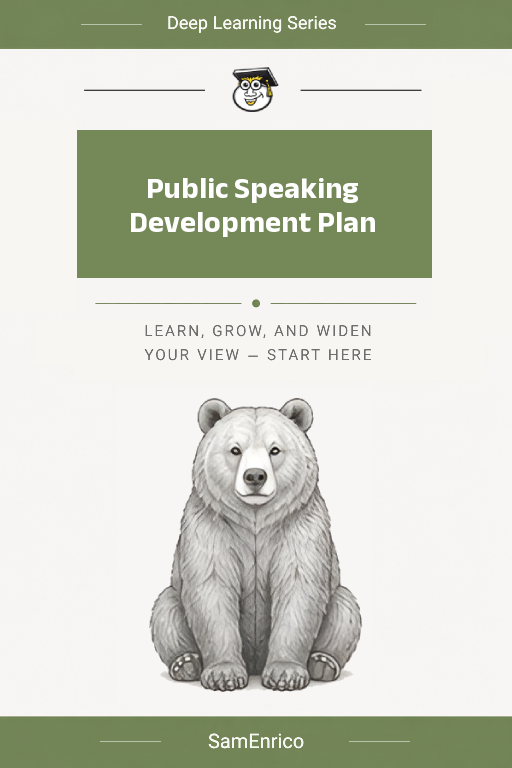
Non-FictionProfessional's Cheat SheetPublic SpeakingPresentation
Public Speaking Development Plan eBook
Build PDP focused on public speaking and presentat
Build PDP focused on public speaking and presentation skills including practice opportunities and feedback loops.
Formats
Free sample
Chapter 1: The Baseline Betrayal--–- Every morning, millions of professionals walk into conference rooms, step up to podiums, or log onto Zoom calls carrying a secret that is slowly destroying their careers. The secret is not that they are afraid of public speaking. That fear is so common it has become a cultural joke. The real secret is darker: they have convinced themselves that their fear is permanent. They believe, somewhere deep in the marrow of their professional identity, that great speakers were born and they were not.
They believe that the colleagues who command rooms with effortless charisma possess some genetic gift that was denied to them at birth. They believe that public speaking is a talent, and talent cannot be taught.This belief is a lie. And it is the most expensive lie you will ever tell yourself.Let me be precise about what I mean by "expensive." In a 2021 survey of 2,000 professionals conducted by the National Association of Colleges and Employers, communication skills ranked as the single most desirable attribute in job candidates, above technical expertise, above leadership potential, above cultural fit. In a separate longitudinal study spanning twenty years, researchers at Carnegie Mellon University found that professionals who received training in public speaking saw their incomes increase an average of 23 percent within eighteen months, compared to a control group that saw no such increase. Twenty-three percent.
That is not a raise. That is a career transformation.And yet, when I ask audiences how many of them have ever received formal, structured training in public speaking beyond a single required college course or a half-day workshop, rarely do more than ten percent raise their hands. We spend years mastering Excel, learning coding languages, earning MBAs, and perfecting technical skills that will become obsolete within a decade. But we refuse to practice the one skill that amplifies every other skill we possess. You can be the smartest person in the room with the best ideas in the history of commerce, but if you cannot present those ideas in a way that makes people listen, remember, and act, you are effectively silent.This book exists to end your silence.
But before we can build, we must measure. Before we can improve, we must know where we stand. And before we can believe in our capacity for growth, we must capture the undeniable evidence of where we started.The Rhetorical Gym: A New Metaphor for an Old Fear Think about how you learned every other complex skill in your life. When you learned to drive, you did not simply read the driver's manual and then assume you were ready for the interstate. You sat behind the wheel in an empty parking lot.
You practiced turning left. You practiced turning right. You practiced parallel parking until your knuckles ached. You made mistakes—dozens of them, hundreds of them—and each mistake taught you something that the manual could not.When you learned to play a musical instrument, you did not pick it up and perform at Carnegie Hall. You played scales.
Boring, repetitive, humiliating scales. Your fingers fumbled. Your timing was off. You sounded terrible for months. But because you understood that sounding terrible was part of the process, you kept practicing.
And eventually, the notes that required conscious effort became automatic. Your fingers learned where to go without asking your brain for permission.Public speaking is no different. It is a physical, cognitive, and emotional skill that responds to deliberate practice exactly the way driving and piano playing do. The difference is that we have been lied to about public speaking. We have been told that it is a test of character rather than a trainable competency.
We have been told that some people have "it" and some people do not, as if "it" were a mystical force rather than a set of behaviors that can be observed, analyzed, practiced, and mastered.I call this book "The Public Speaking Development Plan" because it treats your speaking ability as an athletic pursuit. Imagine walking into a gym for the first time. You do not walk up to the heaviest barbell and attempt to bench press three hundred pounds. You would injure yourself, embarrass yourself, and never come back. Instead, you start with the empty bar.
You learn the form. You add weight gradually. You track your progress. You celebrate small improvements. And over time, the weight that once seemed impossible becomes your warm-up set.That is what this book will do for your speaking ability.
Each chapter introduces a specific skill—structuring a message, using vocal variety, managing eye contact, handling hostile questions—and pairs it with a micro-practice drill designed to isolate that skill and train it to automaticity. Each chapter also includes a feedback mission that gives you objective data about your performance. By the end of this book, you will not have simply read about speaking. You will have recorded yourself, evaluated yourself, been evaluated by others, analyzed your biometric responses, and built a maintenance system for lifelong improvement.But first, you must face the truth about where you are right now.The Baseline Recording: Your First and Most Important Micro-Practice Before you read another word of this book, you are going to record yourself speaking for two minutes. This is not optional.
If you skip this step, you are not really doing the work. You are reading about the work, which is the intellectual equivalent of reading a menu and calling yourself fed.I want you to record a two-minute impromptu speech answering this prompt: "What do I want to achieve in the next six months, and why does it matter to me?"Here are the specific instructions for this recording, which we will call the Single Recording Protocol and use throughout the book:First, set up your camera at eye level. Do not hold your phone in your hand. Do not place the camera below your chin looking up your nose. Prop your phone or laptop on a stack of books or a tripod so that the lens is roughly level with your eyes.
Good lighting matters—natural window light is best, or a lamp placed behind the camera pointing at your face. Avoid overhead lighting that casts shadows under your eyes. You look tired. You are not tired; your lighting is just bad.Second, ensure you have at least two minutes of uninterrupted time in a quiet space. Close the door.
Silence your notifications. Tell your family or roommates that you are not to be disturbed. Two minutes is not a long time, but it will feel like an eternity when you are staring into a lens watching yourself speak.Third, hit record and begin speaking immediately. Do not rehearse. Do not write notes.
Do not start over if you stumble. Do not stop the recording mid-speech to restart. The entire point of this baseline is to capture you exactly as you are right now—raw, unpolished, imperfect, real. If you sound nervous, good. That is data.
If you run out of things to say and sit in silence for ten seconds, good. That is also data. If you say "um" forty-seven times, that is…
This is the end of the free sample. Get the eBook to keep going. Buy now
About this book
Details
- Author
- Lorenz Margarette
- Publisher
- SamEnrico
- Language
- English
- Genre
- Non-Fiction, Professional's Cheat Sheet, Public Speaking, Presentation
- Released
- 2026-05-29
- Pages (approx.)
- 141
- Available as
- eBook, Audiobook

Read better in the ZLOADR app
Your eBooks on your phone or tablet. Sign in with your SamEnrico account and start reading.
More by Lorenz Margarette
 The Two Year Old Sleep RegressionLorenz Margarette$11.99
 North American Migration PatternsLorenz Margarette$11.99
 Polish Green Incentives ManualLorenz Margarette$11.99
 Innocence Project Nevada CasesLorenz Margarette$11.99
 Bodyweight Beginner Zero KitLorenz Margarette$11.99
 Rhythm & Rebellion: The Jazz Warriors of 1924Lorenz Margarette$11.99
 Dwarka's Lost Kingdom: Uncovering India's Sunken CivilizationLorenz Margarette$11.99
 How to Become a Tap-and-die-maker TechnicianLorenz Margarette$11.99
 Nunavut PNP for GraduatesLorenz Margarette$12.99
 Understanding Chromosome 18, TrisomyLorenz Margarette$17.99
 Business Immigration ParalegalLorenz Margarette$11.99
You may also like
 Hong Kong Handover 1997Dunn Johnnie$11.99
 Zumba For Postnatal Recovery CourseNeal Christian$11.99
 Zumba for BeginnersLadner Nikia$11.99
 YouTube Comment Mining GuideHumes Pandora$12.99
 Worry Box MeditationCarlin Rudy$11.99
 Workplace Stress MeditationNguyen Lynn$11.99
 Workplace Stress and Sleep RepairHawley Ivory$11.99
 Workplace Perfectionism CureDelaney Jeffry$11.99
 Workplace Injustice Anger GuideWallen Isabelle$11.99
 Work Addiction and Burnout LinkGreenwood Ester$11.99
 Women in Yoga and WellnessBeattie Galina$11.99
 Women in Stand Up ComedyChun Evangeline$11.99