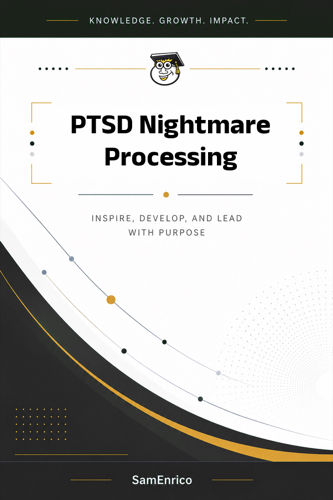
PTSD Nightmare Processing
Reduce trauma related dreams using imagery rehears
by Quick Alyse
Reduce trauma related dreams using imagery rehearsal therapy with this clinical guide.
Formats
About this book
Free sample
Chapter 1: The Stolen Night...--–- Sam, a 34-year-old combat veteran, had not slept without a nightmare in over six years. He described his bed as “a crime scene where my brain replays the ambush on loop.” Each night, he would lie down exhausted, only to jolt awake at 2:00 AM, drenched in sweat, heart pounding, convinced he was back in Ramadi. His wife had learned to sleep on the couch. His children knew not to wake him. Sam’s story is not unusual.
It is the daily reality for millions of trauma survivors whose sleep has been stolen—not by insomnia alone, but by the relentless, replaying terror of the post-traumatic nightmare.This chapter will fundamentally change how you understand nightmares. If you are a clinician, you will learn why standard “dream interpretation” fails for trauma. If you are a survivor, you will learn why your brain is not broken but has simply learned a maladaptive survival script. And if you are both, you will gain the neurobiological roadmap that makes Imagery Rehearsal Therapy (IRT) not just effective but necessary.We begin with a bold claim: The trauma-related nightmare is not a dream. It is a nocturnal seizure of the memory system.
Unlike ordinary bad dreams, which are symbolic, fragmented, and often fade by morning, the PTSD nightmare is a literal, repetitive, high-fidelity replay of a traumatic event or a close thematic variation. It does not process the trauma. It rehearses it. And each rehearsal strengthens the neural pathway you are trying to weaken.This chapter is the first of three in Part I: The Foundation of Traumatic Sleep. Here, we will dismantle common myths about nightmares, walk through the neurobiology of REM sleep disruption, differentiate between REM and non-REM nightmares (because they require different treatments), and provide you with ready-to-use psychoeducation scripts that reduce shame and build motivation for IRT.
By the end, you will understand not just what a trauma nightmare is, but why it persists and how IRT directly targets its mechanism.The Myth of the Processing Dream For decades, popular psychology has embraced a comforting myth: that…
This is the end of the free sample. Get the eBook to keep going. Buy now
Contents
- Chapter 1
- Chapter 2
- Chapter 3
- Chapter 4
- Chapter 5
- Chapter 6
- Chapter 7
- Chapter 8
- Chapter 9
- Chapter 10
- Chapter 11
- Chapter 12
Details
- Author
- Quick Alyse
- Publisher
- SamEnrico
- Language
- English
- Genre
- Non-Fiction, Self-Help, PTSD Treatment
- Released
- 2026-06-06
- Pages (approx.)
- 158
- Available as
- eBook, Audiobook

Read better in the ZLOADR app
Your eBooks on your phone or tablet. Sign in with your SamEnrico account and start reading.
More by Quick Alyse
 Herniated Disc Pain ReliefQuick Alyse$11.99
 Inventory Management CreativityQuick Alyse$11.99
 The Hormonal ED GuideQuick Alyse$11.99
 Wholesaling Virtual AssistantsQuick Alyse$11.99
 Sudden Pet Death Grief GuideQuick Alyse$11.99
 Gaming for VeteransQuick Alyse$11.99
 Freelance Income ThresholdQuick Alyse$11.99
 The Olympic Games of Antiquity: Birth of the College Football RivalryQuick Alyse$11.99
 The Silent Canopy: How Trees Saved a City from DisasterQuick Alyse$11.99
 The Essential Guide to South AfricaQuick Alyse$11.99
 How to Become a Pattern GaterQuick Alyse$11.99
 EBITDA Calculation GuideQuick Alyse$12.99