
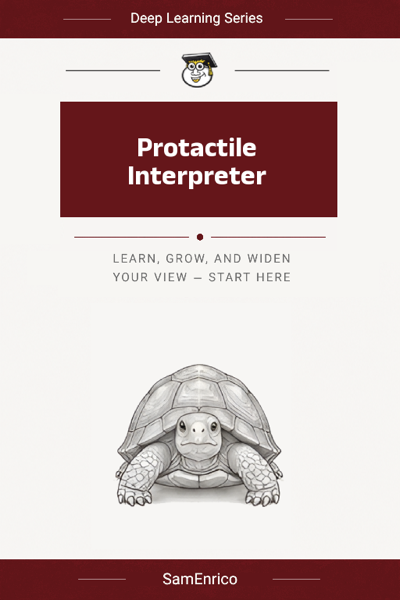
Non-FictionInformativeEducational
Protactile Interpreter eBook
A Coursebook on Protactile Interpreter
A Coursebook on Protactile Interpreter
Formats
Free sample
Chapter 1: The Silent Scream...–- In the winter of 2007, a Deaf Blind woman named Maya sat in a fluorescent-lit hospital waiting room for three hours and forty-seven minutes while her name was called seventeen times. She never heard it. She never felt the vibration of the receptionist's voice through the floor. No one touched her shoulder. No one tapped her hand.
No one even thought to walk the fifteen feet from the sliding glass window to the plastic chair where she sat, her hands folded in her lap, her body oriented toward the door she could not see, waiting for a signal that never came. When her daughter finally arrived to check on her, Maya was still in the same chair. She had missed her appointment. The clinic closed in twelve minutes. She had been present, fully present, for nearly four hours, and the entire medical system had looked past her as if she were a piece of furniture.This is not a story about cruelty.
It is a story about absence—the absence of touch, the absence of expectation, the absence of a basic linguistic principle so fundamental that sighted and hearing people do not even know they possess it. The receptionist did not hate Maya. The nurses did not ignore her on purpose. They simply could not conceive of a world where a person cannot be reached by voice or by sight. They had no framework for a human being whose primary access channel is touch.
And that failure, multiplied across thousands of medical appointments, job interviews, parent-teacher conferences, and courtroom testimonies, is precisely what birthed the Protactile movement.This book is not a gentle introduction to a niche interpreting specialty. It is a field manual for a revolution. It is a coursebook, a manifesto, and a call to action all wrapped into one. And it begins, as all revolutions must, with the recognition that the old way of doing things is not merely inefficient but ethically broken.The Difference Between Touching and Being Touched Back Before we can understand what a Protactile interpreter does, we must understand what a Protactile interpreter is not. For most of the history of Deaf Blind services, the dominant model has been what we will call the "Sighted Guide" approach.
In this model, a sighted interpreter approaches a Deaf Blind person, takes their hand, and begins signing ASL into that hand—often while simultaneously guiding them through physical space. The interpreter sees. The interpreter speaks. The interpreter decides what is important. The Deaf Blind person receives.
The relationship is fundamentally asymmetrical: one person does; the other is done to.This is not Protactile. This is Tactile ASL, and Tactile ASL is not a language. It is a delivery system. It takes a visual language—American Sign Language—and compresses it into the tactile channel. The grammar is still visual.
The syntax is still visual. The assumptions about space, time, and attention are still visual. The Deaf Blind person is essentially watching a movie through a keyhole: they get the action, but they miss the frame, the context, the spatial relationships, and most importantly, the reciprocity.Reciprocity is the first and most fundamental principle of Protactile language, and we will return to it throughout this book. For now, understand it this way: in visual communication, one person can speak while the other watches. In tactile communication, that is impossible.
Touch requires two-way tension. If you stop touching back, the other person cannot tell if you are listening, thinking, angry, exhausted, or dead. The signal collapses. Therefore, Protactile is not a language of transmission; it is a language of mutual construction. Every message is co-created.
Every pause is negotiated. Every silence means something—and the interpreter must learn to read that meaning not with their eyes but with their hands, their breath, and their entire body.The seven core principles that guide this entire book emerged directly from Deaf Blind communities, primarily from a small but fierce group of activists in Washington state who began meeting regularly around 2007. They were tired. They were tired of being led. They were tired of having their hands used as passive surfaces for sighted people's language.
They were tired of explaining, over and over, that they were not broken versions of Deaf people or blind people but an entirely different cultural and linguistic group with their own ways of knowing, being, and communicating.Those seven principles are:First, Reciprocity. Communication is not one-way. The receiver must actively "hold" the language through return pressure, responsive positioning, or counter-touch. If you are not touching back, you are not communicating.Second, Co-Presence. Before any message can be exchanged, bodies must be oriented toward each other in a state of mutual awareness.
This is not proximity. It is intentional alignment. Two people can be sitting side by side and have no co-presence whatsoever.Third, Contact Space. Meaning does not live in the air or on a screen. It lives in the shared tactile field between bodies.
The interpreter's job is not to deliver messages across that field but to inhabit it alongside the consumer.Fourth, Negotiated Access. Touch is not assumed. It is invited, refused, modified, and re-negotiated continuously throughout every interaction. Consent is not a checkbox at the beginning of an assignment; it is a living, breathing protocol.Fifth, Protactile Autonomy. Deaf Blind people determine the goals, methods, and measures of success for their own communication.
The interpreter is a tool, not a director. This is perhaps the hardest principle for sighted interpreters to internalize because it requires surrendering the illusion of control.Sixth, Transparency. All participants in a Protactile interaction—including the interpreter—have access to the full communicative exchange. No whispered asides. No visual shortcuts.
No information held back because it would be "too hard" to convey tactilely.Seventh, Accountability. Interpreters are responsible first and foremost to the Deaf Blind community, not to hearing clients, not to agencies, not to certification bodies. This does not mean ignoring hearing participants. It means refusing the false neutrality that allows interpreters to claim "I just said what they said" while ignoring power dynamics, accessibility failures, and communication breakdowns.These seven principles will appear and reappear throughout this book. By the time you finish Chapter 12, you should be able to recite them from memory and, more importantly, apply them in real time while your body is exhausted, your hands are cramping, and a doctor is shouting contradictory instructions.
That is the bar. Nothing lower is acceptable.What the Pandemic Taught Us It would be convenient to tell the story of Protactile as a straight line from oppression to liberation, but the truth is messier. For years, the movement grew slowly, primarily within Deaf Blind social spaces and a handful of progressive interpreter training programs. Then came 2020, and with it, the COVID-19 pandemic.The pandemic did two things simultaneously. First, it isolated Deaf Blind people more severely than almost any other group.
Zoom interpreting, with its lag, its visual dependence, and its complete absence of tactile access, was not a solution but a torture device. Interpreters signed into cameras. Deaf Blind people stared at blurry, frozen, poorly lit images of hands they could not…
This is the end of the free sample. Get the eBook to keep going. Buy now
About this book
Details
- Author
- Bigelow Jaquelyn
- Publisher
- SamEnrico
- Language
- English
- Genre
- Non-Fiction, Informative, Educational
- Released
- 2026-05-11
- Pages (approx.)
- 158
- Available as
- eBook, Audiobook

Read better in the ZLOADR app
Your eBooks on your phone or tablet. Sign in with your SamEnrico account and start reading.
More by Bigelow Jaquelyn
 Signal Messaging BoundariesBigelow Jaquelyn$11.99
 LGBTQ Workplace EsteemBigelow Jaquelyn$11.99
 HIIT for Long COVIDBigelow Jaquelyn$11.99
 TCM Cancer SupportBigelow Jaquelyn$11.99
 The Siege of the Standard Bank: South Africa's Bloodiest Heist RescueBigelow Jaquelyn$11.99
 AI Bank Reconciliation Tools GuideBigelow Jaquelyn$12.99
 How to Produce Charging ValetsBigelow Jaquelyn$11.99
 How to Become a Correction OfficerBigelow Jaquelyn$11.99
You may also like
 Hong Kong Handover 1997Dunn Johnnie$11.99
 Zumba For Postnatal Recovery CourseNeal Christian$11.99
 Zumba for BeginnersLadner Nikia$11.99
 YouTube Comment Mining GuideHumes Pandora$12.99
 Worry Box MeditationCarlin Rudy$11.99
 Workplace Stress MeditationNguyen Lynn$11.99
 Workplace Stress and Sleep RepairHawley Ivory$11.99
 Workplace Perfectionism CureDelaney Jeffry$11.99
 Workplace Injustice Anger GuideWallen Isabelle$11.99
 Work Addiction and Burnout LinkGreenwood Ester$11.99
 Women in Yoga and WellnessBeattie Galina$11.99
 Women in Stand Up ComedyChun Evangeline$11.99