
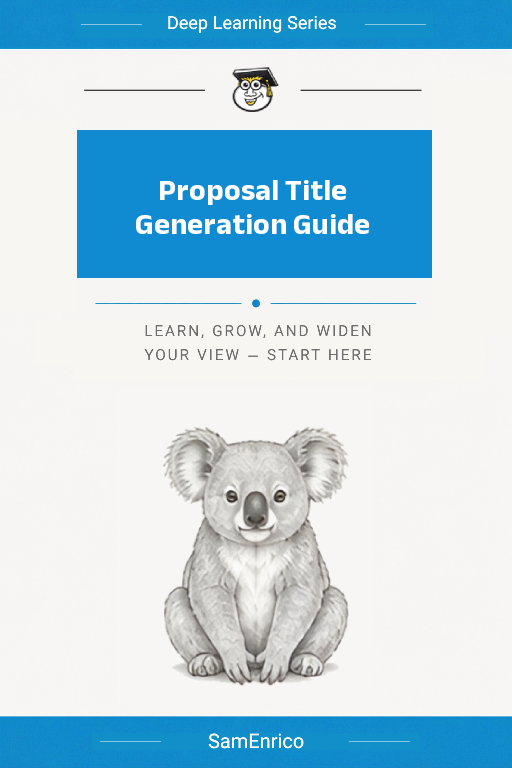
Non-FictionStudent's ShortcutTitle WritingKeyword Strategy
Proposal Title Generation Guide eBook
Create research proposal titles that are descripti
Create research proposal titles that are descriptive yet catchy incorporating keywords for searchability and impact.
Formats
Free sample
Chapter 1: The Ten-Second Judgment--–- Let me tell you something that most grant reviewers will never admit aloud.In the time it takes you to read this sentence, I have already formed an opinion about your proposal. Not your methodology. Not your literature review. Not your budget justification. Your title.I have sat on grant review panels for over a decade.
I have read thousands of proposals. And I have watched program officers sort through hundreds of submissions in a single morning, discarding the ones with vague, generic, or confusing titles before the abstract is even read. The entire interaction takes less time than it takes to brew a cup of coffee.Here is what I am thinking in those ten seconds: Does this person know what they are doing? Have they thought this through? Do they respect my time?
Do they understand their own project well enough to describe it clearly?A vague, generic, or sloppy title tells me the answer is no.A clear, specific, confident title tells me the answer is yes.That ten-second judgment does not determine the final funding decision. But it sets a frame. If I start skeptical, the proposal has to work twice as hard to win me back. If I start impressed, I am looking for reasons to say yes.Most researchers treat the title as an afterthought. They spend weeks, sometimes months, designing their study, reviewing the literature, and drafting their proposal.
Then, at the very end, they slap on a title. "Effects of X on Y." "A Study of Something." "Exploring Factors Related to Whatever."That is like spending months building a house and then spray-painting the address on the roof.This chapter is about why that approach fails. It is about the hidden power of titles in the grant review process, the specific ways that weak titles undermine strong proposals, and the strategic opportunity that a strong title represents. By the end of this chapter, you will never again treat the title as an afterthought.The Three Gates Your Title Must Pass Every research proposal passes through three gates before it becomes funded research. At each gate, the title plays a distinct and critical role.Gate One is the initial screening.
At this stage, program officers or administrative staff sort proposals into broad categories. They are not evaluating scientific merit. They are trying to answer a simple question: does this proposal belong in this review panel?The title is often the only information available at this point. A title that clearly communicates the topic area ensures your proposal reaches the appropriate reviewers. A vague or ambiguous title risks misclassification.
I have seen proposals about educational technology end up in panels on cognitive psychology because the title said "learning outcomes" instead of "digital learning tools." I have seen public health proposals end up in basic science panels because the title said "molecular mechanisms" instead of "community intervention."Misclassification is not just an inconvenience. It is a death sentence for your proposal. Reviewers who are experts in molecular biology will not be sympathetic to a community health intervention. They will not understand your methods. They will not appreciate your contribution.
Your proposal will be evaluated by people who are not qualified to evaluate it, and it will fail.Gate Two is the review stage. Here, panelists read a large volume of proposals under tight time constraints. A typical reviewer might have twenty proposals to evaluate in two weeks. That is more than one proposal per day, each running fifteen to twenty pages.Under these conditions, reviewers form initial impressions quickly. A compelling title generates interest and signals that the researcher is thoughtful and professional.
A weak title signals the opposite. Reviewers may not consciously penalize a poor title, but the effect on their perception of the proposal's quality is real and measurable. Studies have shown that the same proposal with a strong title receives higher ratings than with a weak title—even when the content is identical.Gate Three is the post-award stage. If your proposal is funded, your project will be announced, indexed, and shared. Other researchers will search for work like yours.
They will find it through database searches. A title that lacks keywords disappears from the scholarly record. A great study that no one can find is a great study that no one reads.Each gate is a filter. Your title must pass all three.What Effective Titles Actually Do Most researchers think a title just names their project. That is like saying a storefront sign just names the business.
Yes, that is one function. But a good sign also attracts customers, communicates what you sell, and signals that you are open for business.An effective research proposal title accomplishes four objectives simultaneously.First, it accurately describes the research. This is the non-negotiable baseline. Reviewers must understand at a glance what you propose to study, with what population, and using what approach. If they have to reread your title to understand it, you have already lost.Second, it generates interest.
In a competitive funding environment, your title must stand out. This does not mean being flashy or gimmicky. It means being clear, specific, and confident. It means showing reviewers why your project matters. It means making them want to read more.Third, it incorporates keywords.
Databases and search engines index titles. Including relevant keywords ensures that your proposal—and later, your published work—is discoverable by researchers searching for related topics. A title that says "A Study of Student Learning" will never be found by someone searching for "class size and reading achievement."Fourth, it signals your scholarly identity. The title reflects your approach, your methodology, and your disciplinary orientation. A well-crafted title communicates that you are a serious, competent researcher who knows the literature and understands the conventions of your field.These four objectives can conflict.
A title that is perfectly accurate might be boring. A title that is catchy might be vague. A title packed with keywords might be unreadable. The art of title writing is balancing these tensions. The rest of this book shows you how.The High Cost of Poor Titles The consequences of a weak title extend beyond initial rejection.
They compound throughout the review process and beyond.A vague title leads to misclassification. "Exploring Student Learning" could be about pedagogy, cognitive psychology, educational technology, or any of a dozen other fields. An overworked program officer may send it to the wrong review panel. Once misclassified, your proposal is evaluated by reviewers unfamiliar with your literature and unsympathetic to your methods. You have lost before you have begun.A generic title suggests a generic project.
"A Study of Workplace Motivation" could describe almost any organizational research project. It communicates nothing distinctive about your contribution. Reviewers assume that a researcher who cannot articulate their project in the title likely cannot articulate it in the proposal either. This is not fair. But it is real.A misleading title destroys credibility.
If your title promises a randomized controlled trial and your methods describe a correlational study, reviewers will notice. If your title claims to study "all adolescents" but your sample is thirty college students, reviewers will…
This is the end of the free sample. Get the eBook to keep going. Buy now
About this book
Details
- Author
- Riggins Anissa
- Publisher
- SamEnrico
- Language
- English
- Genre
- Non-Fiction, Student's Shortcut, Title Writing, Keyword Strategy
- Released
- 2026-06-01
- Pages (approx.)
- 125
- Available as
- eBook, Audiobook

Read better in the ZLOADR app
Your eBooks on your phone or tablet. Sign in with your SamEnrico account and start reading.
More by Riggins Anissa
 Celiac Disease vs Gluten Sensitivity HandbookRiggins Anissa$11.99
 Sponsor IRR Benchmark GuideRiggins Anissa$11.99
 Bariatric Surgery Lap Band Removal GuideRiggins Anissa$11.99
 LBO Synergy ValuationRiggins Anissa$11.99
 Cleaning Lady WitnessRiggins Anissa$11.99
 Frozen Echoes: The 1933 Arctic Airship MysteryRiggins Anissa$11.99
 The Whispering General: Vince Lombardi's Unseen PlaybookRiggins Anissa$11.99
 Understanding Cataract Microcornea SyndromeRiggins Anissa$17.99
 How to Become a Mixing-machine TenderRiggins Anissa$11.99
 AI Expense Analysis PlaybookRiggins Anissa$12.99
 Retail Store Launch and OperationsRiggins Anissa$11.99
You may also like
 Hong Kong Handover 1997Dunn Johnnie$11.99
 Zumba For Postnatal Recovery CourseNeal Christian$11.99
 Zumba for BeginnersLadner Nikia$11.99
 YouTube Comment Mining GuideHumes Pandora$12.99
 Worry Box MeditationCarlin Rudy$11.99
 Workplace Stress MeditationNguyen Lynn$11.99
 Workplace Stress and Sleep RepairHawley Ivory$11.99
 Workplace Perfectionism CureDelaney Jeffry$11.99
 Workplace Injustice Anger GuideWallen Isabelle$11.99
 Work Addiction and Burnout LinkGreenwood Ester$11.99
 Women in Yoga and WellnessBeattie Galina$11.99
 Women in Stand Up ComedyChun Evangeline$11.99