
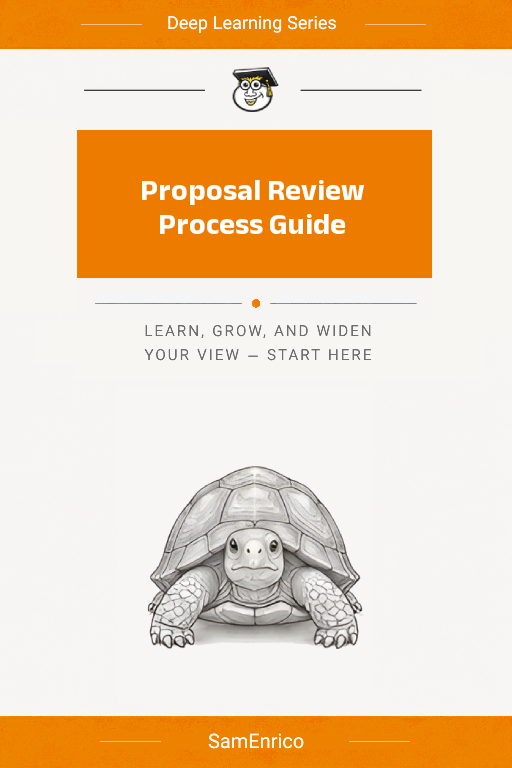
Non-FictionStudent's ShortcutReview Intelligence
Proposal Review Process Guide
Understand how graduate admissions committees eval
by Mott August
Understand how graduate admissions committees evaluate proposals and what reviewers look for in each section.
Formats
About this book
Free sample
Chapter 1: The Seven People...--–- You have spent sixty hours polishing your research proposal. You have memorized the program’s website, named three potential advisors, and run your draft through four different proofreaders. You click submit, exhale, and imagine a panel of distinguished scholars leaning forward in their chairs, reading every word with the careful attention your masterpiece deserves.That image is wrong. Dangerously wrong.The reality is less flattering and far more useful. Your proposal will not be read by a single, omniscient judge.
It will be read by a committee. And committees are not rational, data-processing machines. They are small groups of exhausted, distracted, often internally conflicted human beings who bring wildly different agendas to the table. Understanding those agendas—and writing for all of them simultaneously—is the difference between an application that survives the first cut and one that disappears into a folder marked “discuss if time permits” (which is academic code for “never discuss”).This chapter reveals who actually sits on the other side of the table. We will name the seven archetypes that appear on nearly every graduate admissions committee, from the most prestigious Ivy League program to a regional comprehensive university.
We will map their hidden power dynamics, their competing priorities, and the specific ways each archetype can kill your proposal—or save it. By the end of this chapter, you will never look at a submission portal the same way again.The Myth of the Single Reader Before we meet the committee, we must first bury a common misconception. Most applicants imagine that their proposal is read by one or two faculty members who specialize in their area, who then make a careful, independent judgment. This picture comes from the way undergraduate admissions works—a single regional admissions officer reviews your file—or from the way journal peer review works—two or three anonymous reviewers send comments to an editor.Graduate admissions is neither of these things.In virtually every competitive Ph D program in North America, your file will be read by a committee of between five and twelve people. Only two or three of them will…
This is the end of the free sample. Get the eBook to keep going. Buy now
Contents
- Chapter 1
- Chapter 2
- Chapter 3
- Chapter 4
- Chapter 5
- Chapter 6
- Chapter 7
- Chapter 8
- Chapter 9
- Chapter 10
- Chapter 11
- Chapter 12
Details
- Author
- Mott August
- Publisher
- SamEnrico
- Language
- English
- Genre
- Non-Fiction, Student's Shortcut, Review Intelligence
- Released
- 2026-05-30
- Pages (approx.)
- 157
- Available as
- eBook, Audiobook

Read better in the ZLOADR app
Your eBooks on your phone or tablet. Sign in with your SamEnrico account and start reading.
More by Mott August
 Low Testosterone and Hair LossMott August$11.99
 Pain Relationship HealingMott August$11.99
 Financial Stress at Work SolutionsMott August$11.99
 Cape Town Creative Tech GuideMott August$11.99
 The Fibromyalgia Body ScanMott August$11.99
 The Billion-Dollar Bet: How a Hedge Fund Titan Won the 2008 Financial CrisisMott August$11.99
 The Balloon Boys: How Two Brothers Defied Gravity with a Bunch of BagsMott August$11.99
 Character Requirement For PRMott August$12.99
 Distribution AssociateMott August$11.99
 How to Start a Reupholstery and Furniture Repair BusinessMott August$11.99
 Understanding Charcot–Marie–tooth DiseaseMott August$17.99
You may also like
 Hong Kong Handover 1997Dunn Johnnie$11.99
 Zumba For Postnatal Recovery CourseNeal Christian$11.99
 Zumba for BeginnersLadner Nikia$11.99
 YouTube Comment Mining GuideHumes Pandora$12.99
 Worry Box MeditationCarlin Rudy$11.99
 Workplace Stress MeditationNguyen Lynn$11.99
 Workplace Stress and Sleep RepairHawley Ivory$11.99
 Workplace Perfectionism CureDelaney Jeffry$11.99
 Workplace Injustice Anger GuideWallen Isabelle$11.99
 Work Addiction and Burnout LinkGreenwood Ester$11.99
 Women in Yoga and WellnessBeattie Galina$11.99
 Women in Stand Up ComedyChun Evangeline$11.99