
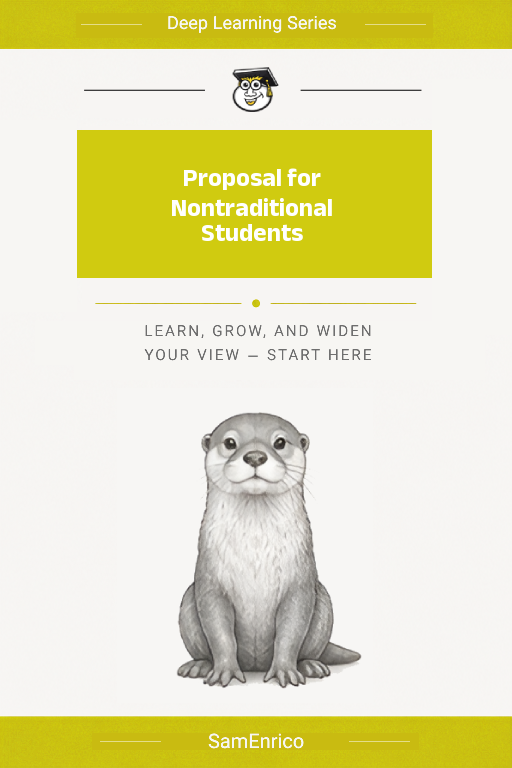
Non-FictionStudent's ShortcutNontraditional Path
Proposal for Nontraditional Students eBook
Write compelling proposals as older students, pare
Write compelling proposals as older students, parents, or working professionals returning to graduate school.
Formats
Free sample
Chapter 1: The Messy Resume...--–- The first time I was asked to write a graduate school proposal, I was sitting in a minivan in a daycare parking lot, a sleeping toddler in the backseat and a stack of unpaid bills on the passenger seat. The laptop on my lap had 12 percent battery. The email from the admissions counselor had arrived three hours earlier: “Your statement of purpose is the most important part of your application.” I had no idea what a statement of purpose was. I had never heard of “fit” or “research alignment” or “funding packages.” I had a 2.9 GPA from a university I barely remembered attending, a resume full of gaps that looked like Swiss cheese, and a voice in my head screaming one very clear message: You do not belong here.That voice is wrong. And this chapter is going to prove it.The Myth of the Perfect Applicant Every year, millions of prospective graduate students sit down to write their applications and immediately confront an invisible enemy: the myth of the perfect applicant.
This mythical creature graduated summa cum laude at twenty-two, never took a semester off, published undergraduate research, secured glowing letters of recommendation from professors who remember their name, and wrote a statement of purpose that sings with youthful ambition. Admissions committees have seen this profile ten thousand times. They know exactly what it looks like. And here is the secret they do not tell you: they are bored of it.What admissions committees actually crave is evidence of resilience. They want proof that an applicant can finish what they start, navigate unexpected obstacles, and bring real-world experience into the classroom.
A twenty-two-year-old with a perfect GPA has never managed a budget during a recession. A twenty-two-year-old has never negotiated a raise, resolved a conflict between two angry coworkers, or kept a household running while a family member was hospitalized. You have. And that is not a consolation prize. That is the entire point.The psychologist Angela Duckworth, in her research on grit, found that the single best predictor of long-term success is not IQ, not test scores, and not family background.
It is the ability to persevere toward a goal despite setbacks. Traditional students demonstrate potential. Nontraditional students demonstrate grit. And grit is what gets you through the second year of a master’s program when the reading is endless, the papers are brutal, and your toddler is up all night with an ear infection. Admissions committees know this.
They just need you to show them.Why Your Resume Looks Like Swiss Cheese (And Why That’s a Feature, Not a Bug)Let me guess what your resume looks like. There is a gap between 2015 and 2016. There is another gap between 2018 and 2020. Your titles do not follow a neat upward trajectory. You worked in retail, then in administration, then stayed home with kids, then consulted part-time, then managed a small team, then took a year off to care for an aging parent.
You look at this resume and see chaos. You see indecision. You see a person who could not commit.Here is what an admissions committee sees when they look at the same resume: a person who has navigated multiple life transitions successfully, who has learned to adapt to new environments quickly, who understands that careers are not ladders but portfolios. The gap between 2015 and 2016? That was a strategic sabbatical to relocate for a partner’s career opportunity.
The gap between 2018 and 2020? That was a season of caregiving that taught you crisis management, resource allocation, and the emotional intelligence required to support someone through illness. The year off to care for an aging parent? That taught you advocacy, medical coordination, and the ability to make high-stakes decisions under pressure.Traditional students have never done any of this. Their resumes are clean because their lives have been linear.
Your resume is messy because your life has been real. Which one do you think produces better graduate students?The Reframe Table: Turning Shame into Asset This is the most important tool in this book. I want you to keep it somewhere you can access it throughout the application process. Every time you feel shame about a part of your history, you will return to this table and ask yourself one question: What did that experience actually teach me?Below is the Reframe Table. On the left is the shame story that your inner critic tells you.
On the right is the asset story that belongs in your application.Shame Story (What your inner critic says)Asset Story (What admissions needs to hear)“I took two years off to raise my kids.”“I developed project management skills by coordinating schedules, budgets, and logistics for multiple dependents.”“I got laid off during the recession.”“I navigated involuntary career transition, rebuilt my professional network from scratch, and emerged in a stronger role within eighteen months.”“I changed careers three times.”“I have intellectual curiosity and transferable skills across industries, including stakeholder management, data analysis, and client relations.”“I have a low GPA from my early twenties.”“I was young and unformed. Here is the evidence of my growth since then.”“I never finished my bachelor’s degree on time.”“I completed my degree while working full-time, demonstrating time management and persistence.”“I have no publications or research experience.”“I have professional deliverables—memos, reports, training materials—that demonstrate analytical writing and evidence-based decision making.”“I took a year off to care for a sick parent.”“I managed end-of-life logistics, medical coordination, and emotional labor for a family member, then successfully re-entered the workforce.”“I worked in retail for ten years.”“I developed customer empathy, conflict resolution, and operational efficiency in a high-volume environment.”Here is the rule: You are not allowed to describe any part of your history using the shame column. From this moment forward, you will only use the language of the asset column. Not because you are lying or exaggerating, but because the asset column is actually true. The shame column is a story you have been telling yourself for years.
The asset column is the same events described honestly.Kaizen: The Nontraditional Student’s Superpower There is a Japanese philosophy called kaizen, which translates roughly to “continuous improvement.” In practice, kaizen means making small, incremental changes every day rather than attempting dramatic, heroic transformations. For traditional students, graduate school often demands heroic effort: all-nighters, cram sessions, manic bursts of productivity followed by burnout. Nontraditional students cannot afford this pattern. You have jobs, children, aging parents, and mortgages. You cannot pull an all-nighter and then show up to work the next day.
You cannot cram for exams when you have parent-teacher conferences.This is not a disadvantage. This is your hidden advantage.Because you cannot rely on heroic effort, you have already developed systems for steady, sustainable progress. You know how to break a large project into daily chunks. You know how to protect two hours of study time in the middle of a chaotic week. You know how to say no to things that do not matter so you can say yes to the things that do.
These are not small skills. These are the exact skills that predict graduate school completion. The research is unambiguous: students…
This is the end of the free sample. Get the eBook to keep going. Buy now
About this book
Details
- Author
- Haskell Lakia
- Publisher
- SamEnrico
- Language
- English
- Genre
- Non-Fiction, Student's Shortcut, Nontraditional Path
- Released
- 2026-06-01
- Pages (approx.)
- 152
- Available as
- eBook, Audiobook

Read better in the ZLOADR app
Your eBooks on your phone or tablet. Sign in with your SamEnrico account and start reading.
More by Haskell Lakia
 Pain Hope Restoration GuideHaskell Lakia$11.99
 Nairobi Social Enterprise GuideHaskell Lakia$11.99
 Alcohol and Testosterone LevelsHaskell Lakia$11.99
 The Desk Worker Body ScanHaskell Lakia$11.99
 Team Conflict Resolution SkillsHaskell Lakia$11.99
 The Great Bitcoin Heist: How a Shadowy Syndicate Stole Millions in Plain SightHaskell Lakia$11.99
 High Stakes: The Untold Bet That Shook the Poker WorldHaskell Lakia$11.99
 Understanding Charcot–Marie–tooth Disease Type 1bHaskell Lakia$17.99
 PR Denial Reasons And AppealsHaskell Lakia$12.99
 How to Start a Hobby in League of LegendsHaskell Lakia$11.99
 Drama Therapy AssistantHaskell Lakia$11.99
You may also like
 Hong Kong Handover 1997Dunn Johnnie$11.99
 Zumba For Postnatal Recovery CourseNeal Christian$11.99
 Zumba for BeginnersLadner Nikia$11.99
 YouTube Comment Mining GuideHumes Pandora$12.99
 Worry Box MeditationCarlin Rudy$11.99
 Workplace Stress MeditationNguyen Lynn$11.99
 Workplace Stress and Sleep RepairHawley Ivory$11.99
 Workplace Perfectionism CureDelaney Jeffry$11.99
 Workplace Injustice Anger GuideWallen Isabelle$11.99
 Work Addiction and Burnout LinkGreenwood Ester$11.99
 Women in Yoga and WellnessBeattie Galina$11.99
 Women in Stand Up ComedyChun Evangeline$11.99