
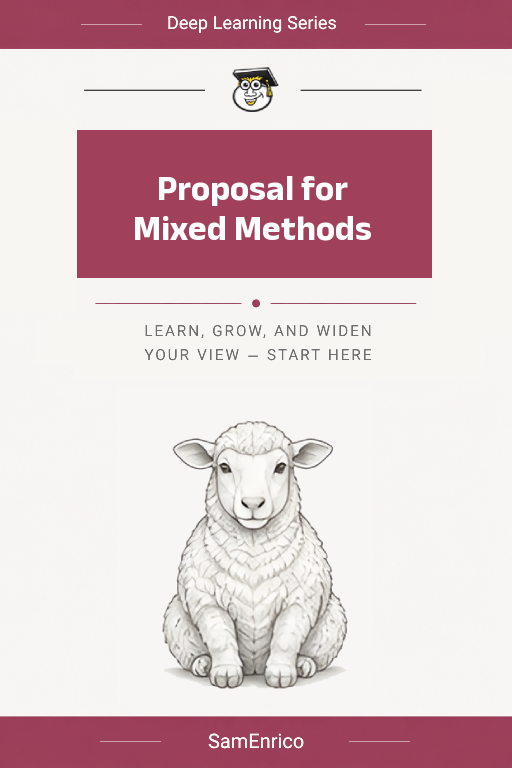
Non-FictionStudent's ShortcutMixed Methods
Proposal for Mixed Methods eBook
Integrate quantitative and qualitative approaches
Integrate quantitative and qualitative approaches with sequencing, priority, and integration strategies for proposals.
Formats
Free sample
Chapter 1: The Pragmatic Edge...--–- In the spring of 2018, a doctoral candidate named Maya submitted her dissertation proposal to her committee for the third time. Her topic was compelling: understanding why a community health intervention succeeded in some neighborhoods and failed in others. Her quantitative data showed statistically significant variation in outcomes across twelve sites. Her qualitative interviews revealed rich narratives from community health workers about implementation barriers. Her committee's feedback was consistent across three rejections: "You have two separate studies here, not one integrated project.
We cannot see how the numbers speak to the stories, or how the stories explain the numbers."Maya's problem was not her intelligence, her work ethic, or her research question. Her problem was philosophical and practical at the same time. She had been trained to believe that quantitative research belonged to one paradigm—positivism, objectivity, measurement—and qualitative research belonged to another—constructivism, interpretation, meaning. Her methods courses had presented these as warring camps, requiring researchers to pledge allegiance to one side or the other. Maya had tried to serve two masters, and her proposal showed it: the quantitative and qualitative sections sat side by side like strangers at an uncomfortable dinner party, acknowledging each other's existence but never truly conversing.This book exists because Maya's problem is the rule, not the exception.
And because there is a solution—not a compromise that waters down both approaches, but a philosophical and practical framework that honors the strengths of each while creating something genuinely new. That framework is called Pragmatism, and it is the foundation upon which every successful mixed methods proposal is built.The Paradigm Wars: A Brief History of a False Choice To understand why mixed methods proposals so often fail, we must first understand the intellectual battle that preceded them. For much of the twentieth century, the social sciences were divided by a fundamental disagreement about the nature of reality and knowledge. On one side stood the positivists (and their descendants, the post-positivists), who argued that reality exists independently of our perceptions and can be measured objectively. On the other side stood the constructivists (and their cousins, the interpretivists), who argued that reality is socially constructed and can only be understood through the meanings people assign to it.These were not merely academic disagreements.
They shaped every aspect of research: what questions could be asked, what methods were legitimate, what counted as evidence, and how findings should be presented. Quantitative researchers looked at qualitative work and saw anecdote, subjectivity, and lack of generalizability. Qualitative researchers looked at quantitative work and saw reductionism, decontextualization, and blindness to human complexity.The "Paradigm Wars," as they came to be called, reached their peak intensity in the 1980s and 1990s. Prominent methodologists declared that paradigms were incommensurable—that mixing methods from different paradigms was like mixing oil and water, or like trying to combine a map of physical geography with a poem about the experience of place. Each paradigm, the argument went, carried with it incompatible assumptions about the nature of truth, the role of values in research, and the relationship between researcher and participant.But something interesting happened while the methodologists were fighting.
Researchers in the real world—evaluators studying community programs, nurses measuring patient outcomes while listening to patient stories, educators tracking test scores while interviewing teachers, business researchers analyzing sales data while conducting focus groups with customers—kept running into the same problem. Neither paradigm alone gave them what they needed. The quantitative data told them what was happening but not why. The qualitative data told them why but not how much or how often or for whom. They needed both, not as a compromise, but because their research problems demanded it.Pragmatism: The Philosophical Third Path Enter Pragmatism, a distinctly American philosophical tradition dating back to Charles Sanders Peirce, William James, and John Dewey.
Unlike positivism and constructivism, which start with abstract questions about the nature of reality, Pragmatism starts with a concrete question: What works? What consequences follow from believing this rather than that? What difference does it make in practice?For the mixed methods researcher, Pragmatism offers liberation from the Paradigm Wars. Instead of asking "Is reality objective or constructed?" the pragmatic researcher asks "Does this combination of methods help me answer my research question?" Instead of asking "Are numbers or narratives more legitimate?" the pragmatic researcher asks "What can numbers tell me that narratives cannot, and vice versa?" Instead of pledging allegiance to a paradigm, the pragmatic researcher pledges allegiance to the research problem itself.This is not philosophical laziness. Pragmatism has its own rigorous commitments: a focus on consequences over abstractions, a recognition that knowledge is always partial and fallible, a belief that inquiry is an active intervention into the world rather than a passive mirroring of it, and a deep respect for the diversity of ways that humans come to understand their experience.
But unlike positivism and constructivism, Pragmatism does not require researchers to choose between objectivity and subjectivity, between generalizability and context, between measurement and meaning. It requires them to use whatever tools are appropriate to the task at hand.This is why Pragmatism has become the de facto philosophical foundation for mixed methods research. In a survey of published mixed methods studies, more than two-thirds explicitly invoked Pragmatism as their guiding framework. The remaining third either implicitly assumed a pragmatic stance or, more troublingly, never addressed philosophy at all—leaving their proposals philosophically unmoored and vulnerable to reviewer criticism.The Four Rationales for Mixing: Why One Method Is Never Enough If Pragmatism provides the philosophical why, the four rationales for mixing provide the methodological how. Developed from the work of Greene, Caracelli, and Graham (1989) and refined over three decades of mixed methods research, these four rationales give proposal writers a clear vocabulary for justifying why their study requires both quantitative and qualitative approaches.
Each rationale names a distinct way that mixing methods produces insights that neither method could achieve alone.Rationale One: Triangulation Triangulation seeks convergence, corroboration, and correspondence between results from different methods. The logic is simple: if multiple methods point to the same conclusion, that conclusion is more credible than if it came from a single method. Triangulation is most appropriate when you have established measures and well-understood constructs, and you want to test whether your findings are robust across different ways of measuring.Consider the Hospital Patient Experience example (🏥) that will appear throughout this book. A research team wants to understand patient satisfaction on a surgical unit. They administer a standardized satisfaction survey (quantitative) and conduct semi-structured interviews with a separate group of patients (qualitative).
If the survey shows high satisfaction ratings and interviews reveal positive narratives, the findings converge—triangulation supports the conclusion that patients are satisfied. But if the survey shows high satisfaction while interviews reveal frustration and unaddressed pain, the discrepancy itself becomes a finding, pointing to problems with the survey instrument or to patients' reluctance to criticize in a written format.In a proposal, triangulation is justified with language like: "This study will use a convergent mixed methods design to triangulate findings from patient satisfaction surveys and semi-structured interviews. Convergence between quantitative and qualitative results will strengthen confidence in…
This is the end of the free sample. Get the eBook to keep going. Buy now
About this book
Details
- Author
- Shumaker Prince
- Publisher
- SamEnrico
- Language
- English
- Genre
- Non-Fiction, Student's Shortcut, Mixed Methods
- Released
- 2026-06-01
- Pages (approx.)
- 160
- Available as
- eBook, Audiobook

Read better in the ZLOADR app
Your eBooks on your phone or tablet. Sign in with your SamEnrico account and start reading.
More by Shumaker Prince
 Pain Sound Based MeditationShumaker Prince$11.99
 The 10 Minute Body ScanShumaker Prince$11.99
 Kigali AgriTech Startup ManualShumaker Prince$11.99
 HcG Therapy Testosterone GuideShumaker Prince$11.99
 Performance Review Anxiety SolutionsShumaker Prince$11.99
 Freedom Rides: The Forgotten Women of the MovementShumaker Prince$11.99
 Bones of the Lost Kingdom: Love and Fossils in the Jungles of BorneoShumaker Prince$11.99
 Understanding ChalazionShumaker Prince$17.99
 Subclass 190 State Nominated VisaShumaker Prince$12.99
 Data Scientist InternShumaker Prince$11.99
 How to Start a Rice Milling Business (Beginners Guide)Shumaker Prince$11.99
You may also like
 Hong Kong Handover 1997Dunn Johnnie$11.99
 Zumba For Postnatal Recovery CourseNeal Christian$11.99
 Zumba for BeginnersLadner Nikia$11.99
 YouTube Comment Mining GuideHumes Pandora$12.99
 Worry Box MeditationCarlin Rudy$11.99
 Workplace Stress MeditationNguyen Lynn$11.99
 Workplace Stress and Sleep RepairHawley Ivory$11.99
 Workplace Perfectionism CureDelaney Jeffry$11.99
 Workplace Injustice Anger GuideWallen Isabelle$11.99
 Work Addiction and Burnout LinkGreenwood Ester$11.99
 Women in Yoga and WellnessBeattie Galina$11.99
 Women in Stand Up ComedyChun Evangeline$11.99