
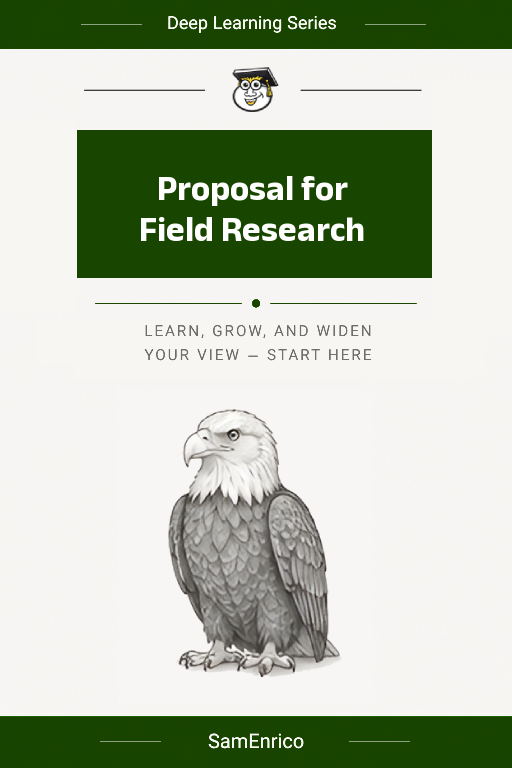
researchStudent's ShortcutField Methods
Proposal for Field Research
Plan site selection, access negotiation, and data
Plan site selection, access negotiation, and data collection for anthropology, ecology, or geography proposals.
Formats
About this book
Free sample
Chapter 1: The Beautiful Trap...–- The email arrived on a Tuesday. Three years of literature reviews, two rounds of revisions, and one glowing letter of recommendation—all condensed into a single paragraph beginning with “We regret to inform you.” The proposal had been perfect. The hypothesis was elegant. The methods were state-of-the-art. And every single reviewer had said the same thing in different words: “This project cannot be done where you want to do it.”The Ph D student who received that email had spent eighteen months planning a study of human-wildlife conflict in a national park in Central Africa.
She had secured preliminary permits. She had identified the perfect village—close enough to the park boundary for wildlife sightings, far enough from the main road to avoid tourist interference. She had even learned basic phrases in the local language. What she had not done was ask a single question that could only be answered in the field.When she arrived six months later—after appealing the rejection, finding a different funder, and flying to the capital—she discovered three things on her first day. First, the “perfect village” had been abandoned two years earlier after a drought.
Second, the national park she had studied from satellite images was actually a contested zone where two armed groups operated. Third, the local phrase she had learned for “I am a researcher” was, in that dialect, closer to “I am a spy.”Her project did not fail because she was lazy or unintelligent. It failed because she had written a proposal that was academically rigorous and field-impossible. She had confused a research gap—what we do not know—with a fieldwork impossibility—what we cannot observe or measure given the actual constraints of time, access, safety, and ethics.This chapter is about the difference between those two things. And it is the difference between a proposal that gets funded and a proposal that gets you on a plane to a place where no one will talk to you.The Most Common Mistake in Field Research Proposals Every year, funding agencies receive thousands of proposals that look beautiful on…
This is the end of the free sample. Get the eBook to keep going. Buy now
Contents
- Chapter 1
- Chapter 2
- Chapter 3
- Chapter 4
- Chapter 5
- Chapter 6
- Chapter 7
- Chapter 8
- Chapter 9
- Chapter 10
- Chapter 11
- Chapter 12
Details
- Author
- Mckeever Selena
- Publisher
- SamEnrico
- Language
- English
- Genre
- research, Student's Shortcut, Field Methods
- Released
- 2026-06-01
- Pages (approx.)
- 155
- Available as
- eBook, Audiobook

Read better in the ZLOADR app
Your eBooks on your phone or tablet. Sign in with your SamEnrico account and start reading.
More by Mckeever Selena
 Pain Chair Meditation GuideMckeever Selena$11.99
 Low Libido Testosterone GuideMckeever Selena$11.99
 Nairobi EdTech Startup CourseMckeever Selena$11.99
 Yoga Nidra Body ScanMckeever Selena$11.99
 Managing Up Without Burning OutMckeever Selena$11.99
 The Last Flight of the Phoenix: The Miraculous Rescue of the Andes SurvivorsMckeever Selena$11.99
 Operation Golden Fleece: The Secret War for the World's Rarest MetalMckeever Selena$11.99
 Understanding Chandler's SyndromeMckeever Selena$17.99
 Australian Study Requirement GuideMckeever Selena$12.99
 Design Thinking for Product TeamsMckeever Selena$11.99
 How to Start a Motor Accessories Dealer (wholesale) Business (Beginners Guide)Mckeever Selena$11.99
You may also like
 Scientific Research On TM GuideMartens Nathanial$11.99
 Research Proposal Methodology Section MasteryPauley Debroah$11.99
 Research Proposal Appendix CompilationRaines Tyisha$11.99
 Academic Researcher Distraction GuideFord Virgil$11.99
 TM Research and ScienceCovert Nicki$11.99
 Social Anxiety Research ReviewRoberge Cole$11.99
 Research Proposal Significance Section GuideBock Tory$12.99
 Research Proposal Reviewer PsychologyLugo Tawanda$11.99
 Research Proposal Research Questions DesignLara Robbi$11.99
 Research Proposal References and CitationsPatten Shanice$11.99
 Research Proposal Mixed Methods DesignCameron Omega$11.99
 Research Proposal Data Management PlanAnderson Roberto$12.99