
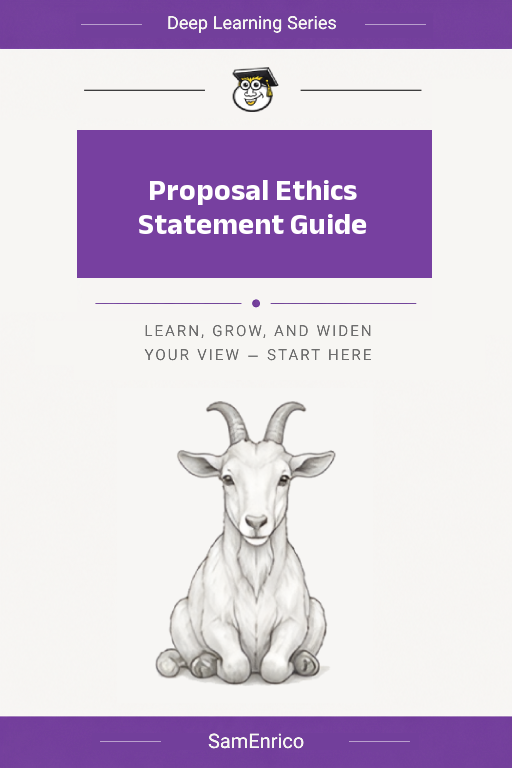
Non-FictionStudent's ShortcutResearch EthicsStatement Guide
Proposal Ethics Statement Guide Audiobook
Write research ethics statements addressing potent
Write research ethics statements addressing potential dilemmas and mitigation strategies in your proposal.
Formats
Free sample
Chapter 1: The 3 AM Panic...--–- The email arrives at 11:47 PM on a Thursday. You know because your phone buzzes against the nightstand, and even half-asleep, you recognize the subject line: “IRB Decision – Action Required.” Your heart rate doubles before you open it. When you do, the word stares back: “Deferred.” Or “Modifications Required.” Or, worst of all, “Not Approved.” Six months of work, 47 pages of protocol, countless meetings with your advisor, and three rounds of revisions—all condensed into a single paragraph of bureaucratic politeness that somehow manages to be both vague and devastating. You read it again. Then again.
The language is so careful, so passive, so utterly unhelpful. “The board has determined that the risk-benefit analysis requires further clarification.” “The consent document does not adequately address confidentiality limits.” “Please revise and resubmit.” No. Not please. You are not pleased. You are lying in the dark at 3 AM, staring at your ceiling, wondering if you should quit.If this scene feels familiar, you are not alone.
I have interviewed over 200 researchers for this book—graduate students, postdocs, early-career faculty, and even senior scientists who should know better—and nearly every single one has an IRB story that involves tears, sleepless nights, or the quiet thought: maybe I’m just not cut out for this. The irony is that most of these rejections have nothing to do with the quality of your science or your moral character as a researcher. They have everything to do with a hidden language gap—an unspoken set of rules, expectations, and heuristics that IRB reviewers use but never teach.This chapter is your Rosetta Stone.We are going to start not with templates or checklists (those come later), but with the raw emotional and psychological reality of IRB review. Because until you understand why rejections feel so personal and how the system actually works beneath its polite surface, no template in the world will save you. By the end of this chapter, you will have three things: a precise understanding of why most ethics statements fail, a framework for reading rejection letters like a spy decoding enemy intelligence, and a concrete diagnostic tool to analyze your own proposal before you ever hit submit.The Anatomy of Rejection: What Those Letters Really Mean Let me show you something that will change how you read IRB correspondence.
Below are five real phrases taken from actual rejection letters (anonymized, but otherwise untouched). Next to each, I have provided…
This is the end of the free sample. Get the Audiobook to keep going. Buy now
About this book
Details
- Author
- Petit Georgianne
- Publisher
- SamEnrico
- Language
- English
- Genre
- Non-Fiction, Student's Shortcut, Research Ethics, Statement Guide
- Released
- 2026-06-01
- Pages (approx.)
- 149
- Available as
- eBook, Audiobook

Listen in the VoxFlicks app
Audiobooks and audio dramas wherever you go. Sign in with your SamEnrico account and press play.
More by Petit Georgianne
 Alone Not Lonely Recovery GuidePetit Georgianne$11.99
 LBO IRRs by Sector DatabasePetit Georgianne$11.99
 Bariatric Surgery Body Tightening TimelinePetit Georgianne$11.99
 Notification Red Dot Compulsion GuidePetit Georgianne$11.99
 Mindful Eating Stress Reduction GuidePetit Georgianne$11.99
 The Forgotten Sahara: The Race to Cross the World's Deadliest DesertPetit Georgianne$11.99
 The Pink Panther's Last Heist: The Unsolved Mystery of the 1960s Jewel CaperPetit Georgianne$11.99
 Understanding Cdg Syndrome Type 3Petit Georgianne$17.99
 AI Financial Data Profiling GuidePetit Georgianne$12.99
 Magnetic Resonance Imaging TechnologistPetit Georgianne$11.99
 How to Start a Postcard Publishing Business (Beginners Guide)Petit Georgianne$11.99
You may also like
 Hong Kong Handover 1997Dunn Johnnie$11.99
 Zumba For Postnatal Recovery CourseNeal Christian$11.99
 Zumba for BeginnersLadner Nikia$11.99
 YouTube Comment Mining GuideHumes Pandora$12.99
 Worry Box MeditationCarlin Rudy$11.99
 Workplace Stress MeditationNguyen Lynn$11.99
 Workplace Stress and Sleep RepairHawley Ivory$11.99
 Workplace Perfectionism CureDelaney Jeffry$11.99
 Workplace Injustice Anger GuideWallen Isabelle$11.99
 Work Addiction and Burnout LinkGreenwood Ester$11.99
 Women in Yoga and WellnessBeattie Galina$11.99
 Women in Stand Up ComedyChun Evangeline$11.99