
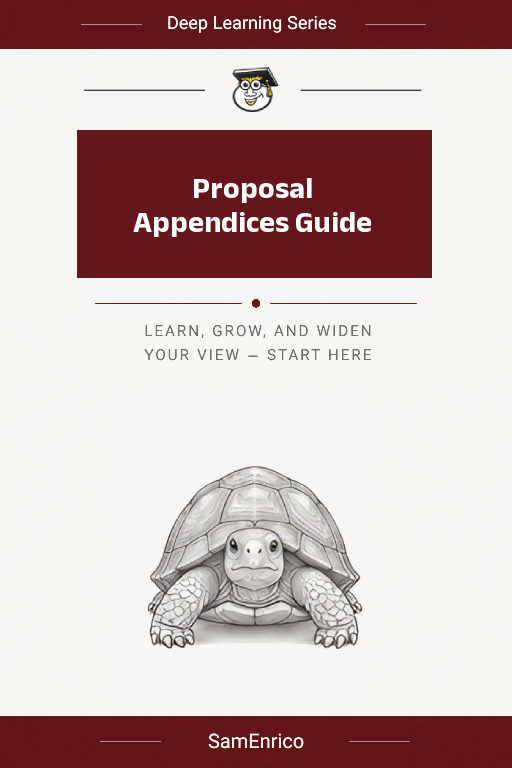
Non-FictionStudent's ShortcutAppendicesSupplementary Materials
Proposal Appendices Guide eBook
Include relevant appendices in research proposals
Include relevant appendices in research proposals including surveys interview protocols and supplementary data.
Formats
Free sample
Chapter 1: The Appendix Trap--–- Every year, thousands of research proposals die not because the science was bad, not because the hypothesis was weak, and not because the literature review was incomplete. They die because of what reviewers find—or fail to find—in the back of the document. The appendix, that neglected graveyard of questionnaires and consent forms, is actually the first place experienced reviewers look. And if your appendix fails, nothing else matters.This is the central paradox of proposal writing. You spend months crafting elegant prose in your introduction, polishing your literature review until it shines, and carefully articulating your methodology.
Yet the person evaluating your work—whether a dissertation supervisor, a grant panel member, or an Institutional Review Board (IRB) chair—will likely flip past all of that and turn directly to the appendices. They do this not because they are lazy or because they distrust your writing. They do it because they are smart. They know that the appendix reveals the truth.Consider what happened to Dr. Sarah Chen, a fourth-year Ph D candidate in organizational psychology at a major research university.
Her dissertation proposal was exceptional by every traditional measure. Her literature review synthesized 147 sources. Her methodology chapter was meticulous. Her chair had called the proposal "the most promising I've seen in five years." Yet her proposal was rejected by the dissertation committee. The reason?
On page 42 of her proposal, she wrote: "See Appendix C for the complete pilot study data." But Appendix C did not exist. She had forgotten to include it. The committee did not request a revision. They simply rejected the proposal, requiring her to defend it again the following semester—a six-month delay that cost her a fellowship and nearly derailed her graduation timeline.The missing appendix was not a scientific error. It was not a conceptual flaw.
It was a clerical omission. But to the committee, it signaled something deeper: carelessness, lack of attention to detail, and perhaps a more general unreliability. As one committee member later told her, "If you can't keep track of your own appendices, how can we trust you to manage a multi-year research project?" That question haunts every proposal writer, whether academic or corporate.This chapter reframes the appendix from its traditional status as a dumping ground for excess material to its rightful place as the most strategically important section of any research proposal. You will learn why reviewers read appendices first, what they are looking for, and how to avoid the three fatal errors that doom otherwise excellent proposals. You will also complete a diagnostic quiz to assess your current "Appendix Readiness Score"—a metric that predicts proposal success with surprising accuracy.The Psychology of Reviewers: Why They Flip to the Back First To understand why appendices matter so much, you must first understand how reviewers think.
Reviewers—whether academic committee members, grant panelists, or corporate evaluators—share a common psychological profile. They are overworked, time-pressed, and deeply skeptical. They have read hundreds of proposals, and they have learned that the main text is often optimized for persuasion rather than accuracy. The methodology chapter, in particular, is where writers are most likely to present an idealized version of their research plan—one that sounds rigorous but may not be supported by actual instruments.Reviewers know this. So they employ a simple heuristic: go to the appendix first.
Why? Because the appendix is harder to fake. A beautifully written methodology chapter might claim that you will use a "validated 10-item Likert scale measuring employee engagement," but the appendix reveals whether you actually have that scale, whether it is properly formatted, and whether the questions are any good. A proposal that promises semi-structured interviews might sound sophisticated, but the appendix shows whether your interview protocol includes probes, timing cues, and branching logic—or whether it is just five vague questions scribbled on a napkin.This phenomenon is not unique to academia. Corporate proposal reviewers use the same tactic.
When a consulting firm responds to a Request for Proposals (RFP) from a Fortune 500 company, the evaluators will read the technical approach section, but then they will flip to the appendices to examine the sample deliverables, the detailed project plan, and the resume of the proposed team. If those appendices are missing, incomplete, or poorly formatted, the proposal is discarded regardless of how eloquent the main text.The implication is clear: your appendix must be designed for skeptical readers who are actively looking for flaws. This is a fundamentally different orientation than most proposal writers adopt. Most writers treat the appendix as an afterthought—something to assemble quickly after the "real" writing is done. That approach is a recipe for rejection.
Instead, you should begin your proposal writing process by designing your appendices first, then writing the main text to align with them.The Chain of Evidence: Connecting Questions to Methods to Appendices The most successful proposals are built around what I call the Chain of Evidence—an unbroken logical thread connecting each research question to a specific methodological approach and, finally, to a specific appendix item that demonstrates how that approach will be executed. When this chain is intact, reviewers can trace any claim in your proposal back to concrete evidence in your appendices. When it is broken, reviewers sense that something is wrong, even if they cannot articulate exactly what.Consider a simple example. A qualitative research proposal might include this research question: "How do first-generation college students experience the transition from high school to university?" The methodology chapter might promise "semi-structured interviews with 20 first-generation students." The Chain of Evidence requires that the appendix contain an actual interview protocol—not just a list of questions, but a complete moderator's guide with opening remarks, probes, transition statements, and closing procedures. The reviewer should be able to look at that protocol and see exactly how each research question will be addressed.Similarly, a quantitative proposal might ask: "Does remote work affect employee job satisfaction?" The methodology might describe a survey of 500 remote employees.
The Chain of Evidence requires that the appendix contain the complete survey instrument, with all questions properly formatted, screener questions separated from main items, and response scales clearly defined. The reviewer should be able to administer that survey to a test subject and verify that it measures what the proposal claims it measures.The Chain of Evidence also operates at a more granular level. Within a survey appendix, each question should map to a specific hypothesis. Within an interview protocol, each major question should map to a specific research theme. When reviewers cannot make these connections, they become suspicious.
And suspicion, in the world of proposal review, is fatal.This concept is introduced here as a foundational mindset. However, the detailed tools for creating and documenting your Chain of Evidence appear in Chapter 10, where we introduce the Crosswalk Table—a one-page matrix that makes your alignment explicit and review-ready. For now, understand that the Chain of Evidence is not an abstract ideal; it is a practical requirement that separates successful proposals from rejected ones.The Three Fatal Errors Through analysis of hundreds of rejected proposals—both academic and corporate—I have identified three fatal errors that appear repeatedly.…
This is the end of the free sample. Get the eBook to keep going. Buy now
About this book
Details
- Author
- Tobias Nikita
- Publisher
- SamEnrico
- Language
- English
- Genre
- Non-Fiction, Student's Shortcut, Appendices, Supplementary Materials
- Released
- 2026-05-30
- Pages (approx.)
- 153
- Available as
- eBook, Audiobook

Read better in the ZLOADR app
Your eBooks on your phone or tablet. Sign in with your SamEnrico account and start reading.
More by Tobias Nikita
 Statute of Limitations EscapeTobias Nikita$11.99
 LBO Club Deal GuideTobias Nikita$11.99
 LBO Model Audit ChecklistTobias Nikita$11.99
 Bariatric Surgery Portal Hypertension GuideTobias Nikita$11.99
 FODMAP Meal Planning Weekly GuideTobias Nikita$11.99
 The Phantom of the Pentagon: The Night the U.S. Military VanishedTobias Nikita$11.99
 The Last Stand of the Iron Lady: Thatcher’s War on the MinersTobias Nikita$11.99
 AI Financial Ratio Analysis GuideTobias Nikita$12.99
 How to Start a Potato Flour and Meal Business (Beginners Guide)Tobias Nikita$11.99
 Understanding Cataract-glaucomaTobias Nikita$17.99
 ZinesTobias Nikita$11.99
You may also like
 Hong Kong Handover 1997Dunn Johnnie$11.99
 Zumba For Postnatal Recovery CourseNeal Christian$11.99
 Zumba for BeginnersLadner Nikia$11.99
 YouTube Comment Mining GuideHumes Pandora$12.99
 Worry Box MeditationCarlin Rudy$11.99
 Workplace Stress MeditationNguyen Lynn$11.99
 Workplace Stress and Sleep RepairHawley Ivory$11.99
 Workplace Perfectionism CureDelaney Jeffry$11.99
 Workplace Injustice Anger GuideWallen Isabelle$11.99
 Work Addiction and Burnout LinkGreenwood Ester$11.99
 Women in Yoga and WellnessBeattie Galina$11.99
 Women in Stand Up ComedyChun Evangeline$11.99