
Non-FictionAI OperatorData Analytics
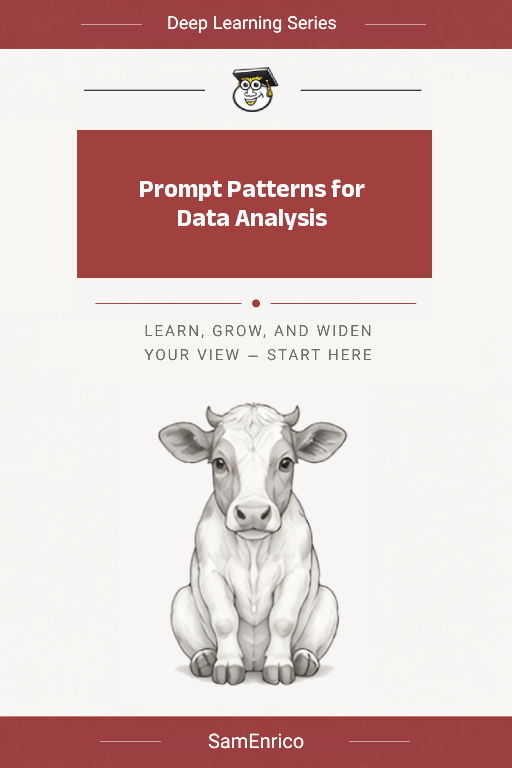
Prompt Patterns for Data Analysis eBook
Apply reusable prompt templates to clean datasets,
Apply reusable prompt templates to clean datasets, discover anomalies, and summarize findings faster than manual Excel work.
Formats
Free sample
Chapter 1: The 4-Hour Lie--–- The email arrived at 4:47 PM on a Friday. Priya, a senior marketing analyst with two advanced degrees and seven years of experience, had spent the entire day cleaning a CSV file. She had removed trailing spaces, fixed misaligned columns, manually converted date formats, and debugged a VLOOKUP that kept returning #N/A for reasons she still didn't fully understand. She was exhausted, but she was done. She attached her pivot tables to the email, clicked send, and closed her laptop for the weekend.Forty-five minutes later, her phone buzzed. It was her VP."Priya – the numbers don't match the dashboard. Can you take a look? Not urgent, but Monday morning would be great."On Monday, she discovered the truth. The original CSV had used two different date formats: MM/DD/YYYY in the first 10,000 rows and DD/MM/YYYY in the last 20,000. Her cleaning had missed this because she had only spot-checked the first 100 rows. Every pivot table was wrong. Every trend line was inverted. Every conclusion was garbage.The 4-hour cleaning session had been a lie. She hadn't saved time. She had lost four hours and then wasted another six on Monday redoing everything from scratch.Priya is not alone. She is not lazy. She is not bad at her job. She is a victim of a system that rewards clicking over thinking, speed over accuracy, and effort over leverage. This book is the antidote.The Excel Death Spiral Before we build a single prompt pattern, you need to understand the trap you are currently in. I call it the Excel Death Spiral. It has four predictable stages, and you have probably experienced every single one of them in the last month.Stage 1: The Innocent Open. You receive a CSV, an XLSX, or a database export. You double-click it. Excel opens. You start scrolling. You look at the first few rows, maybe the last few rows. You nod. It looks fine. You have no idea what is actually in the file because you have only seen 50 out of 50,000 rows.Stage 2: The Fragile Formula. You need to combine two columns, clean a text field, or look up a value from another sheet. You write a formula. You copy it down. It works on the first ten rows. You assume it works everywhere. You do not check row 8,421. Row 8,421 contains an apostrophe, a trailing space, and a line break that your formula was never designed to handle. The formula fails silently, returning #N/A or, worse, the wrong answer that looks correct.Stage 3: The Copy-Paste Lock. You are afraid the formula will break if the source data changes. So you select all, copy, and paste values. The numbers freeze. The logic disappears. The workbook becomes a statue. When someone asks, "Can you refresh this with March data?" you say yes, but inside you know the truth: you have to rebuild the entire thing from scratch because you paste-valued your own logic into oblivion.Stage 4: The Silent Corruption. The data updates. The source file changes. Your frozen workbook does not. You send a report based on last month's numbers. Nobody notices immediately. Three weeks later, a director makes a bad decision based on your outdated report. Nobody blames you because nobody knows the data was wrong. But you know. And the doubt grows.The Excel Death Spiral is not a bug. It is a feature of manual, mouse-driven workflows. Every click is a chance to make a mistake. Every drag is an opportunity to misalign a range. Every copied formula is a hidden time bomb.There is a better way.What This Book Actually Is (And What It Is Not)Let me be clear about what you are about to read.This is not a Python book. You will not learn how to write loops, define functions, or install packages. If you never want to see a line of code, you can skip every code block in this book and still get immense value. The AI writes the code. You write the prompts.This is not a statistics book. You will not calculate p-values by hand or derive covariance matrices. You will, however, learn how to ask an AI to calculate correlations, flag outliers, and explain results in plain English. The AI does the math. You ask the right questions.This is not an Excel book. I will not teach you pivot tables, conditional formatting, or VLOOKUP. You already know those tools. You already feel their limits. This book is about what comes after Excel—a world where you describe what you want, and the AI executes it instantly.What this book actually is: a collection of reusable prompt patterns. A prompt pattern is a text template that you copy, paste, and customize. You feed it a dataset. The AI returns a cleaned file, a flagged anomaly list, a correlation matrix, or an executive summary. You do not need to know how it works. You only need to know when to use which pattern.Think of it like a cookbook. You do not need to understand the Maillard reaction to cook a steak. You need to know the recipe, the temperature, and the timing. Similarly, you do not need to understand gradient boosting or transformer models to clean a dataset. You need the right prompt pattern.The 80/20 Insight That Changes Everything Here is the dirty secret that professional data consultants know but rarely share: 80 percent of data analysis is repetitive pattern-matching work. Fixing date formats. Standardizing state abbreviations. Flagging outliers. Removing near-duplicate customer names. Aggregating by region and quarter. These tasks are not creative. They are not strategic. They are mechanical.The most expensive analysts spend 80 percent of their time on the 20 percent of work that is automatable. The least expensive interns spend 100 percent of their time on that same work. The difference is not skill. The difference is leverage.A prompt pattern is a leverage tool. When you write a prompt pattern once and reuse it on ten different datasets, you have multiplied your time by ten. When you chain three prompt patterns together (clean, then detect anomalies, then summarize), you have turned a 90-minute manual workflow into a 90-second automated workflow.One reader of this book's early draft had a weekly report that took four hours every Friday afternoon. After implementing three prompt patterns from Chapter 3, Chapter 5, and Chapter 10, his report took eleven minutes. He did not learn to code. He did not buy new software. He changed how he asked questions.That is the promise of this book. Not artificial intelligence as magic. Artificial intelligence as leverage.The Mental Model Shift: From Clicking to Asking Before we dive into specific prompts, you need to rewire one fundamental habit. Every time you open Excel, your brain enters "click mode." You look at the data. You reach for the mouse. You highlight a column. You right-click. You format cells. You drag a formula down. You are thinking in clicks.Prompt patterns require "ask mode." Instead of reaching for the mouse, you reach for the keyboard and type a sentence. Instead of "I need to remove duplicates from column B," you type: "Find fuzzy duplicates in the 'Customer Name' column. Group similar strings. Flag potential matches for review."The difference…
This is the end of the free sample. Get the eBook to keep going. Buy now
About this book
Details
- Author
- Gustafson Elana
- Publisher
- SamEnrico
- Language
- English
- Genre
- Non-Fiction, AI Operator, Data Analytics
- Released
- 2026-06-01
- Pages (approx.)
- 135
- Available as
- eBook, Audiobook

Read better in the ZLOADR app
Your eBooks on your phone or tablet. Sign in with your SamEnrico account and start reading.
More by Gustafson Elana
 Panic Disorder Self Help ManualGustafson Elana$11.99
 Empowerment in EducationGustafson Elana$11.99
 Alcohol Recovery Driving CalmGustafson Elana$11.99
 FCPA Wire Fraud CasesGustafson Elana$11.99
 Failure Reframing for ImpostersGustafson Elana$11.99
 Managing Bipolar Highs WorkbookGustafson Elana$11.99
 Pattern Recognition for AuditoryGustafson Elana$11.99
 TM For Long COVIDGustafson Elana$11.99
 Franco CaudilloGustafson Elana$11.99
 Velvet and Vengeance: The Untold Duets of Broadway’s Forgotten RivalryGustafson Elana$11.99
 The Bone Hunters of the Gobi: Uncovering the Secrets of the Desert GiantsGustafson Elana$11.99
 Glass Ceiling: The Invisible Walls of the 1980s Corporate WorldGustafson Elana$11.99
You may also like
 Hong Kong Handover 1997Dunn Johnnie$11.99
 Zumba For Postnatal Recovery CourseNeal Christian$11.99
 Zumba for BeginnersLadner Nikia$11.99
 YouTube Comment Mining GuideHumes Pandora$12.99
 Worry Box MeditationCarlin Rudy$11.99
 Workplace Stress MeditationNguyen Lynn$11.99
 Workplace Stress and Sleep RepairHawley Ivory$11.99
 Workplace Perfectionism CureDelaney Jeffry$11.99
 Workplace Injustice Anger GuideWallen Isabelle$11.99
 Work Addiction and Burnout LinkGreenwood Ester$11.99
 Women in Yoga and WellnessBeattie Galina$11.99
 Women in Stand Up ComedyChun Evangeline$11.99