
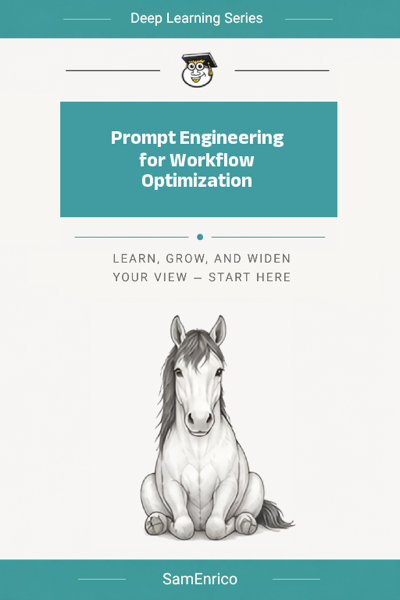
Prompt Engineering for Workflow Optimization eBook
A Coursebook on Prompt Engineering for Workflow Op
A Coursebook on Prompt Engineering for Workflow Optimization
Formats
Free sample
Chapter 1: The Copy-Paste Trap--–- Maya stared at her screen, watching the same customer email she had already answered three times today. The question was straightforward: “When will my order arrive?” She had a template. She had the tracking number. She had done this hundreds of times before. But instead of automating it, she was copying the tracking number from one database, pasting it into a Chat GPT window, typing “Write a polite response about shipping delays,” copying the output, pasting it into her email client, and clicking send.
Twelve minutes per ticket. Fifty tickets per day. That was ten hours per week. Forty hours per month. Almost five hundred hours per year.
Maya was a smart, capable operations manager. She had a master’s degree in supply chain logistics. She had led digital transformation projects. And she was spending the equivalent of twelve full workweeks each year doing something a properly engineered prompt could do in three seconds. She was not alone.Welcome to the copy-paste trap.
You have probably fallen into it yourself. The trap looks like productivity but delivers exhaustion. It feels like using AI but functions like manual labor. It promises leverage but delivers more work. And it is the single biggest reason why most professionals who use AI are not actually saving time.
According to a 2024 study of 1,200 knowledge workers, seventy percent of professionals who use AI in their daily work spend more than two hours per week manually reformatting, correcting, or transferring AI outputs. That means seven out of ten people are using cutting-edge language models as expensive, slow, unpredictable copy-paste machines. They are not engineers. They are not automators. They are digital janitors cleaning up after AI.This chapter exists to pull you out of that trap.
Before we build a single prompt chain, before we write a line of validation code, before we optimize a single API call, we must first understand what makes workflow automation fundamentally different from casual chatbot conversation. The difference is not technical. It is philosophical. And it will determine whether you spend the next year of your career as an AI user or an AI engineer.The Vibe Coding Illusion Let us begin with a confession. Every prompt engineer starts as a vibe coder.
Vibe coding is the practice of typing natural language instructions into a chat interface, reading the output, feeling pleased or frustrated, and then iterating until the answer feels right. The term emerged from the early days of LLM adoption when the novelty of talking to a machine still felt like magic. You ask a question. The AI answers. You ask a follow-up.
It refines. You feel smart. The process is conversational, forgiving, and deeply satisfying.Here is the problem. Vibe coding works beautifully for one-off tasks. If you need a haiku about your cat, vibe away.
If you want a brainstorming list of marketing slogans, the vibes will serve you well. But vibe coding is a terrible foundation for workflow automation because it optimizes for the wrong thing. Vibe coding optimizes for conversational fluency. Workflow automation requires deterministic reliability.Consider what happens when you ask a chatbot to “summarize this customer feedback email.” The chatbot produces a paragraph. You read it.
It captures the main points. You copy it into your CRM. Success. But then you run the same prompt tomorrow on a different email. The chatbot produces a bulleted list instead of a paragraph.
You paste it anyway. The formatting breaks your CRM’s character limit. Now you are editing. The next day, the chatbot adds a disclaimer at the bottom. You delete it manually.
The day after, it refuses to summarize because it detects “sensitive content.” Your workflow stops.This is the non-deterministic nightmare. The same prompt, with the same model, on the same day, can produce meaningfully different outputs. For a chatbot, that variety is a feature. It keeps conversations feeling natural. For an automated workflow, that variety is a bug.
It breaks pipelines, corrupts databases, and sends incorrect information to customers. The professional who treats a chat interface as an automation engine is like a pilot treating a bicycle as an airplane. Both move you forward. One will eventually crash.The Engineering Mindset Shift To escape the copy-paste trap, you must make a fundamental cognitive shift. Stop thinking of prompts as questions you ask an intelligent assistant.
Start thinking of prompts as functions you call in a software system. This is not a semantic distinction. It is a practical one with measurable consequences.In traditional software engineering, a function takes inputs, performs deterministic operations, and returns predictable outputs. When you call calculate_tax(income=50000, filing_status="single"), you know exactly what you will get. The same inputs always produce the same outputs.
The output format is guaranteed. Errors are handled explicitly. Functions compose into programs. Programs run without human intervention.A well-engineered prompt behaves the same way. It takes structured inputs.
It follows strict formatting rules. It returns validated, typed outputs. It fails gracefully when something goes wrong. It can be chained with other prompts. It runs automatically as part of a larger system.
The person who wrote that prompt does not sit there waiting to copy and paste the result. The result flows directly into the next step of the workflow.This is the difference between using AI and engineering with AI. The user asks for help. The engineer builds a system. The user celebrates when a single answer is helpful.
The engineer celebrates when ten thousand answers are correct, consistent, and cost-effective. The user treats the AI as a junior assistant who needs supervision. The engineer treats the AI as a reliable component in a distributed system.Three Constraints That Define Workflow Automation Every workflow you will build in this book operates under three fundamental constraints. Understand them now, and every decision you make later will be clearer. Ignore them, and your automations will fail in predictable, expensive ways.Constraint One: Latency Latency is the time between sending a prompt and receiving a response.
For a chatbot, latency of two or three seconds feels fine. You are a human. You are reading. You can wait. For an automated workflow processing hundreds or thousands of requests per minute, latency is the enemy of throughput.Consider a simple workflow that routes customer emails to the right department.
The workflow must classify an email, extract an order ID, look up the customer record, and draft a response. If each AI call takes two seconds, and the workflow makes four AI calls per email, that is eight seconds per email. For one hundred emails, that is over thirteen minutes. If you add retries for failed parsing, latency doubles. If you use a slower model for better quality, latency triples.Latency forces trade-offs.
You can use a faster, cheaper model for simple tasks and reserve powerful models for complex reasoning. You can batch requests to amortize overhead. You can implement caching to avoid repeated calls. You can design prompt chains that run in parallel instead of sequence. But you cannot ignore latency.
Every workflow you build must account for the time cost of every AI call.Constraint Two: Cost Per Token Tokens are…
This is the end of the free sample. Get the eBook to keep going. Buy now
About this book
Details
- Author
- Beaulieu Letitia
- Publisher
- SamEnrico
- Language
- English
- Genre
- Non-Fiction, Informative, Educational
- Released
- 2026-06-02
- Pages (approx.)
- 134
- Available as
- eBook, Audiobook

Read better in the ZLOADR app
Your eBooks on your phone or tablet. Sign in with your SamEnrico account and start reading.
More by Beaulieu Letitia
 Breaking the Paycheck to Paycheck CycleBeaulieu Letitia$11.99
 Sleep Hygiene Meditation RoutineBeaulieu Letitia$11.99
 Healthcare Provider Empathy GuideBeaulieu Letitia$11.99
 The Governor's Death Row DecisionsBeaulieu Letitia$11.99
 Proteobacteria DysbiosisBeaulieu Letitia$11.99
 Sleep Apnea TipsBeaulieu Letitia$11.99
 Pomodoro For PlanningBeaulieu Letitia$11.99
 Apple Calendar Memory GuideBeaulieu Letitia$11.99
 Miyazaki SpiritedBeaulieu Letitia$11.99
 The Iron Crown and the Spice Roads: How the British Empire Forged Global TradeBeaulieu Letitia$11.99
 Seeds of the Future: How a Farmer’s Rebellion Sparked a Global Food RevolutionBeaulieu Letitia$11.99
 Bloodline of the Sun: The Unseen Dynasty of the Axumite QueensBeaulieu Letitia$11.99